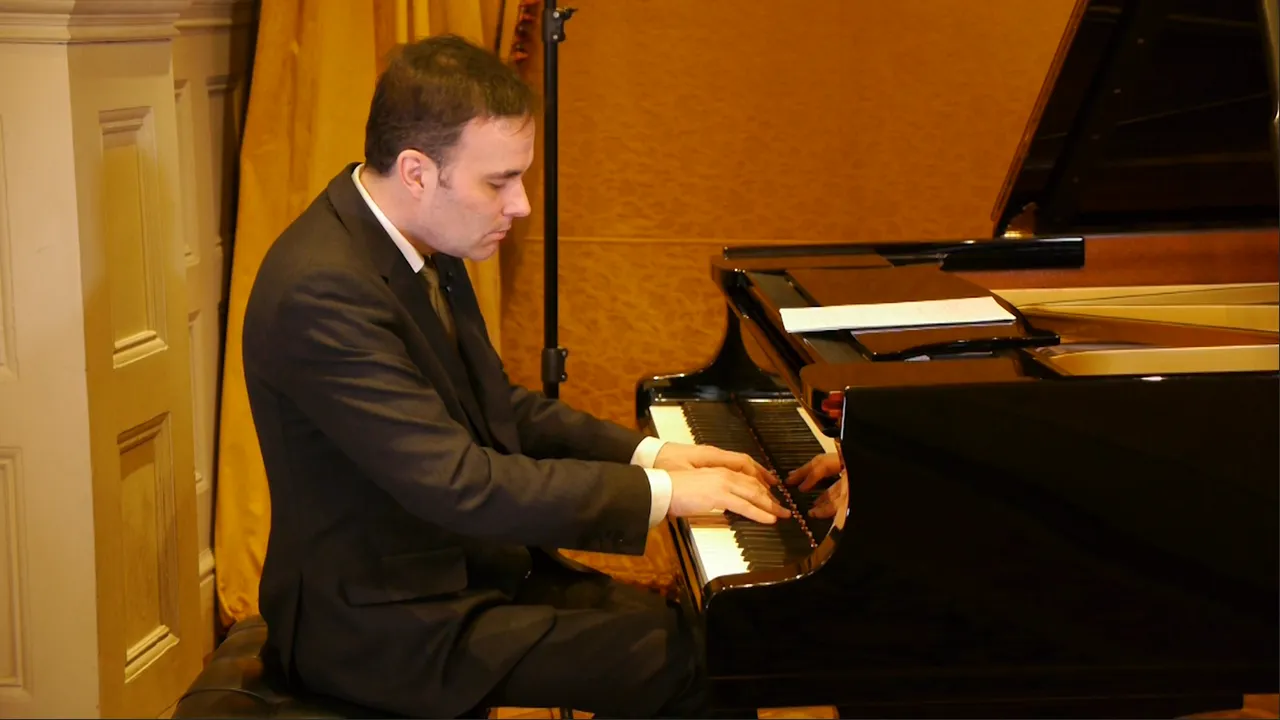
Die Hände tauschen
Lesson time: (4min 31sec)
Course preview
This lesson is part of the course Klavier lernen und genießen: eine Fast-Track-Methode für Anfänger und Wiedereinsteiger
Watch a preview of the full course below.
Lesson transcript:
Reversing the Hands in Piano Improvisation
The next step is to reverse the hands. Now, this is a really crucial thing. As I said in the introduction, there are so many things that we're using improvisation for in this film. One of the crucial aspects is really developing technique.
Going massively ahead of step after step would otherwise take lesson after lesson to learn. One of the things that pianists often find when they're first learning is that the left hand can become underdeveloped.
The Right Hand Melody vs. Left Hand Accompaniment
A lot of the pieces that we learn, especially the early piano pieces, have a right hand melody and a left hand accompaniment. Here's a famous example by none other than Mozart.
Admittedly, that might not be the first piece of music that an early pianist learns. Of course, this film is all about creating our own music, not using repertoire, even if it is as great as that. But it's a good example of the mindset that becomes a reality and also becomes the muscular memory for us as pianists.
We get into the mindset of playing right hand melodies and accompanying with the left hand. Through this kind of work, through the creative work and through improvisation, we can reverse that. Where better to reverse it than right at the start? This is why I'm including this in the first section of getting started.
Getting Started: Left Hand Pulse to Right Hand
So, we've had our left hand pulse, and we're now going to take that pulse to the right hand. I'm going to use exactly the same hand positions again.
- You might want to take a step back if you are a beginner.
- It will only take 10 seconds to get that hand position going again.
- Imagining the egg: Turn the egg over and put it onto the keyboard.
- I'm still in the white keys for now; we'll come to the black keys in a moment.
I'm going to use my right hand, little finger (finger number 5) and continue the pulse that I started previously in the left hand. For clarity's sake, in both hands and in piano playing, we think of the thumb as number one.
Finger Numbering Clarification
- Thumb = 1
- Second Finger = 2
- Third Finger = 3
- Fourth Finger = 4
- Fifth Finger = 5
In my right hand, I'm now going to take that pulse and get it going. I'm doing the same with my right hand, using it to create a little musical shape with a rhythm.
Deliberately, for now, I'm keeping both hands within exactly the same hand position. I haven't moved the hand at all. We'll come to that in a moment.
Key Recap: Pulse and Phrase
To recap, the really important things here are pulse and phrase.
- Give yourself a pulse that will start everything. From that pulse, you can do anything.
- The pulse is as simple as just repeating a note, it really doesn't matter what speed. I recommend you don't do it at 100 miles an hour, but you could certainly go slower.
Musical pulse is just like the heartbeat; it goes up and down.
- It could be slightly faster or slightly slower.
- Likewise, with the left hand, you could have a more moderately fast pulse.
Whatever the speed of the pulse, in a way, it's irrelevant. The crucial issue is that, like the heartbeat, the pulse itself is the heartbeat of music. This learning tool of improvisation is so generic and exciting because it addresses everything.
Music needs a heartbeat to exist. Performance needs that musical heartbeat within any piece of music that we play. So, where better to explore those nuts and bolts than with this work?
Conclusion
Hopefully, that section has now got both of your hands improvising a melody without moving your hand at all. Just by using your different fingers, thinking of a beat, and growing it organically.
- Random order of the fingers really doesn't matter.
- We're also developing coordination between the hands, which is something that all pianists need to constantly work on by putting the hands together in that way.