



Zweihändige Tapping-Akkorde und Basslinien
Lesson time: (35min 23sec)
Von hier an lernst du am besten mehr über Bassisten, um mehr über das Bassspiel zu erfahren. In Lektion 15 führt dich Roy gleichzeitig in zweihändige Tapping-Akkorde und Basslinien im Stil von Bass-Legenden wie Victor Wooten, Stu Hamm und Roscoe Beck ein. Außerdem lernst du 2 neue Stücke – Jet Propelled & B3 Blues.
Course preview
This lesson is part of the course Teach Me Bass Guitar vol.4: Ernsthaftes Musikertum
Watch a preview of the full course below.
Lesson transcript:
Two-Handed Tapping Lesson
Introduction
Alright, welcome back! In this lesson, we're going to look at two-handed tapping. I would categorize this as a spice, something you wouldn't live on but can enhance your playing. I certainly don't frequently use this style in the recording studio unless asked or while backing up a singer. It can be a "look at me" style, perfect for a cool solo segment or adding another instrument in a three-piece band.
Warm-Up
Let's go ahead and warm up. I will take that four by four exercise but do something a little different. See, what I was doing there involved using my right hand to tap the notes.
Making It Work
Now, let's talk a little bit about how to make this work:
-
Check Your Bass: Make sure your action is reasonably low. If your action is half an inch off the neck because you play aggressive punk rock most of the time, this may not be a good technique for that bass. You might need one with a slightly lower action. We'll talk about adjustments in the pro section.
-
Right Hand Tapping: The key with right-hand tapping is that it mirrors what's happening with the left hand.
-
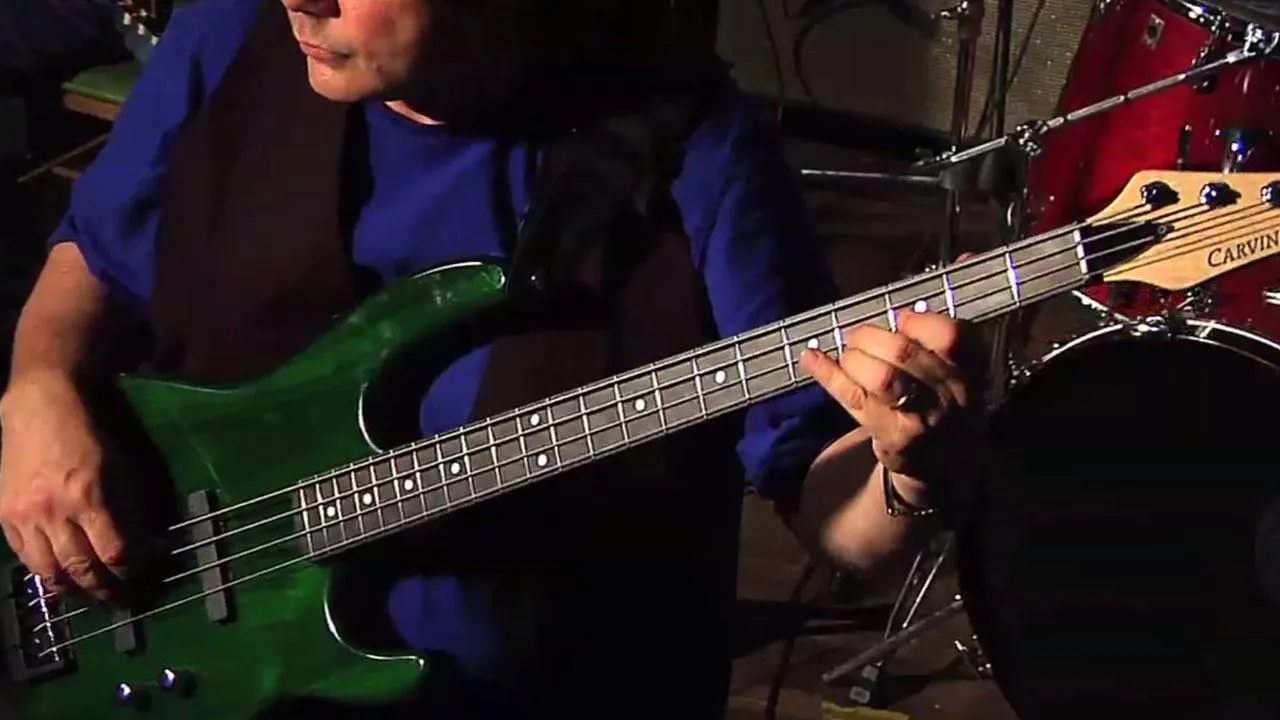
When using the left hand, my thumb is right in the middle to the back of the neck. With the right hand, we can put the thumb on the top of the neck, this acts as an anchor.
-
If I try to tap without that anchor, it becomes harder and increases the chance of missing or hitting a weird note.
-
Warming Up with the Right Hand
Let's warm up with the right hand only. I'll tap at the 12th fret, walking straight across and then back.
-
We will do this in time at quarter note equals 60. Pay attention to the fact that my right hand, once I put my first finger down, stays put while the others roll on and off.
- 1, 2, 3, 4
- Roll them off
If you're tapping a little quicker, you can roll on and roll off.
Octave Matching
The other thing I was doing was matching notes an octave apart. For instance, when I tap this A down here (fifth fret of the E string), I tap this one up top.
Now, let's do both hands together:
- 1, 2, 3, 4
- Back down: 1, 2, 3, 4
Working with Major Scales
If you're interested in single lines, I would recommend taking some of the modes, major, and minor scales from earlier lessons. Try doing that with the right hand first and then both hands together. Remember, the fingering is the same; it's just the mirror image.
Accompaniment Style Tapping
The majority of this lesson will focus on a different style of two-handed tapping that I'd call an accompaniment style. Let's revisit the drums on bass exercise I started with:
- Right, left, right, left, right,
- Right, left, right, right,
- Left, right, left, right, left,
- Right, right, left, right.
Now let's add notes to that. I'll do two E's first and then play some chords (E octave up and down).
Using Double Notes
When doing a single line, I sometimes double the two notes like I learned from rock bassist Billy Sheehan. Simply put one finger on top of the other for more power.
Now let's look at E minor 7. I've got the E, G, and D. Here's my voicing:
- E
- D
- G
Move it down an octave.
Drums on Bass Rhythm with Chords
Let's do the drums on bass rhythm using the E minor 7 chord:
- 1, 2, 3, 4.
- You can also flip it: left, right, left, right, left, left, right, left.
Student Interaction
Now let's get together with my student Cody, and I'll show you some things you'll need to play the first tune.
Cody, let's work on two-handed tapping. Here's that E minor 7 chord again.
-
Remember when we were working with it? Perfect! I'll tap the D and G with my right hand while anchoring my thumb on top.
-
Now let's take our left hand to tap down here.
- If you want to add movement, include the fifth.
- Great! Moving that top note up two frets changes the chord from an E minor 7 to an E suspended sound.
Exploring Chords
Let's also learn two more chords:
- Move your right hand up to the 14th fret (E and A).
- Move from: A, E, A, F sharp, and B.
After this, we'll add what the other hand does, which is cool.
Now, I can move the bass notes down to C. When I put those on, I get a C, D, and G, creating a C major add 2.
- Good job! Now let's create a progression together.
New Tune: Jet Propelled
Let's look at the first tune: Jet Propelled. Taking the root and the 5th of an E minor chord (E and B, D and G), I'll play this rhythm:
- Left, left, right, left, left, right...
This rhythm played with a three-note sequence and a four-note accent is called a hemiola, adding rhythmic interest.
Chord Changes
Now I'm moving the bass notes to C and G. When I drop my D to a ninth, it creates a nice sound! As I move up, I get a C6 chord.
Initial Progression
- 1, 2, 3, 4
This is just the first half of the tune; the rest loops around.
Turnaround
I'll start on an A with a busier right-hand activity.
- 1, 2, 3: A, E, F sharp, B.
Now, let's put everything together and try it at 60 beats per minute:
- 1, 2, 3, 4...
Let's give it a shot at 80 beats per minute.
Review and Practice
Now let's head over to the club and play with Brian. We'll take some of those double stop chords and compose a little tune.
New Tune: B Flat Blues
Next, we'll change the feel and chord voicings for our B flat blues, inspired by my friend Roscoe Beck.
We'll do a simple shuffle rhythm:
- 1 and 2 and 3 and 4...
Start with the B flat 7 chord and use the staggered left-right shuffle.
- 1, 2, 3, 4
Chord Changes
Moving to E flat, just move the top two notes down half a step, the D flat and G chord for your four chord.
Also, I'll illustrate the transition to the F7 chord.
- 1, 2, 3, 4
Final Jam
Let's try this at a slow tempo, and you can follow along. I'll play a walking line with my left hand and stabs with my right hand.
Now let's speed it up a little and then we'll try it quicker!
Cool Down Stretches
To cool down, let's do some stretches.
- Bring your hands out in front, lock them, and stretch up.
- Bend backward, then bring your arms around your back.
Congratulations! If you've completed lesson 15, you're ready to dive into the pro toolkit. The material we've covered will help you become a well-rounded professional bass player.
Let's explore the details needed in the upcoming lessons.
See you soon!
About the instructor
Roy Vogts Karriere umspannt eine außergewöhnliche Bandbreite an Bühnen, von MTVs Headbanger's Ball, dem Montreux Jazz Festival und dem Montreal Jazz Festival bis zum London Palladium, der Grand Ole Opry und dem Kreml. Von Punk bis Funk, von der Schlichtheit von Country und Blues bis zur Komplexität von HyperJazz und World Beat - er hat alles gespielt. Roy war der erste Mensch, der an der renommierten Musikhochschule der University of Miami einen Master in E-Bass-Performance erwarb, und er widmet sich seit über vierzig Jahren der Kunst des Basses. Er war Mentor Dutzender erfolgreicher Profis, darunter der legendäre Willie Weeks. Elektrisch, bundlos, Kontrabass - was auch immer: Wenn es tiefe Töne spielt und Saiten hat, ist Roy ein Meister darin, es zu spielen und anderen beizubringen, dasselbe zu tun. Im Laufe seiner vier Jahrzehnte währenden Karriere hat Roy mit einer erstaunlichen Liste von Topstars aufgenommen oder gespielt, darunter Larry Coryell, Victor Wooten, Dave Weckl, Tom Scott und der LA Express, Chester Thompson, Miroslav Vitous, Glen Campbell, BJ Thomas, Chet Atkins, Engelbert Humperdinck, Dickey Betts, Tony Joe White, Charlie Daniels, Jerry Reed und viele Dutzend mehr. Roy unterrichtet seit dreißig Jahren auf Hochschulniveau. Seit 1983 hat er den Lehrstuhl für Bass an der renommierten Belmont University (Nashville, TN) inne, einer der ganz wenigen Hochschulen, die einen Studiengang in kommerzieller Musik anbieten, der darauf ausgelegt ist, Studierende zu professionellen Musikern an der Spitze der Branche zu machen. Roys Studenten sind mit namhaften Stars wie Trisha Yearwood, Faith Hill, Little Texas, Michael W. Smith, Lady Antebellum, Chick Corea, Sir Tom Jones, Blood Sweat and Tears, Yanni und unzähligen weiteren Musikikonen getourt und haben mit ihnen aufgenommen. Seine Serie Teach Me Bass Guitar bringt dir genau diesen Ansatz auf Hochschulniveau nahe und führt dich vom Schnellstart für absolute Anfänger (Vol. 1) über Rhythmusgrundlagen (Vol. 2), das Finden deines eigenen Stils (Vol. 3) und ernsthafte Musikalität (Vol. 4) bis hin zu einem Werkzeugkasten für Profispieler (Vol. 5), damit du Schritt für Schritt echte Fähigkeiten aufbaust. read more