



Analyse und Erklärung mit Gábor Takács-Nagy
Das steckt im Kurs
3 Lektionen (1h 13m) · 1 gratis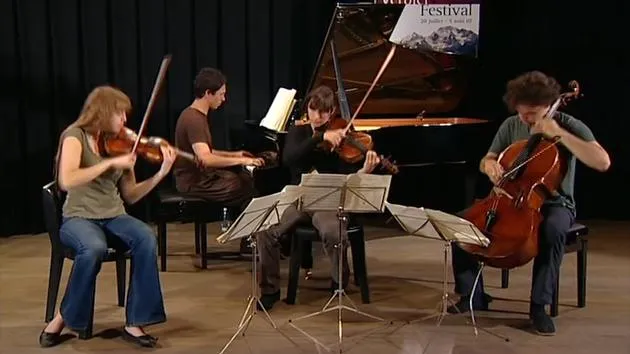
Transkript der Lektion
Music Lesson: Brahms Quartet
Bravo! It's very good.
Understanding the Background
Before we start to work, I'd like to say something: it's essential to know what is behind the piece. Brahms sent a letter to the editor Fritz Schimrock on August 12, 1875. He stated:
"I have my new quartet for piano and three string instruments ready, and I'm sending it to you. I suggest to you, on the cover, you must have a picture of a head with a pistol pointed towards it."
Now you can form an idea of what kind of music I wrote. Of course, it's very good. It's desperate and dark, C minor.
Starting from the End
I like to start from the end. Can you play for me? You will understand later why I am starting from the end.
- Do you have bar numbers?
- Yes. 315 with upbeat.
- Can you play 300? 315?
- Yes. Try it. You have it.
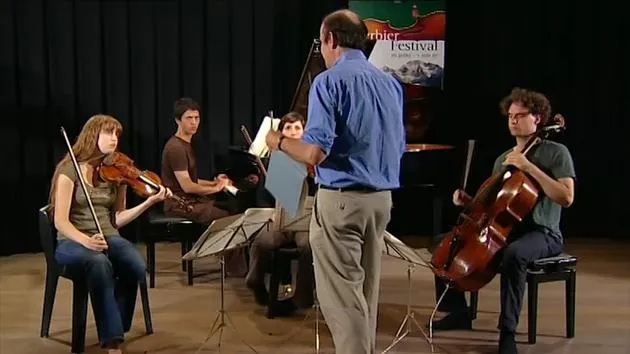
Okay, that's enough. Here, I think the most important part is the piano left hand.
Eduard and Leonard, can you play this tie, only the two of you?
Moving to the Third Bar
Now, start from the third bar of the movement. Go back to that third bar.
This is piano, of course. But to know everything, the whole thing should be the end solution. We are starting; it should be the same heavy playing, but piano. I mean piano throughout the whole piece. Many times, you have to make much more difference between piano and pianoforte versus forte.
Just piano is just decibels, but what is behind it is what's important.
Try to play as three of you. Imagine you hear this forte, but behind three doors. This should be it.
"Try this. Very good, very good."
Closer to the Bridge
Now, go a little bit closer to the talon. Don't play in the middle of the bow. I feel sometimes, for an extreme character, we need to go to an extreme point of the bow because it's too comfortable.
Here, try a little bit closer with more compact speed.
"Excellent, excellent."
Anticipation and Character
A little thing: the anticipation. What you are doing should already reflect the anguished character. You don't do this T. I think of T like a conductor.
The upbeat and the breathing should already be in that character.
"That's right. Very good."
Already a little bit before you go in direction, don't start from here. It will be deeper, and yes, okay, much better.
Now, I could say this is too loud, no piano. But with the same type of heavy, right?
Being Detectives
If we are detectives, which we have to be, it's already very good. Later coming, the expressivo at the same spot. Eliminate even this kind of beautiful sound; don't play too much vibrato.
Imagine someone moments before putting the gun here. I know it's horror, but try this as if something is wrong, not right.
Pardon? Yes, something has to be wrong if... something threatening. The sound should be threatening.
The Psychological Background
How to start a piece like this, knowing the terrible psychological background?
Let's try the fifth bar now, a little bit closer to the bridge. A little bit closer with a bit more gravitation.
"Yes, try once."
Almost no people,
"That is exactly it."
Later, the same thing will be played. The espressivo is coming here; this will be the big difference.
Deeper Attack
Edward, it was very, very good. Do a deeper attack. Imagine that you are a member of the Berlin Philharmonic cello and double bass section, going into the string with the first harmony.
Not a percussive attack, but vertically.
Yes, it's good, but the timing is banal. Music is an art of timing. Don't count: 1, 2, 3, 4, 5, 6. Think of three.
And when you feel ready, do it. I'm not saying to wait too much, but please be there.
"Bravo, bravo! Very, very good."
Logic and Expression
Logically, something is not logical. It's written here espressivo.
Where you starting, before you do, a hyper expressive part, I say would be better and more refreshing from the stomach.
"Because you devaluate in the espressivo, there."
Let's say four times claro, but from here, express yourself because you devaluated.
So, start, Edward. B flat.
Was that fine? Yes, please, with more energy. Still forte is not a mezzo forte, of course.
"But yes and no T. Yes, very good, very good."
Bow Technique
One thing, don't forget that is not a stick; it's a bow. Which means when you're finishing the CL, already the finish should prepare the next bar.
Otherwise, here, just this once again.
"Pa. Excellent."
Just a small thing as well, Edward. You don't have a subito forte with the upbeat. I mean chi, pianissimo underwater.
And the pizzicato marcato could also be a little later, but somewhere, these pizzicatos are not usually ... I would say pam.
Pam with direction, but it's on nowhere slender.
Applying Technique
So, the pizzicato can be done, but could be even more bizarre. Don't play healthy or even... I don't know how much you disturb if some... If it's here, yes, but even here some metal sticks.
Usually, timpani players say don't play on the edge of the timpani but somewhere in the middle, where? Around the middle, to get it more resonant.
But I would say touch the percussive instrument at the rim.
"Yes, yes."
Also very important, where you touch, where you do the pizzicato, and with how much flesh.
If it's on the tip of the finger where the skin is much harder, or don't do it with too much flesh. Don't be too generous now.
Pianissimo Moments
To do this from a pianissimo spot, which (4) 24, 5, 6, 27, from pianissimo, no vibrato.
"Absolutely excellent."
Now the tempo is fine: allegro non troppo. But I'm exaggerating.
What you did is too easy.
Can you imagine that you're walking in the sea? Some resistance feeling.
Suffer a little, but it's not louder. It's about the timing.
"Not a Mandelzon Scherzo Venice."
And please, it's forte. The energy and the inner fire are more important than the huge decibel, of course.
Try, exactly, not a hysterical energy.
Feeding Creativity
What I mean is more threatening.
Do I try? Yes! Very excellent.
But it sounds like this: Boom.
I think you should start it, and after, immediately, Christian, though an articulation.
"Beautiful, beautiful, beautiful."
Keeping the Spirit Alive
I have to say something: one thing you did very well within the fortissimo; you still did two different levels.
So, 46, even a little bit, higher level. But for this, I would suggest a bigger articulation team.
Para tara, terra terra. A little bit earlier, take that away.
Here, barbaro, of course is piano and dolce, but not a French impressionist.
"Debussy, Ravel, I mean, it was too fast, the bow speed."
I'm always saying, the most important factors for making a sound are a combination of weight, speed, and the contact point.
Balancing Dynamics
And here, we are still in the 19th century, middle Brahms.
I would do it a little bit close, so not so much here, but a little bit fatter. More contact from here, 50, as bar.
Beautiful, beautiful, but here, but don't attack the last note. This is resolution for you, your E flat. He's taking over, but you don't have to attack it.
"Excellent, excellent."
Barbara, you're doing this three times. You can change it a little, or you don't have to repeat the same.
Listening to the Greats
I just heard Mikhail Platinum rehearse with the orchestra, and he said something Svlatoslav Richter taught him, that great musicians never repeat the same way, the same thing.
"I mean, you are a great musician, but I'm just reminding you."
So, you do little differences.
Can we do 60 as bar 60?
Edward, you have also in the right and left hand 1, 2, 3. 1, 2, 3.
So there are slurs; it suggests you can start again the next one and the next one.
Showcasing Harmonies
Can you show these harmonies?
And after, Tim Pam Johannes.
Somewhere, the first harmony is timpan. A little bit more on the first... and no, together.
60. Pardon.
And everybody with Y.
"Beautiful, beautiful."
Now, it's beautiful what you're doing. I'm inviting you to an experience. Eduard, try to eliminate that you are a pianist. And in the third bar, be a string player.
Achieving Legato
It sounds a little bit for a string player; this would be legatum. And after, Pam. Pam. Sambar.
These portato things.
The other thing is the tempo is good, but allegro non troppo. You have time to read the same way, but somewhere you have to love every note, and it's difficult to leave them.
It sounds like... yes, I met her; it's easy. Everything is your friend, or fantastically beautiful.
You know, you were almost... it was so improvised. This is real music-making.
When I feel that you are the composer, you know the piece but suddenly you're leaving it. This is when somebody forgets they are at a masterclass.
Final Touches
All I have to say is, "Oh, so very good." Once again, the left hand was much more alive now.
Your left hand was like Pablo Casals in top form, because...
"Excellent, beautiful."
You're doing all these beautiful things.
I mean, I'm just saying some small things here. When we arrived here, we reached E flat minor, but it should be a surprise.
If you prepare too much with diminuendo, you take away this.
Somewhere like a conductor, holding here the hand; just a little bit there, subito, not dynamic.
Weight and Presentation
Edward, how you're attacking the fourth bar is too percussive. It's too much piano.
Not piano; it may be not a good word, but your love...
Exactly.
The B flat is not representing a pa, but...
And the pizzicato, Pop, pop, pop, pop. Don't run with it.
And mar. poco marcato.
So again, yes, it's very good, but not bum, bum, bum, but dim pa. Pam, pam. So tap bum.
Conducting Your Sound
This is the moment when a conductor would be absolutely with the upper body.
So not yampa, but holding back the cello section.
I'm talking about conductors, talking to string players, to you, also talking about timpani.
Somewhere it's refreshing our imagination if we eliminate our instruments.
So don't think you are a viola, piano, cello.
Einstein told, imagination is more important than knowledge.
Of course, you have knowledge; huge knowledge.
Revisiting the Movement
Now, can we do again from the 86th bar?
It's beautiful, it's beautiful. But, but, Edward is great. But don't go back so much now.
It sounded like a violin solo. You have the statement, and she's enriching your playing, but you should not accompany her playing.
So we arrive at T, and yours, not legato. Not total legato, but speaking legato.
"Put letter Y. And er."
That's right. Bravo, Bravo.
It was beautiful before; bravo.
And piano! But we know already, the piece is sotto vocalito.
The same thing.
Here, it is piano, but espressivo.
For this, if you would sing it.
So the air is coming out from my lung with a kind of...
Please, break the speed more concentrated.
Maintaining Weight
It's piano, but it's heavy somewhere. You know this feeling.
So please, try this bow speed thing, a little bit more weight.
And also here, don't let it go too much towards, to the black.
Because we know later the whole character and harmonies are sinking down underwater and sick.
This is not sick yet; just anguish.
Try this; it was beautiful before. Bravo, Bravo.
Emphasizing Expressiveness
One more small thing.
Say something there for me: it's too much legato and too easy for you.
Suffer a little bit, and from here, diminish, underwater territory.
And here, to him.
Oh, and about the balance control.
Fortissimo, of course, fortissimo, but somewhere it has to be a homogeneous effort between you two.
Because now it's so...
It's heavier, more energetic.
If it's hard to hear, I know it's also difficult about our profession.
Listening in Multiple Directions
Because one of our ears should be here, and the other is somewhere at the end of the room.
This was Rossapovich who talked about this, always one of your ears, the other is there.
How does it sound?
And Barbara, it's a very good tempo, but not so much with this tempo which is a little too controlled.
Not a nervous running; hold back the horse.
Now the horse was running; the horse was the boss. You know what I mean?
It was superb!
Embracing Creativity
Even the small accidents that happened before, the fortissimo wasn't disturbing for me because it was creative and convincing.
This is what I would like to say: live dangerously.
I know today's difficulties.
But if you are in a highly creative moment and some small accidents happen, real music lovers, I don't think they're disturbed.
Maybe in a jury where somebody is counting mistakes, this is disturbed.
But okay, try this two bars before.
Yes, yes. But, but, but again from underwater.
Yes. Very good, very good, very good.
Now you can see marcato fortissimo and points on the tam Pam.
But it doesn't mean pa Pa.
More dramatic!
Deepening the Dramatic Tone
Somewhere, if it's a little bit longer, if it wouldn't be dots there, you would play...
But you don't have to play, Pa PA is team Pam.
Can you show me how?
Yes, yes!
It means that no, Haron not.
But I think...
I mean, palm is not. And I'm even sacrificing what you might call tonal beauty.
You don't have to play so not... but a little bit deeper into it.
Final Techniques and Encouragement
Beautiful, beautiful, beautiful.
And here, Bravo, Edward!
Here, don't hit hard; don't play too comfortable.
Because it's still timpani behind you and after, yes, exactly.
Imagine that you...
This is for sure cello and double bass in a Brahms symphony, and sure, it should be close to the bridge.
So don't play like here!
"Exactly."
And also a little bit, but still closer.
We can do this; we can do this in a piano quartet.
Maybe ask another instrument to show things.
Here, we can do it.
So can you play this like this?
Very good, very good, with the timing.
"Not tire. Papiya, Papa Tapi. Keep tapia. Papiya, papi."
Don't run with it.
Yes, yes.
Don't, don't, don't tire.
Don't come up, don't come up too early, too high.
Because this is really horror.
Distorted Reality in Music
I mean, this is really threatening.
Actually, the key of this movement, this small second, this is the same.
So this is coming from the, you can see anything, but this is the Clara motif.
Okay? Yes, yes!
And this is really also the harmonies suggesting lots of dissonances here.
Plus, he wrote espressivo; it should not sound again too comfortable piano from the stomach.
Playing with Assurance
You asked me to show before, I got the message.
Because it's not, pardon.
So somewhere, a very much slower bow.
So, no, but...
And he, and he really speaks, and in the left hand, in the right hand is piano.
But here, it's a desperate forte.
You're speaking softly, let's say, in a theater piece.
The Importance of Conviction
They speak very softly, but huge articulation.
Having said this, Wilde, on the other side, you can say anything if you're not convinced.
This is also part of...
I never met Brahms.
So if you feel that we can talk it, I had teachers in my life, excellent teachers, but nobody could say anything.
They thought it had to be right.
No, but everybody was wrong.
I just want to say I'm also a detective.
I'm searching for the truth.
None of us could say this is the only way.
Lifelong Learning
Just know, if tomorrow you're getting up or in one week you're playing, and suddenly you discover something new, why not doing it?
Maybe I would also discover in a week something.
Just to always be open to the end of your life, I think is important.
Well, let's keep in touch.
Yes, no, no, but we are really searching always.
I just went to a theater masterclass, and they said actors, this was in the afternoon before 4, they said they just analyzed Shakespeare's Midsummer Night Dream, saying this is the beauty in their profession.
They get up, and the next day they sing new things in this sentence.
Why not this now?
Okay.
Beautiful, beautiful.
Bravo, bravo!
You did brilliant things.
And here again, it's a little bit easy.
I'm saying forte, but a different forte.
This is too fast, the bow.
"Look, if I'm telling you, play slower bow, it's... You will concentrate."
Approach Through Music
Okay?
He told me a slow elbow.
So it was only concentrated slow elbow.
But it should come from the...
If you listen to the harmony and the character, it suggests that it should always come from the musical approach.
Actually, you are such good players that for you, you should not really think about technical things.
Always, musical approach, and under conscious, it's organizing your technical solution.
Although, I have a technical question.
Yes?
About the bowing.
Barbara, I know my answer will be deliberate.
This is a point when I will answer probably the musical things.
But this will...
So, I mean, I know it shouldn't be comfortable, but somehow it doesn't sound the way it should be.
Searching for Solutions
So, maybe we can.
Hi.
Aha.
Yes, I realize, it is not really speaking; you're really asking me easier things because you did Tia Papa.
No, no, no, no, no.
Vancy? Yes, but it's very different.
So, this is Vancouver solution.
But it's very dangerous.
Ti papa, Ti papa.
Yours is good.
Yours is good.
But the problem is you arrive into this...
Maybe because Tia Papa if you can hold it and not going...
Because here, you don't have enough energy.
I know it's extremely difficult.
So don't use the whole bow.
So another dumbo or T.
Yes, like this.
Yes, don.
But you can even separate this.
T. Papa. Ti, ti, ti, ti ha pa pa.
You can do it because it's acoustical reason for it.
If you were alone in a violin solo sonata, a viola solo, a song Tia Papa.
But in this context, what is here?
Tia Papa. Ta ta ta.
You can do portato.
But this is a typical point when you can feel that he didn't play the string instruments.
Understanding Brahms
And he was only 100% musical.
So there are also in Schumann, string-farted points when you feel, oh, he is a pianist.
Yes, yes.
Okay, and okay, continue from here.
The 203, 4, 5, 6 is not the best place, Eduard, but 206.
Once again, once again.
And don't take it too metronomical.
Music is an art of timing.
Very good, very good.
Don't overpower your friend.
I think so.
It should be a little bit more basement; otherwise, the house is collapsing.
It was too heavy.
Structure and Flow
The upper part was fantastic.
Beautiful magic moments you did.
Don't do that return so much.
If you see the whole movement, how to keep still a structure of the movement.
Be careful to not write it too much auto.
Even if it's musical, it can make it too much mosaics.
Sometimes you have to sacrifice; just go.
"Yes, this was much better."
And why not playing the T with the third finger?
Yes, because it's more flesh.
And you can put it down with...
But one more important thing after this, when you play at Barbara, it's pianissimo moido dolce (excellent).
Excellent, excellent, excellent.
And before, when you played from 251, suddenly you started to push the tempo.
You played a beautiful pianissimo, but you were...
I mean, you have time.
I'm not saying slower, but somewhere...
This moment is really...
It's a lake, but even under the lake, I mean you have to feel in a movement when it's really action, action, and suddenly this is...
The Hallucinative Moment
Almost unconscious moments, hallucinative, should not be pushed with pulsation.
So just try once again, listen once again, Barbara.
She's beautiful.
This, actually, if you're singing this, it's impossible to sing.
So very, yes!
"Yeah, yeah, yeah, yes!"
But you, you cannot make anything anyway.
No, no, the glissando is missing.
Oh, oh!
But on the other hand, I can see.
The Challenge Ahead
I, in the future, yes. And there, and there.
Or the surfing it.
Okay, now it's difficult; now it's difficult.
Try how you're doing it without glissando; it's almost impossible.
Sing. Sing it.
You know, it almost feels like stroking a cat the other way, not this!
I mean, it's not the nature.
I know it's difficult, but...
Okay, not now, but on long runs.
Conclusion
From here, let's try this pianissimo passage. And you have time.
You have to,
And again: don't push the tempo.
"Bravo, bravo."
It's much more beautiful.
And it's not for a second boring or...
Okay, it's very, very good.
Can you play now without stopping?
That was the first moment we talked through most of the elements.
And now it's a concert, concert.
Try not to prove anything.
Not to prove, like a child who is playing with the toys, who is in it and not thinking, who thinks what's outside somewhere.
This is,
Is the secret.
Try it.
3 Lektionen
1 Std. 13 Min. strukturierte Videolektionen
Erweiterte Videofunktionen
Verlangsamen, Passagen loopen, mitlesen
Handy, Tablet & Desktop
Üben, wo du willst
100 % Zufriedenheitsgarantie
30 Tage Geld-zurück-Garantie
Lern deinen Guru kennen
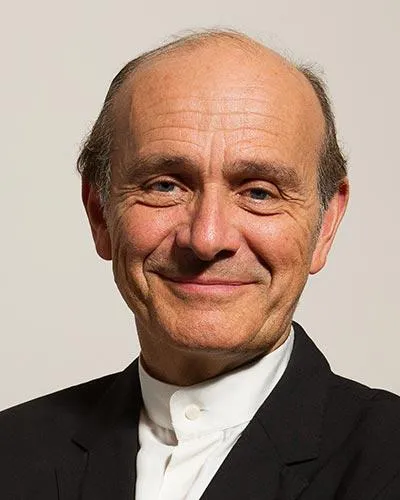
Lern deinen Guru kennen
Gábor Takács-Nagy wurde in Budapest geboren, wo er mit acht Jahren begann, Geige zu lernen. Noch als Student an der Franz-Liszt-Akademie gewann er 1979 den Ersten Preis beim Jeno-Hubay-Violinwettbewerb, woraufhin er seine Studien bei Nathan Milstein fortsetzte.
Von 1975 bis 1992 war er Gründungsmitglied und erster Geiger des Takács-Quartetts, das erste Preise bei den internationalen Wettbewerben in Evian (1977) und Portsmouth (1979) gewann. Das Quartett trat mit Sir Georg Solti, Lord Menuhin, Isaac Stern, Mstislav Rostropowitsch, András Schiff, James Galway, Paul Tortelier, Mikhail Pletnev, Joshua Bell, Zoltan Kocsis und Gidon Kremer auf und machte mehrere Aufnahmen für Decca und Hungaroton.
1982 wurde ihm der Liszt-Preis verliehen. 1996 gründete er das Takács Piano Trio, mit dem er Werke von Franz Liszt, Laszlo Lajtha und Sandor Veress einspielte, und die BBC in Großbritannien hat ihre Aufnahme von Beethovens Erzherzog-Trio ausgestrahlt. 1997 wurde Gábor Takács-Nagy zum Professor für Streichquartett am Genfer Konservatorium und am Konservatorium von Sion im Wallis ernannt, und er gibt regelmäßig Meisterklassen an internationalen Akademien. Seit 2001 dirigiert er außerdem Orchester und gründete 2005 sein eigenes Streichorchester, die Camerata Bellerive.
In seinen Meisterklassen verwandelt Gábor ein Leben inmitten des Kammermusikrepertoires in praktische Anleitung und zeigt, wie Phrasierung, Intonation, Charakter und Ensembledialog von innen heraus aus der Musik geformt werden. Hier erschließt er zwei Eckpfeiler der Literatur – Brahms' Klavierquartett Nr. 3 in c-Moll und Béla Bartóks Streichquartett Nr. 5 – und teilt die interpretatorischen Entscheidungen, die diese Partituren zum Leben erwecken, damit du dasselbe Denken auf dein eigenes Spiel anwenden kannst.







