



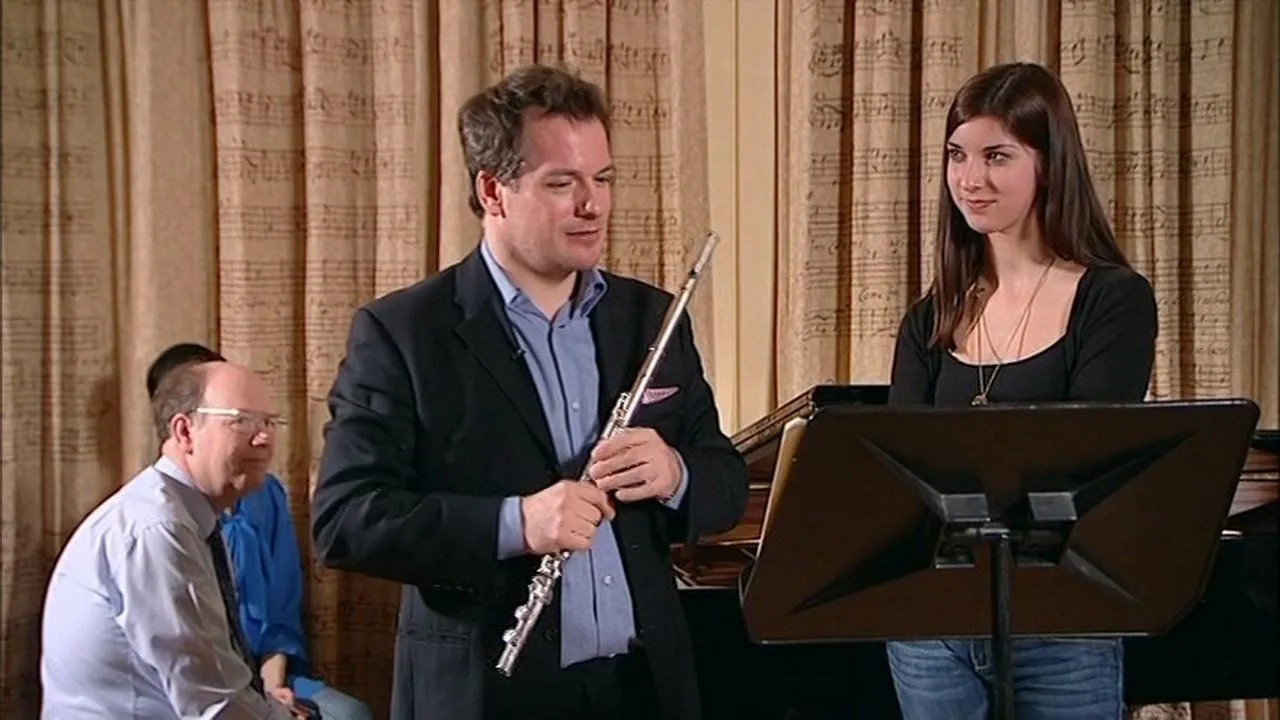
Analyse, Erklärung und Demonstration von Emmanuel Pahud
Lesson time: (38min 0sec)
Course preview
This lesson is part of the course Werke für Flöte von Schubert, Hüe und Sancan
Watch a preview of the full course below.
Lesson transcript:
Music Lesson
Introduction to Variation Number Five
Surprise! The easiest bit is variation number five, the one that we practice the most. That we. Yeah, because it's the most difficult one. Looks like this:
- Yes, only very dark notes.
- All of us have practiced it a lot.
- It's the one working better.
Understanding the Challenges
The slow sections of this very last one, as well as the introduction and the theme, are where you're struggling the most because you don't know what to do. You didn't practice really anything; you just hit the notes, trying to hit them. But I'm not sure that it makes sense really for you or where you're driving it.
When you're playing here, standing here, you don't look really committed. You've got to give us the feeling that we're really about to experience a very special moment.
The Privilege of Playing Schubert
You playing Schubert has never happened to me before, and you know, it should be very special. It should be a privilege for everyone here to listen to this Schubert piece for flute and piano.
- That's the only one we have.
- Wow, that's... you know, it's very special.
Composer's Mindset
Therefore, you have to know, and I will explain what I think is going on in the mind of the composer at certain spots.
- Style: There's a conversation between classical language and romantic expression.
- A lot is in the part, not only the flute part, but also the piano part and the intricacies of how they interact with each other.
Analyze the Music
The answer is very often by analyzing the music and comparing your part with what the piano has. It requires a little more reflection about the piece itself than just pure preparation on the instruments and trying to hit the notes.
Specific Examples
For instance, when you have bar number 330, we're now in variation number seven, by the way.
- It's the first variation with a tempo marking Allegro.
- All the other variations are connected, basically; they are not waiting time that you decide. They are kind of theme pumping.
You go straight forward; you can take the time to breathe, but there's no waiting as such. While here, people have to expect something. Then you go with this march in the last movement. If you play it then and it's not a march, it's not the character.
Tempo and Character
- Rhythm: Bum, bum, bum, bum, bum.
- The upbeat should never be longer than the other beats.
That's the piano part. It's really playing drums.
Importance of Specific Moments
Later, in bar 330, as I was saying, could you play, please, together with me from the Sforzando before?
- All of this is material with the harmonies we find there from the previous time.
- The chromatic things, etc., are elements we don't find elsewhere in the piece except in the introduction.
So, he waits until variation seven to bring back the things that we had in the introduction, all these chromatic scales and crooked harmonies.
Character Dynamics
We need this character that we had in the introduction there again, as opposed to the previous context.
- Look here at this bar; you won't find it anywhere in the piece except in the introduction and here.
This is a very special moment that breaks the development of the seventh variation, Allegro. Therefore, it has to be highlighted as distinct from the context before and after.
Introduction Analysis
Now, while we're talking about the introduction, when we have this thing in the beginning:
- Pom pom, pom, pom, pom.
There's a kind of feeling of fate, destiny, of a heartbeat, whatever.
Transition to the Flute
And the piano is playing everything in this E minor key. Then, when the flute joins in, we just blend into the piano.
- The first major chord since the beginning comes suddenly, surprisingly.
It's just like you're lost in the forest, you're not going to find your way. It's dark, it's getting really dark. Then suddenly, you see light somewhere, with all that it means, hope. Before that, you didn't have the hope.
Engagement and Emotion
So that's just the difference between before this C sharp and after this. Can you try to do something?
- I gave you the script, basically, so now you make the movie.
Okay, I see you trying, looking for what's okay. How could I do this?
- Try. Not. Well, don't try. Just be.
Feeling and Rhythm
Yes, you're there, and it's dark. Then you're happy in the 6th, 7th bar, you're happy. And then the piano, even in the beginning of the 8th bar, is still happy. But when you go...
- But how am I going to find my way there? Because you don't know.
Then you start walking, make your way through the woods. Be careful; there's some ambush. That's the meaning of that rhythm there.
Narrative in Classical and Romantic Music
For all this classical and romantic music, starting from Mozart concertos at the latest and all throughout the romantic music, you have to have a story, a film, a script. Each note has a meaning and adds something to the situation.
- Some notes are describing the atmosphere or the setting.
- Some others are characters moving in there, acting, and interacting with each other.
And this is all happening there.
Interaction Between Flute and Piano
When it's not you having the ta de, then it's the piano having it while you play ta da da da da da da. That's called counterpoint, these voices interacting.
Struggles in the Introduction
In the introduction, it ends up on this theme that's supposed to be one of the saddest spots of the Sch?ne M?llerin cycle. Be careful not to play ta rim ti ta da da da da da, the last note longer on the piano. You cannot play Tam tarim p ta da da da da that long artificially.
- There's a dot on that last note, so it should be kept short.
Transition to the Theme
Can we move to the theme? Yes, but keep the tempo.
- The upbeats are all 16th notes, not long, all the same.
- After forte, piano, it should be piano.
That's right! It stays piano. Don't, no, that was too loud!
Expression in Dynamics
Let's do it again and keep it soft. For me, this here is too wobbly. I don't know what you're trying to do there. Just keep it equal; this could be nice.
- It's just an ornament around, it's already an ornament of itself.
Now, with the tempo, I don't mind a tempo change or not, but it's certainly not slow. Andante means "going" in Italian.
- It literally means "going." So let's keep it going.
Keeping Up With Dynamics
Andantino, some people say it's faster than andante; some say it's slower. Anyway, it's a little andante, so it's a little "going."
- Whether a little going like this or like that, it's up to you, but it's going.
That's the main thing about it.
Accents in Dynamics
Now, we have accents, but still in pianissimo, more expression on the accent.
- If you look at Schubert's manuscripts altogether, he never writes an accent; he writes a diminuendo on the notes.
- Some publishers have simplified and placed an accent whenever they see this.
Usually, it's over one beat, be it an eighth or a quarter note. It's a kind of diminuendo, so it's an expressive marking on the note.
Articulation of Repeated Notes
If you listen to the right hand of the piano, remember the articulation of bam, bam, bam, bam. When you repeat a note on the piano, it has to be bum, bum.
- So play the same piece the same way.
- Don't play ta da, da, di pam, pam, pam, pam.
Variations Have Consistency
You join your forces, and you don't play against each other; you play together. This also implies slightly shorter and the same beat, same tempo.
- Again, the Allegro only applies to variation seven.
So the theme and all the variations should have, in theory, the same beat.
Tendency of Instruments
Now, the natural tendency of the flute, especially during the time of Schubert or Mozart, is that the high range is brighter.
When the phrase goes up, it should be brighter, and when it goes down, it should be softer. Just follow that line, and the dynamics will follow.
- You don't have to force anything in any direction because we have a tendency to have this complex of low notes.
Note Holding and Breath Control
I don't like the way you hold that long note.
- Do you? I don't hold it.
- So why don't you just hold it?
If you breathe properly before starting this variation, then you can breathe again in bar four instead of bar two.
- It's nice to have the T resolve itself one octave lower, naturally.
Clarity and Timing
When you have repeated notes, it's nice to breathe in between so that we hear the beginning of the new section.
I'm not happy about the timing in the beginning; it's not really together because you're not obvious with your breath and with the tempo.
Reflections on Performance
Very good! It was clear, so you don't have to spit it.
- Good, very good!
- Be careful not to play.
Much better! Please remember something: Schubert had a wooden flute at his disposal.
Understanding Sound Choices
He didn't want the brassy sound. That's not what he had in mind. Of course, we can do it, but again, it's not because we can do it that we have to.
Let's be civilized and try to find what the composer had in mind.
- Why did he choose the flute?
- Why did he write this piece for the flute?
Because there was a virtuoso player who was very impressive.
Maintaining Historical Context
This was the first piece he wrote for flute. The first version of the fifth variation wasn't working on the flute because he didn't know. It was corrected with this flute player.
But then others have been adapted, and the whole thing is working like that.
Exploring Sound Colors
He knows that when he writes for the flute, it won't be something unidentifiable, whether it's wood or metal.
You have to find it. It's up to your own imagination and investigate the tone colors and shades.
- Again, it's not because we can play that we must.
- Later, in music written for metal instruments, yes.
Moving Back in Time
Yes, please use it; do it. Because that's what it's been written for, to display the new possibilities of the new instruments.
This is all the French repertoire from the end of the 19th century.
But in this particular case, Bach, C.P. Bach, Mozart, Schubert, Beethoven, works with all wooden instruments, even in the German culture.
Tradition and Interpretation
Actually, Brahms and Mahler hated the metal flute.
He liked the Bohm flute but hated the metal flute; he didn't like the sound of this instrument, unlike French composers and Scandinavian composers who were playing both kinds.
So it's important to know what kind of sounds the composers had in mind, and why they used the flute, for what purpose, and what they expected to sound in that range.
Proper Musicianship
Try to keep with this musical language the composer was using; otherwise, we risk misusing or misinterpreting the piece.
Consistency in Performance
Let's try to keep the same tempo in variation three. It's very easy to get lazy there.
Please don't.
You always push the upbeats, and they become louder and brassier in sound than the downbeats.
Natural Phraising and Focus
Focus on the sound; change the setup on every note, and they'll sound uneven.
This happens if you're not really focused. In the previous variation, follow the line, which is the opposite of what was possible on the instrument in that time.
Just by following the line of the melody, you achieve a natural phrasing. You won't make mistakes in taste or style if you do this in the flute part.
Historical Context Affects Playing
The same rule applies to Bach and Mozart. In concertos and quartets, unless the composer writes something different, which they usually don't for Baroque or classical composers.
Late romantic composers write a lot of markings because everything feels unnatural.
Conclusion
For the Baroque or classical composers, it's just how the instrument sounds: When you go up, it sounds louder. When you go down, it sounds softer.
- Just follow this and make a nice shape for the whole phrase, keeping it flowing in a relaxed way.
Thank you!
Note on Timing
To keep the beat is not the same as playing like a metronome. It can still breathe and have a flow, but within a bar, it has to be consistent.
- The notes are not equal; they're all different.
Now it's about transitioning into something crisp.
Capturing Emotions
Could I listen to the introduction, please? Just the introduction. Because I'd like you to come from this mysterious feeling where we're lost at the beginning.
We don't know! You show us the way with the light that you see; you try to find your way, but it's not easy because you don't see anything.
- The piano isn't helping with Bum, bum, bum, bum, bum bum, bum, bum, bum, bum.
All of this has to feel strange, creating a sense of fear in this introduction.
Channeling the Character and Spirit of the Music
Yes! Take your time to breathe there, no stress, no rush. The stress was before; that was scary!
But then you show a more resigned sentiment.
- I'd like to hear the sound on the edge of the head joint, but more mysterious.
Imagine you're blowing air through the ear, like Shrek, but don't lose the pulse!
Capturing Surprises in Musical Phrasing
This is really a big surprise with this E flat major chord, the piano is.
- You go, "Who's that?" That should be your reaction!
This is why he writes an accent and gradually repeats.
Performing with Emotional Honesty
Could we play just the upbeat of the flute before that? That was the last bar with the upbeat.
Suddenly, all this builds up.
- Oh my God, oh my God, oh my God. Am I going to find my way? You know, supplicating like this.
Remember that in the last variation, the crescendo, diminuendo, same expression here.
Same formula reversed, so it's no longer T.
Final Thoughts
The whole story is there, floating around, Trogno Blumen from the Sch?ne M?llerin, etc. There are texts, poems, these are songs with collections of songs that have a story.
This is one of the saddest points in the story, and it's funny to have these variations being seemingly lighthearted for the flute, a light instrument compared to others, specifically on that very sad thing.
So where is the sadness in this theme?
I recommend you explore a bit more, see what Schubert's life was like at that moment, what did he try to convey in his music, and how this could be very personal and very sad.
It's all about acting and believing in it, not just pretending.
You might find clues there, and every time you play in a concert or audition or competition, it's yet another try.
This is why I'm still going on stage after many years of playing the flute, because I still believe in it every time.
I hope you find the same pleasure and happy feelings in music, too. Thanks very much!
About the instructor
Der in Berlin ansässige Emmanuel Pahud ist einer der herausragendsten Flötisten der Welt, am bekanntesten für sein barockes und klassisches Flötenrepertoire. Pahud wurde in Genf, Schweiz, in eine nicht-musikalische Familie hineingeboren. Als kleiner Junge war er vom Klang der Flöte gefesselt, und vom vierten bis zum 22. Lebensjahr wurde er von Flötisten wie François Binet, Carlos Bruneel und Aurèle Nicolet unterrichtet und betreut, bevor er am Conservatoire de Paris ausgebildet wurde. Er stieg in die internationale Orchester- und Solistenszene ein, als er 1992 als einer der jüngsten Solo-Flötisten seiner Geschichte den Berliner Philharmonikern beitrat. Seine angeborene Musikalität und außergewöhnliche Technik haben ihn zu einer festen Größe für Soloauftritte in Japan, Südostasien, Europa und den Vereinigten Staaten gemacht. Zu seinen regelmäßigen Recital-Partnern zählen Eric Le Sage, Hélène Grimaud, Yefim Bronfman und der Jazzpianist Jacky Terrasson, und er ist als Kammermusiker sehr gefragt, nachdem er mit den meisten der weltweit führenden Solisten zusammengearbeitet hat. Seine Vielseitigkeit über die Musikstile hinweg hat "die Ankunft eines neuen Meisterflötisten angezeigt" (The Guardian). Er spielt in unterschiedlichsten Genres, ob Barock, Jazz, zeitgenössisch, klassisch, orchestral oder Kammermusik. In Works for Flute by Schubert, Hue and Sancan richtet Emmanuel diese Kunst auf drei Eckpfeiler des Flötenrepertoires und teilt die interpretatorische und technische Einsicht, um jedes Stück lebendig zum Leben zu erwecken. read more