



Einfacher Boogie-Rhythmus

Mit
Mat WalklateDer einfache Boogie- oder Shuffle-Rhythmus, der als Grundlage des Blues dient
Das steckt im Kurs
9 Lektionen (0h 54m) · 2 gratis
01. Mit deiner Mundharmonika vertraut werden
Gratis-Lektion3:56
02. Einfacher Akkordrhythmus, erstes Blues-Solo
8:52

03. Lerne ein einfaches Blues-Solo
7:04
04. Ansatz (Lippenform)
4:51

05. When The Saints Go Marching In
12:37
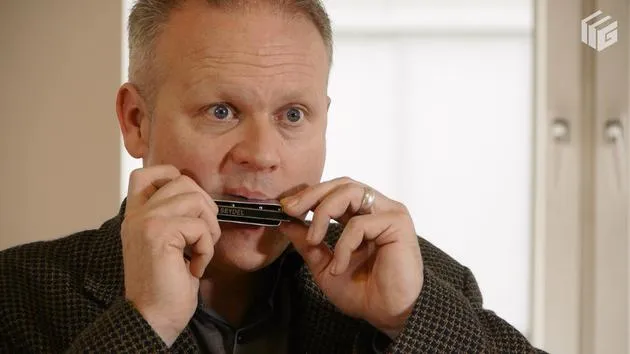
06. Tongue Blocking
8:03
07. Tonleitern spielen
1:58
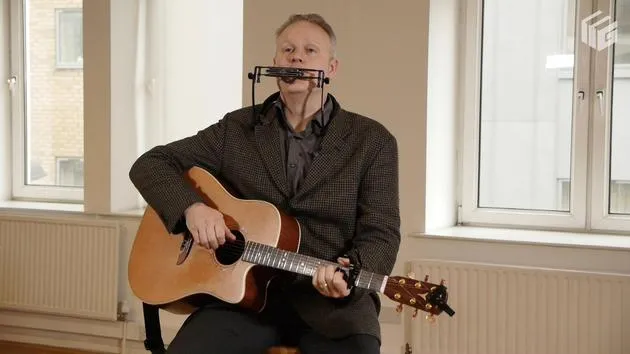
08. Einfacher Boogie-Rhythmus
Du bist hier5:25

09. BONUS: Lerne, The Beatles, Love Me Do zu spielen
Gratis-Lektion1:48
Transkript der Lektion
Boogie Rhythm on the Diatonic Harmonica
Hello, my name's Matt. What we're going to look at now is playing a very simple boogie rhythm on the diatonic harmonica.
Introduction to Boogie Rhythm
You'll have heard something like this if you've listened to any music from the past hundred years. I'll give you a quick demonstration. Sometimes it's called the shuffle rhythm, and sometimes it's called a boogie rhythm. Here, we're calling it a boogie rhythm, and it's quite straightforward if we approach it slowly.
This rhythm fits along with the 12 bar blues in the appropriate key, which as usual is G in this case. There will be some tab for this on the site that tells you which notes to play and when.
Choosing Your Starting Note
You've probably noticed, if you try to play the harmonica a bit, that two draw is a difficult reed to play. It's challenging to make the note sound good at first. We tend to get this, which isn't very good.
What we're looking for is this:
- Two draw and three blow are the same note; both are notes of G.
- The three blow is very stable; you can't really make three blow misbehave.
- However, two draw will go flat; it will go down in pitch with very little encouragement.
So, if you're struggling with two draw, and most people do when they first start, then use three blow instead because it's much easier to play.
Boogie Rhythm Structure
The boogie rhythm starts off with this melody line, and we get that twice. This covers the first four bars of the 12 bar blues. Then the chord changes, so we change the melody that we're playing.
-
Start from hole number four blow.
- Play that once.
-
Play the first melody again just once.
- This takes us to the end of bar number eight.
-
For bar number nine, breathe in holes four and five together and say "D D," but there's a beat in between the Ds.
It sounds like this, like so.
- To finish off, we play a line that's very similar to the first line, except there's one note less, and we phrase the last three notes slightly differently.
It sounds like this, I'll play it again, like so.
When we put that all together, it follows a 12 bar blues, and it sounds quite good, quite melodic.
Demonstration
I'll play it for you nice and slow. If you want to join in, please feel free.
After a count of four:
1, 2, 3, 4.
And there you go!
Playing Along with the Guitar
Okay, folks, let's try playing the boogie rhythm along with the guitar. It will be after a count of four. You can either start on hole two draw or three blow, whichever one works best for you.
Here we go:
1, 2, 3, 4.
There!
9 Lektionen
0 Std. 54 Min. strukturierte Videolektionen
Erweiterte Videofunktionen
Verlangsamen, Passagen loopen, mitlesen
Handy, Tablet & Desktop
Üben, wo du willst
100 % Zufriedenheitsgarantie
30 Tage Geld-zurück-Garantie
Lern deinen Guru kennen
Lern deinen Guru kennen
Mat Walklate ist ein in Manchester ansässiger Mundharmonikaspieler und Lehrer, der im Blues und Folk zu Hause ist und außerdem Flöte, Whistle und Uilleann Pipes spielt und singt. Er gewann 1992 die British Blues Harmonica Championship und 1993 das All-Britain Fleadh Cheoil an der Mundharmonika und ist ein von Seydel unterstützter Künstler.
In einer dreißigjährigen Laufbahn ist er mit Bands wie The Moochers und der Irish-Music-Gruppe The House Devils durch Europa getourt, hat zwischen 2001 und 2021 rund vierzehn Alben aufgenommen und gemischt – darunter Sea of Blues und Traditional Harmonica – und tritt heute im Duo mit dem Sänger und Gitarristen Alex Haynes sowie an der Seite des Blues-Gelehrten Dr Tom Attah auf. Er unterrichtet Mundharmonika am Leeds Conservatoire und privat.
Auf MusicGurus führen dich seine Kurse von deinen ersten Tönen auf einer C-Mundharmonika – Ansatz, die Cross-Harp-Position, Bending und deine erste Improvisation – bis hin zu flüssigem Blues-Spiel, mit Vibrato, alternativen Positionen und der Phrasierung, die ein Solo zum Singen bringt.







