



8-Takt-Blues

Lesson time: (16min 56sec)
Doug MacLeod stellt den Achttakt-Blues auf der Akustikgitarre vor und zeigt, wie man die Form angeht und sie nach dem Ein-Akkord-Blues und dem Zwölftakt-Blues spielt.
Course preview
This lesson is part of the course 101 Grundlagen der Blues-Gitarre
Watch a preview of the full course below.
Lesson transcript:
Eight Bar Blues Lesson
Alright, in this segment, we're going to talk about an eight bar blues.
Previous Concepts
- We talked about:
- A one chord blues
- A 12 bar blues
- Now, let's get to the eight bar blues!
Tuning
First, let's make sure we're in tune:
- Hit the low E.
- Go to the A.
- Move to the D.
- Next, hit the G.
- Then B.
- Finally, top it off with that high E.
Yeah, that sounds better to me. Let's use this chord to check.
Important Chord
This is the one we talked about earlier. This is a darn good chord because there's no third in it. Sometimes it's hard to hear the third. Like I told you about that tomato theory, thirds can vary, and when people sing, it's like that. So I think this is a real good chord.
The Eight Bar Blues
Now, let me play you an eight bar blues and I'll count the bars out to you so you can understand exactly what an eight bar is.
They go like this:
- We're going to be in the key of A.
- One bar: A
- Yes, we're going here: D
- In the traditional one, you stay on the D.
- Back to A,
- To E,
- To A.
- Now you turn around with simply chords.
Walk Down
Now let's do it like this:
- Walk down to the seventh.
- Go to the F#, which is on the D7 chord.
- Now hit the F on the D minor chord.
- Nice little line in there.
- There's your E on the A7D.
Isn't that a cool line?
Guide Tone Line
Look, if you add this, boy, that's good, isn't it? Let me show you what that is.
I've heard this called a guide tone line. That means that if you just hear this line by itself, you get an idea of what the chords are.
Check this out:
- We're going from A to G.
- That gets you to A7.
- Now we're going to D7.
- Here's the F#.
- Now we go to D minor, right?
- There's the F on there.
- Now we just go right down the line to E down.
When we hit the E chord, instead of hitting the high E, we hit the D on the E7 chord.
The Blue Note
And then this chord, that's the blue note. But it's part of the E7 chord.
Let me see, if I play from here, this kind of augmented chord. And what makes that sound so good again is voice leading.
Voice Leading
What we're talking about here is voice leading, just like when someone's singing. You're going to get this note, this note, and it comes together.
That's one of the most important things you can remember in making music: It's got to sound like a voice.
Playing the Eight Bar Blues
So let's go ahead and play this a little bit and get used to it down here in the low position of the eight bar blues.
- Keep that thumb going, you know what I'm saying?
Alright, there's our D7.
- Now, hit the D minor.
- Go back to the A.
- Next, we're going to go to the E.
Walking Down
Now we're going to walk this down. Here we go:
- This is a walk down that they've been using for years.
- It's just simply G, F#, F, E.
Something sound familiar to you? Wasn't that what we had here?
Searching for Patterns
Again, if you find it on a guitar in one place, find it somewhere else.
- Why does it work?
- It all makes sense, but the thing to do is to search it out and seek it out.
So, okay, we got this going here.
Harmonization
Can I harmonize this just like we harmonized this? Absolutely! Robert Johnson had this sort of come down.
Now, you can also do this. I thought Robert Johnson did some of these where he barred the fifth fret like this and then got the G with his finger and went, "mm."
Now that's true!
Adding Another Layer
Right, again, if this is available, what else is available? Check this out. We've got three of the notes of an A7 chord.
- Let's add the third.
- There it is!
Now, can we harmonize that whole walk down using chords? Absolutely.
Chord Sliding
Watch again, you can check out the left hand. See what I'm doing now? I'm just sliding down like this.
You can also come up, just like we talked about in E.
Major Seven Chord
There's another one you can use that is very, very nice too. I call this my major seven.
Start like this. You want to say, "What does that? Does that really work?" Listen, I'll show you it works!
All I did there was I just brought this finger off and hit that E because it's available.
Building Melodies
You know what I mean? So I hit that E because it's available and it gives me a little more melody.
So when I come on back, it'll sound like, "yeah!"
And now I'm gonna hit that sweet lick, that major seven. See, you can go on like that.
Alternative Eight Bar Blues
Right now, I'm going to show you the other eight bar blues that's available, and that is one that has an inside change, what I call an inside change.
- You start at the A, and then your second chord, instead of being the A7, is going to be a C7.
- This is like the trouble in mind sound.
- Now we go to the D and now we go to the diminished.
Notice the difference here: the line is going up on this one. In the previous one, the line was going down.
Putting It All Together
Then you hit this and you hit your five:
- D, C, A.
That's a good sound. So it sounds like this when you put it together. We approach taking our time.
Now, when you get to this A, because the line is going up, you want to accent it, but it's not the root of the chord.
Accenting Notes
The A is the root of the chord. So you accent the E and A at the same time.
So the ear goes, "Oh, yeah, yeah, I wanted to hear that."
It should sound like this. (Let me get this.)
Now the diminished...Here we go. I'm going to try and get them both.
Closing Riff
Sound pretty good. Now this little run here.
This little run goes like this:
- All this is I hit the low A, hammer on, slide on up to the C#, to the E.
- Then I go back.
Now we're using this little turn around here.
Final Thoughts
Let's play some blues on this.
On this 12 bar, we just groove in here. I use the G there. I'm gonna show you what that run is here.
Got two things to show you. Alright, that little run.
That little run was just coming something like that, I think.
Yeah, those are the notes!
These are the same notes that we use in the key of E.
Key Principles
Remember:
- If they're available on these three strings, where are they available on the lower three strings?
- This is what you want to get: Building blocks.
Exploration
Here we are at this A. Let's find where the G is:
- G, E, E flat, Open D, C, A.
- And again, G, E.
So that means we have... Let's check how many notes we got.
We're just in this one position, down here in the low position of the guitar, and we have:
- One octave,
- Two octaves.
That's a lot of notes, man! You can make a lot of music there.
Reminder
Don't let me forget! I almost forgot. I won't cheat you on that thing.
What was that run-up I did on the E? I just went like this. That's all that is: Partializations of a chord.
And I'm sure if you get it to the left hand, you put your DVD thing on the left hand, you'll find them.
Making Music Together
So let's make a little music together down here. We're doing that eight bar blues.
Now, I'm gonna play it, I'm gonna walk up, I'm gonna go up the middle. Remember that chord we have in E? There it is!
Final Chord Changes
Check this one out. Now I'm gonna slide up here.
Ooh!
So it's time to show you what that is, isn't it?
Okay, the A, which was just a normal A7.
Then I went to the E, which is that partialization of that E chord, right?
Natural E is this one. But I use this one because I like to sneak my pinky off and get the blue note against that.
I love that sound.
The Good Sound
That's a good blue sound!
Then we go down here to the D7, back to the A, and then we go back to the E going up and then up here, which is again another partialization of this A chord.
This is the A7 chord right here.
See what I did was I took this finger off and I'm using it like this.
Inspiration from the Greats
If you're a blues fan, I know you've heard of Albert King.
And Albert King does things that sound like that's his thing.
And that's what all that is, just that partialization.
Bringing It Home
And again we use the thumb snap there.
That's right in here in this part of the neck.
Now let's get up to the high part of the neck with the 12 bar and I'll show you a chord that, well, I use this.
I don't know too many guys that do, but I use it.
And I'll show you why: it's this one!
Chord Construction
It's an A7 chord.
But you'll notice that instead of it being like an A chord, I take my first finger off the G string and I go over here on the C# of the E string.
So I got this, I got these, working this distance: A to G.
That's that seventh that back in the previous segment we talked about in E, right?
That seventh gives a nice sort of depth to it, get that kind of sound.
Options for the Five
I use this one.
And now for my five, you can use this one.
Now for your D, you have some options here on the D.
- You can use this with the open E.
- You can also use, well, that's a good sound too.
The minor is here.
Final Notes
See what I'm saying? Then you go back here to this one.
And then we go to the E.
And now, how about that sweet sound we had?
That blue note that we had down here, can we get it here?
Yeah, we can get it here.
Listen. Ah, yeah!
And then we can slide down.
Conclusion
Again, the principle being that we try and take the three parts of the neck:
- The low,
- The mid,
- The high, And put them together so it becomes one neck instead of three positions.
Instead of 14 positions, you're thinking one neck and you're thinking musical, and you're putting together building blocks.
So it sounds like this.
I'm going to play the old standard one now, and I'm gonna move on up.
Now I got that lead belly strum going there.
That sounds good. I'm just taking my time trying to make music here.
Final Playthrough
We'll do it like this.
Now I'm going to come down, see that?
I'm not stuck up on that high part. I come down, I make a connection.
We can do this too.
Watch this.
What was that?
That was just taking this shape of a form of a chord going right up here.
Here's an E and a C# of an A7 chord.
And what we did was move chromatically up to the G and the E of an A7 chord.
Closing Thoughts
It's like there's a jazz line that goes right.
And all I did was say, "Well, this is available."
That sounds pretty good!
And then we're down to the D.
Here's a good D chord.
Look at that one. Now that's an interesting one, just going to it.
An F# in the bass.
Final Reminder
Now, the name of the chord is a D, right?
But there's an F# in the bass, but it works good.
That's just part of blues.
Now we're going to hit the D.
Yeah, let me do that again for you.
Now here's the A7.
Now I'm gonna walk up.
Doesn't that sound good?
A little run there.
No turnaround there, just stand on that 8 chord.
You can do that too.
Let's walk it one more time, connect it, and bring it back down.
We extended the ending here, you know, hit it pretty cool in the end.
That gives you a working example of an eight bar blues in A.
And now, I'm going to sing you one!
About the instructor
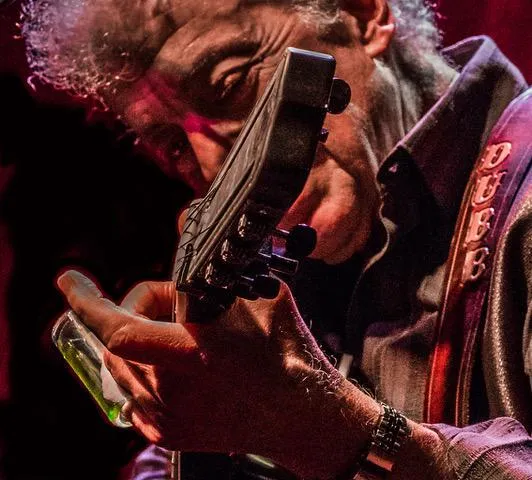
Doug MacLeod ist bekannt für sein hervorragendes Songwriting, seine Gitarrenkunst, seinen warmen, seelenvollen Gesang, seinen Witz und seine unvergesslichen Liveauftritte. Das Herzstück eines Auftritts von Doug MacLeod ist sein Talent zum Geschichtenerzählen, mit dem er Figuren - von den Namenlosen bis zu den Legendären - eindrucksvoll lebendig werden lässt. Doug hat mehrfach den Blues Music Award gewonnen, darunter den Blues Music Award 2020 als Acoustic Artist Of The Year und den Blues Music Award 2018 als Acoustic Album Of The Year für 'Break The Chain', und war für den Blues Music Award 2021 als Acoustic Artist Of The Year nominiert. Sein Album mit dem Produzenten Jim Gaines erschien 2021. In 101 Blues Guitar Essentials vermittelt Doug die Grundlagen seines Handwerks - die Grooves, Techniken und das Feeling, die authentische akustische Bluesgitarre ausmachen - damit du dir ein echtes Vokabular auf dem Instrument aufbauen und beginnen kannst, deine eigenen Geschichten darüber zu erzählen. „Wie alle großen Bluesmänner lebt MacLeod seine Musik, und die Songs liegen nicht nur auf seinen Fingerspitzen und seiner Zunge, sie sind eins mit seinem Wesen.“ - Blues Music Magazine „Einer der großen Blueskünstler ... Punkt!“ - Jorma Kaukonen read more