



12 Bar Blues

Lesson time: (3min 35sec)
Doug MacLeod erklärt die Form des 12-bar blues, die Akkorde I, IV und V und wie man das Spiel angeht.
Course preview
This lesson is part of the course 101 Grundlagen der Blues-Gitarre
Watch a preview of the full course below.
Lesson transcript:
The 12 Bar Blues
In this segment, we're going to talk about the 12 bar blues.
Review of the One Chord Groove
Last segment, we discussed the one chord groove. This is the 12 bar form, meaning there are three chords involved in this style of blues:
- E
- E7
We'll focus on these chords down here on the bottom part.
Understanding the Chords
Next, we go to our A chord, which is known as the IV chord.
- Why is it called the IV chord?
Because it's four steps up in the E scale:
E, F sharp, G sharp, A.
The five chord is the B. You just move up one more step, as this is the fifth note of the E scale.
So, when you hear someone say 1, 4, 5, that's what it means in any key.
You have your E, E7, and then we go to A.
- Down here, you have this flat A (which I call it), and you also have A7 that you can use.
- Furthermore, you have your B7.
The Tomato Theory
A lot of people say you shouldn't play certain notes because they clash. However, this idea ties into my tomato theory:
"If it sounds good, it is good."
The old blues guys didn't know theory; they just knew that if it sounded good, it was good. This is a crucial rule of thumb for you when making music.
- If it sounds good, it is good.
- If it sounds bad, you don't need me to tell you to change it.
Playing the 12 Bar Blues
Let's play a little bit of this 12 bar and see how it sounds.
- We're going to keep the groove slow.
- Remember: if you can play it slow, you'll get the hang of it.
- Speed will come later, so practice slowly first.
We're maintaining a nice, easy groove with a heartbeat feel, think of that classic Jimmy Reed feel.
Hammering On
Now, let's discuss what we can do on this four chord; it's pretty hip!
- We can hammer on.
- Hear that? All I did there was hammer on with my third finger at the second fret of the B string and then hit up on the E string.
With my pinky available, I can adjust my groove a bit.
The Five Chord
Here's your B7. You can use this little C sharp from the A7, and voila, you've got the groove going!
The Turnaround
Now, let's get to what we call a turnaround.
- Remember that double stop we had?
- And we're back.
Let's do it in time.
That was just to showcase those chords.
- You can check that out with your DVD controller.
- Review the left hand part there in time.
It'll sound like this...
About the instructor
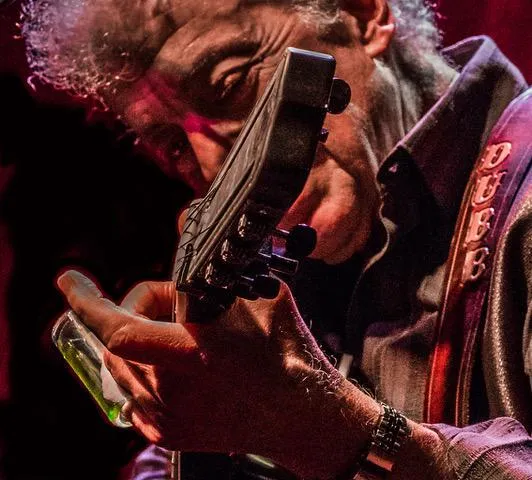
Doug MacLeod ist bekannt für sein hervorragendes Songwriting, seine Gitarrenkunst, seinen warmen, seelenvollen Gesang, seinen Witz und seine unvergesslichen Liveauftritte. Das Herzstück eines Auftritts von Doug MacLeod ist sein Talent zum Geschichtenerzählen, mit dem er Figuren - von den Namenlosen bis zu den Legendären - eindrucksvoll lebendig werden lässt. Doug hat mehrfach den Blues Music Award gewonnen, darunter den Blues Music Award 2020 als Acoustic Artist Of The Year und den Blues Music Award 2018 als Acoustic Album Of The Year für 'Break The Chain', und war für den Blues Music Award 2021 als Acoustic Artist Of The Year nominiert. Sein Album mit dem Produzenten Jim Gaines erschien 2021. In 101 Blues Guitar Essentials vermittelt Doug die Grundlagen seines Handwerks - die Grooves, Techniken und das Feeling, die authentische akustische Bluesgitarre ausmachen - damit du dir ein echtes Vokabular auf dem Instrument aufbauen und beginnen kannst, deine eigenen Geschichten darüber zu erzählen. „Wie alle großen Bluesmänner lebt MacLeod seine Musik, und die Songs liegen nicht nur auf seinen Fingerspitzen und seiner Zunge, sie sind eins mit seinem Wesen.“ - Blues Music Magazine „Einer der großen Blueskünstler ... Punkt!“ - Jorma Kaukonen read more