



Finger style funk
With
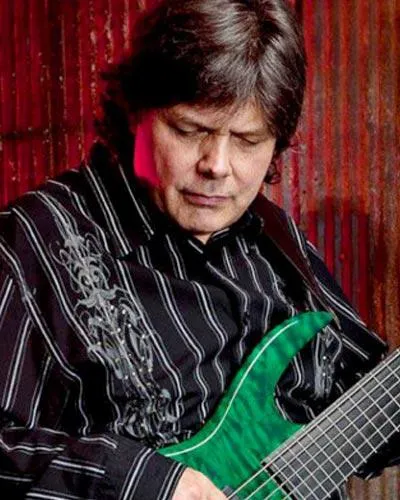
Roy VogtRoy Vogt introduces fingerstyle funk on bass - upper-register notes and left-hand muting - plus two new tunes, Florida Groove and Popcorn Popper.
What's in the course
5 lessons (3h 17m) · 1 free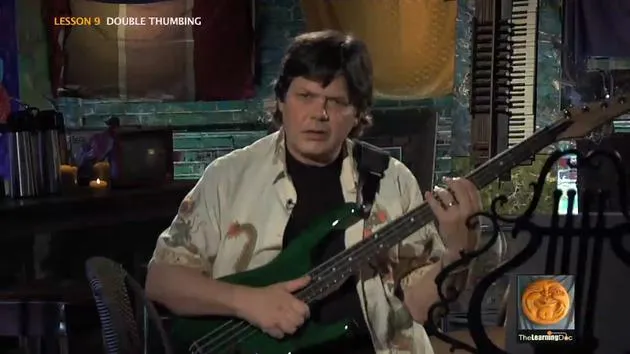
Lesson transcript
Music Lesson: Right Hand Technique & Note Practice
Welcome Back
In this lesson, we're going to learn a very specific right-hand technique associated with two very famous players. We'll also cover the notes from the double dot (twelfth fret) all the way up to the seventeenth fret.
Warm-Up Exercise
Let's start with a warm-up. This warm-up will prepare us for what's to come.
- Warm-Up Technique:
Take your power chord from a few lessons back and add one note on top, creating a root-five octave.- Picking Pattern: Pick each note twice.
- Note Values: We'll work with quarters, eighths, and sixteenths.
- Starting Tempo: Quarter note equals 60.
1, 2, 3, 4.
Now you can work it up to speed anywhere on the neck. Remember, my pattern is root-five-octave.
Notes from the 12th to the 15th Fret
Now, let's learn the notes from the 12th to the 15th fret.
-
First Position Reference:
When we reach the double dot, we start over again with the notes in the first position:- G, G# (G sharp), A, A# (A sharp), B, C.
-
12th Fret Notes:
At the 12th fret, the notes are:- G, G#, A, A#, B, C.
Remember, the first position repeats itself at the 12th fret.
- Walking Across the Notes:
I'll do a couple of left-hand shifts to cover that fret range.
1, 2, 3, 4.
Right Hand Technique
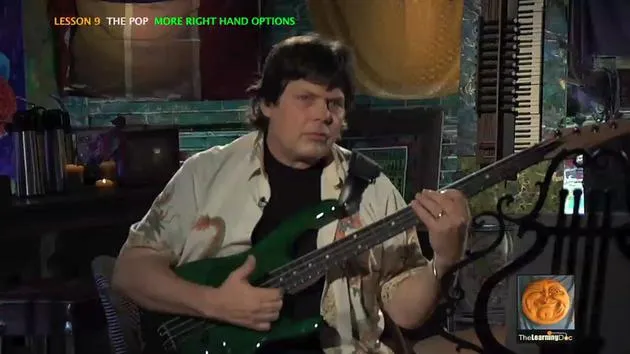
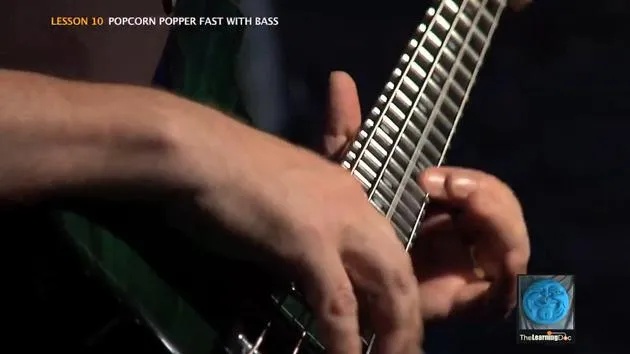
Now, let's talk more about the right-hand technique. Essentially, I will perform quick sixteenth notes with my index and middle fingers, often referred to as "finger funk" or "finger style funk."
- Hand Placement:
- If I try doing this higher up, the strings feel floppy due to lesser tension.
- Moving back will provide better string tension and recovery.
Left Hand Muting
Next, let's discuss left-hand muting.
- Warm-Up with Muting: I'll demonstrate the warm-up exercise with and without left-hand muting.
Here's with left-hand muting.
Here's without left-hand muting.
Without left-hand muting, everything starts to blur together. To achieve left-hand muting, release a bit of pressure during the second note in the series.
Famous Technique: Jaco Pastorius
One of the most famous bass players utilizing this technique was the legendary Jaco Pastorius. Let's look at a typical lick in his style.
- Standard Note Choice:
This line follows the conventional boogie-woogie pattern: Root, 3, 5, 6, flat 7. - Unique Order:
Jaco changed the order of the notes.
Lick Breakdown
- Starting Notes: Start with the root of the chord, move to the fifth, then play two sevenths, two sixths, and finally go to the third, incorporating passing tones.
3 passing, passing 5.
Playing the Lick in Different Tempos
Let's practice this at three tempos: 60, 80, and 100 beats per minute.
- Tempo 60:
1, 2, 3, 4.
- Tempo 80:
1, 2, 3, 4.
- Tempo 100:
1, 2, 3, 4.
Transposing the Lick
You can transpose this shape around just like we did with the major scales.
- To F:
1, 2, 3, 4.
Second Lick Overview
The second Jaco lick is common during solos. Let's discuss the technical and theoretical elements:
1, 2, 3, 4.
- Chord Sound: F7 (F, A, C, E flat).
- Technical Execution: Starts on the third, walks down to the root, then to the seven, marking an approach tone.
Practice Transposition
If we want to perform this lick in D:
- Pitch Numbers:
F#(3), E(2), F#(3), Go down to D(1).
Now play at different tempos (60, 80, and 100 beats per minute) just like before.
Combining Licks in a Tune
Let's combine all the licks we've worked on into a tune called "Florida Groove," named after Jaco Pastorius's home state.
- Practice Together:
Let's play this together at 60 beats per minute.
1, 2, 3, 4.
Advanced Technique: Popcorn Popper
Next, we'll work on another tune in the style of Tower of Power called "Popcorn Popper." Notice that we'll be playing up to the 17th fret.
Final Tips
- Stretching and Flexibility: Remember to pull back on the fingers while stretching. Avoid forearm curls that can limit flexibility.
Looking Ahead
In our next session, we will finish learning all the notes on a 20-fret bass guitar and explore double-stop chords, inspired by bassists like Roscoe Beck and Chuck Rainey.
See you soon!
5 lessons
3h 17m of structured video lessons
Advanced video features
Slow down, loop a passage, follow along
Mobile, tablet & desktop
Practise wherever you are
100% satisfaction guarantee
30-day money-back guarantee
Meet your guru
Meet your guru
Roy Vogt's career spans an extraordinary range of stages, from MTV's Headbanger's Ball, the Montreux Jazz Festival and the Montreal Jazz Festival to the London Palladium, the Grand Ole Opry and the Kremlin. From punk to funk, the simplicity of country and blues to the complexity of HyperJazz and World Beat, he has played it all.
Roy was the first person to receive a Master's degree in Electric Bass Performance, from the University of Miami's prestigious music school, and has been pursuing the art of bass for more than forty years. He has mentored dozens of successful professionals, including the legendary Willie Weeks. Electric, fretless, upright - you name it: if it plays low notes and has strings, Roy is a master at playing it, and at teaching others to do the same.
Over his four-decade career, Roy has recorded or performed with an amazing list of top stars, including Larry Coryell, Victor Wooten, Dave Weckl, Tom Scott and the LA Express, Chester Thompson, Miroslav Vitous, Glen Campbell, BJ Thomas, Chet Atkins, Engelbert Humperdinck, Dickey Betts, Tony Joe White, Charlie Daniels, Jerry Reed, and dozens more.
Roy has been teaching at university level for thirty years. Since 1983 he has held the Bass Professor chair at prestigious Belmont University (Nashville, TN), one of the very few schools to offer a commercial music degree program designed to turn students into professional musicians working at the top of the industry. Roy's students have toured and recorded with notable stars such as Trisha Yearwood, Faith Hill, Little Texas, Michael W. Smith, Lady Antebellum, Chick Corea, Sir Tom Jones, Blood Sweat and Tears, Yanni, and countless other music icons.
His Teach Me Bass Guitar series brings that same university-level approach to you, taking you from a complete beginner's quick start (vol. 1), through rhythm fundamentals (vol. 2), finding your own style (vol. 3) and serious musicianship (vol. 4), all the way to a pro-player toolkit (vol. 5), so you build real skills step by step.







