



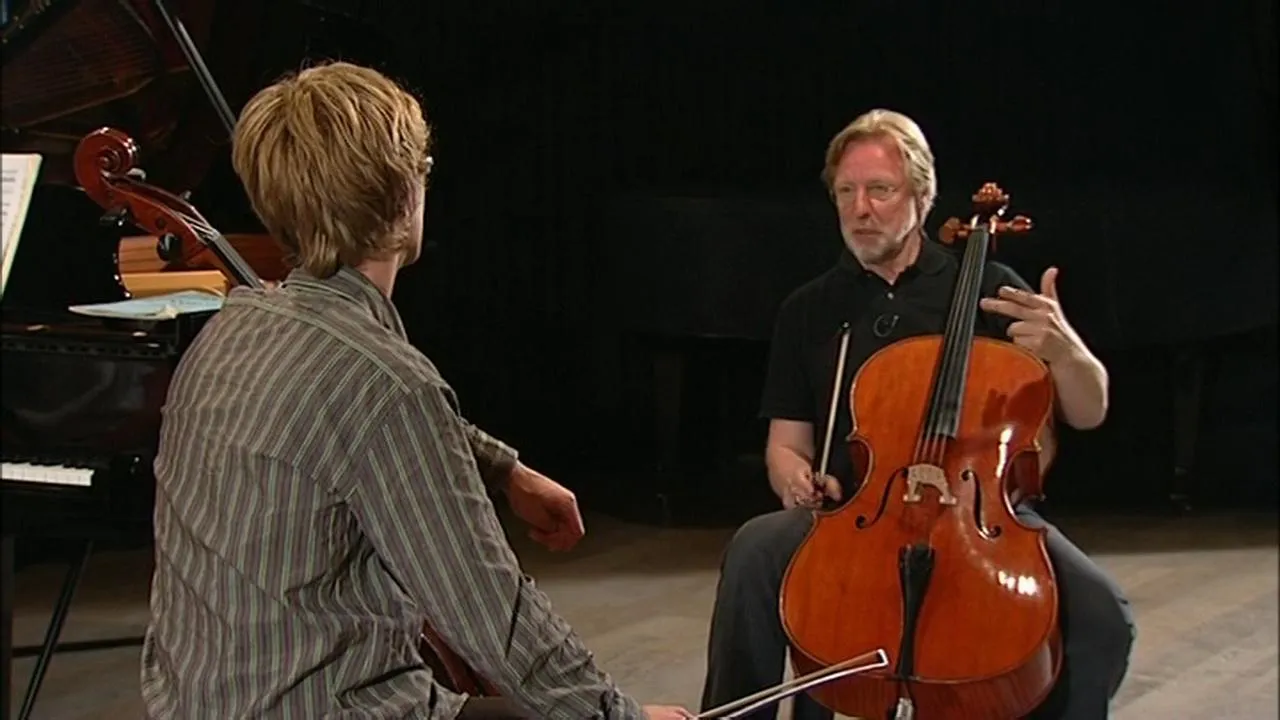
Analysis, explanation, demonstration with Frans Helmerson
Lesson time: (32min 28sec)
Course preview
This lesson is part of the course Schubert - Arpeggione Sonata (I. Allegro Moderato)
Watch a preview of the full course below.
Lesson transcript:
Music Lesson
Bravo. Beautiful.
I like very much. It's very musical and very honest playing. I think I like that.
Schubert's Unique World
You know, of course, Schubert is always such a special world, a world that belongs to Mozart, and to, in a way, Beethoven and Mendelssohn, several of the figures around Schubert.
But what he does with time, what he does with harmony is so incredible. What he does with the rhythmical language.
Transitions in Music
And this, in my opinion, is what creates problems. It is as if transitions... For example, when you get to a transition in the music, when you read the music, it's obvious. The phrase goes from there to there, and then the next phrase starts from there, and it goes until there.
But actually, when you get there, it's like it has already started the next phrase. And that's what is so difficult. You play is immediately there, and you have to close in a way, but at the same time, you must be so aware of how it continues.
When it continues, it is completely the right sound, the right emotional language, the right expression, the right dynamic.
Contrast with Beethoven
Of course, it's the opposite to Beethoven in many ways because, in some of his music at least, it is so crystal clear what is what. Here is this, here is this, and it contrasts with each other.
Here you have everything in transition. Everything is transition somehow, and that's what makes it a little difficult.
Musical Honesty and Phrase Shaping
Where I feel that you are so musical and where you are so honest is how you shape each phrase. But you're not yet on the stage where you connect in the transition.
Actually, I feel each phrase exactly where it goes, and I feel exactly where the next starts. And actually, it has already happened, so to speak.
You know, it's a little like in the language of dynamics in music. Many times when you have a hairpin in the music, it looks like it should grow crescendo, and there starts the diminuendo.
But mostly, you need to grow a little before that place. If you grow to that place, it's already too late, right?
Anticipation in Performance
It's a little the same with the shaping of the phrasing here in the music. You always have to anticipate everything.
Anticipation is the word that one needs to remember all the time when you play this very, very well. Let's try again.
As if already... When you play the first note, you have to be with your mind in the second note already. And when you play, you have to be there, now you have to be there, and you have to be there, and you have to be there. You are always in front of yourself.
Technical Aspects
Beautiful, beautiful beginning. Also, technically, it's like you need to be already on the bridge that takes you here, so that we don't have this kind of corners in the technique either.
Maybe you can do a little more technically. Can you avoid this obvious glissando? I think you have to be a little smart with a bow also.
You see, this has to have a clear color. This top note is the top note so far from here, and now we're there.
Dealing with Time
What I mean is, one of the things that are so important is how you deal with time. By the end of the shape or the phrase that you use, the stretch, you do the stretch where it's obvious that the stretch has to be.
But not by the end, because that is a bad habit. I think you can only live once, like summer. You can only experience it once a year.
Creating Intimacy
Exactly. Yes. And now we come into Schubert's salon a little. No, it's not... You know, this is a piece that I really feel is composed for a small group of people.
So, of course we hear it in Carnegie Hall also. But if you perform it in Carnegie Hall, you should not perform it for Carnegie Hall. You should make the audience in Carnegie Hall come to you simply; otherwise, it easily grows out of proportion and becomes a little aggressive. So be careful with that.
Expressive Movements
But yes, you make such beautiful movements with your head when you do this. Exactly, exactly the right shape with the head.
Can you do it with the bow?
Still sounds a little stiff. Tara, Tara, Tara, Tara.
Can you finish the taram with an M or an N?
Don't get serious. Don't make it sound serious just because it's more difficult.
Artistic Interpretation
No, not a rhythm of 2/8 notes, but a shape of 2/8 notes.
Y. Bravo. Very good, very good!
It just sounds like this. You forget about that last one; already we are in our thoughts. We have to be to the next, yes.
For the whole, you know, you're very musical in the way you think. But actually, in the piano, it doesn't... it's not like that. So go with that.
Can it sound not like... yes, not 1, 2, 3, 4?
1, 2, 3, 4.
It's better. It's better because I hear that you think about it, but it's still not artistic enough. That was my feeling.
Moving to the Next Stage
You see, when you played through earlier, it was very musical but not artistic. That's the next stage that you have to take it to: each articulation, each figure, each little motive, each theme here, it has to have its own world and its own character and its own emotion and expression or energy or whatever.
This takes anticipation.
Bow Techniques
Maybe you can find a closer way to get between the string and... no, you make a big angle here. Can you find a way to let the bow move more inside the hand like this, so that you don't fix your fingers too much on the bow?
Because then you have to do everything with the arm. The bow should do some of the work, and the arm does the rest.
Yes, it's like you need to know exactly which is the medium level that you go down from, and that you go up from, so that you don't go from down to up too much.
Exploring Emotions
Can you show suddenly, with this funny scale here, it darkens? But of course, like always in Schubert, it doesn't darken to real tears; it just darkens to seriousness, which is then resolved again.
There's always the interplay between the melancholy and the small smile. And in the smile, you have the melancholy and the sadness. You have the smile. You have both always.
Clarifying Goals
This really wants to... this E flat, I think. I don't know if you should stop here before. Tarata tatarata. It comes back.
Try to find another solution so that you do it a little earlier than what you want to do here.
Because it needs some time somewhere, but not that it's... yes. This note already doesn't feel like the goal. Yeah, because the goal is... I'm not sure where the goal is. It goes between levels here the whole time.
If you can feel that, how you shape, but also how you connect. It's very paradoxical, but that's how it is in Schubert.
Letting Go of Fear
Let it go. Don't be afraid of sentimentality. It has to be sentimentality with great feeling of taste in it. But don't be afraid of it.
You know, just to understand the difference between the harmonies when you are making the repeat or when you go on. The difference is important to feel, I think.
First time, when it is a clear dominant chord, it's important that, ah, this time it's more like putting a question mark.
Can you just do the chords a little more from you?
Yes, yes. Because otherwise, it gets lost in our ear, you see?
It is just like that shape... with her shape for her. Yes. Don't get stuck in figures of 8th notes. Don't get stuck in anything in the music which looks regular.
Playfulness in Performance
Can you do a game from change? Yes. Once more. Once more. Yes.
Also like talking. And this word is more important than... because it's like an appoggiatura. Right? Not both notes with the same sound.
More playful. It's a little too much. Little too much work from here, you see.
Find a better place on the bow where the bow can help you to do... I haven't practiced this. That's why I don't...
Yes, you don't need to be too stiff here. Directly, directly.
I think this time it's not a bad idea just to go right into it. Yes, it's like a magnet that pulls you to it, you see?
Dynamic Control
You choose, it's of course, diminuendo, but it's a little too simple with only diminuendo. Each note should be part of a diminuendo that just falls.
They have different places, I would say different vowels in them, you see?
Yes. When it comes to things like this, that move over the whole register on all four strings, I try to think like this.
I love the color, the very specific color of each string. Not always thinking to make the sound and the cello as equalized as possible, but really very different colors in the sound, like different voices.
Conclusion
Now G string. And now C string. Yes. Tell me, because I'm provoking you a little now to go forward.
Maybe you thought the other way around, because that's also possible. No, it should be, should be moved. Yes. Then move it. Move it with a sound.
Because you moved it with tempo somehow, but a little with this kind of bosom.
Yeah. Let a lot of air into the sound. Beautiful.
And she has the main thing, no, you do a little of the same thing each time. I think we need to feel the second and the fourth beat in the bar. Not taranta.
Yeah. This time, not. Yeah. Good, good, good.
Can you just... can you make sure that you just go with a pulse? You're always here in these bars that come now.
With the first and the third beat, you can be very free, but not with the first and third beats. You vibrate on the first note also, so that's okay already. But with a bow, you do something; you're a little too careful with the bow stroke.
Taking Risks
You need to take a little more risk. But you see, it's not as simple as you make it. I think like three sequences, that's more... a little more painful.
And again, I played just for the color, so just to change color. But this is possible also here. Not wary.
Closing Remarks
Thank you very much. Thank you. Thank you, Catherine. Thank you very much.
About the instructor
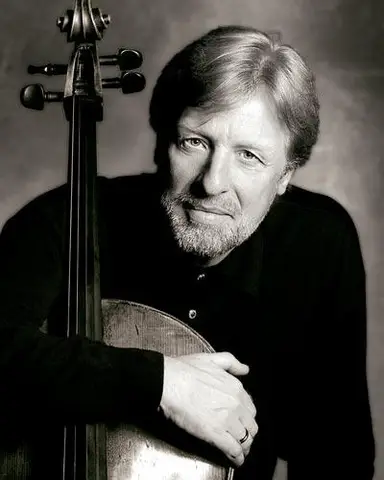
Swedish cellist Frans Helmerson was born in 1945 and began playing the cello at the age of 8. After studies in Goteborg, Rome and London, followed by a debut in Stockholm, his solo career has taken him on countless tours all over Europe as well as the USA, Asia and Russia. He has performed with many of the finest orchestras under the baton of some of today's greatest conductors. An important aspect of Frans Helmerson's musicianship is chamber music, and he is a frequent guest at some of the most important European festivals. He is the artistic director of the Umeea-Korsholrn International Chamber Music Festivals in the north of Sweden and Finland. Frans Helmerson works regularly with Scandinavian orchestras as a conductor. He also holds professorships at the Musikhochschule in Cologne, where he is based, and at the Escuela Superior de Musica Reina Sofia in Madrid. His recordings are available on the BIS label, including a rendering of the Dvorak Concerto hailed by critics as one of the finest recordings of the work. His recording for Chandos of the two Shostakovich Cello Concerti with the Russian State Symphony Capella, Valery Polyansky conducting, has received acclaim from music critics around the world. As a teacher, Helmerson brings that same depth to the student. Working through the cello repertoire phrase by phrase, he shares the bowing, tone production, phrasing and interpretive choices behind a truly singing line - the hard-won insights of a lifetime on the concert stage. read more