



La Clemenza di Tito analysis

Lesson time: (21min 29sec)
Course preview
This lesson is part of the course Singing Mozart: Arias from Figaro, Cosi and The Magic Flute
Watch a preview of the full course below.
Lesson transcript:
Music Lesson: Teaching a Scene from Opera
Instructor: Great Coloratura. Fabulous. Okay, let's start. So just tell us who you are in the opera.
Sesto: I'm Sesto.
Instructor: And what's happening in this scene?
Sesto: I am in dialogue with Vitalia, who believes she has a claim to the throne, which Titus currently has. She wants me to assassinate him, but he's also my best friend. So this whole aria is me in turmoil because I desperately love her. But, you know, obviously, I don't want to kill my best friend. So, yeah, lots of conflict.
Instructor: Not only that you don't want to kill your best friend, but also you don't want to commit murder to begin with. You are Sesto, a good person.
- Vitalia: She's the evil one.
- You: You are a good person.
And we are in opera seria, so it's a completely different style. The spina was "Cosi fan tutte," opera buffa. Now we have opera seria, which is another genre that Mozart was fabulous at writing.
Exploring the Female Characters
Instructor: Let's start. She's a great woman. Yeah, she's an evil person, but she is very powerful, and she has you completely. I mean, she managed to seduce you.
To talk about the female characters of Mozart, he really understood the mind of a woman. So, Vitellia presents all the negative aspects of that. I want to hear in your voice and in the language, again, true, it's not German, it's Italian, but Italian doesn't have as many consonants as German. But those that she has have to be very present.
Working on Musical Expression
Instructor: Okay, so the coloraturas were great. Now let's work on the easy bits.
- Sesto: Great, but I feel like you are singing an exercise.
Instructor: P is very difficult because you're basically telling her you had a discussion, and you're telling her, "Okay, I'm gonna leave." I want to hear, there's so much emotion in this. There has to be so much emotion.
You are a bit... I want to hear. I want to feel the inner struggle. Sure. Super. Very, very musical.
This tone can be better because it was a bit under again because of the B. Okay, so you are again.
Sesto: But you are my love. I'm going to leave. But you, my love, you have to make peace with me again. We have to be.
If I am going to kill him, at least I want to be sure that you love me. Because she doesn't really, and you know it. You know that she's using you. You feel it.
Technical Corrections
Instructor: You know, I have goosebumps. It's so much. You're so musical; it was great. The pace, the "Ah" was a bit held in your throat. It's too bad because it was amazing.
- Tip: Don't release the tongue.
Okay, you can start from there. Super. Super. It's almost there. It's very, very difficult.
Intonation: In Mozart, it's very, very difficult, and it's so much easier to correct than to actually sing it. So it's much easier to be a teacher than to be a singer.
Tempo: You slowed down, which I like this tempo. But is it comfortable for you? If not, just... You can be in character, but it can move, so whatever.
Instruction: Just listen here, okay? Yeah.
Detailed Vocal Exercises
Instructor: Okay, so let's do it again.
-
R: Never from under. Always on the tone. Super. It's really good. Really good. I'm going to be so picky because it's so beautiful.
-
T: This "tea" is a bit horizontal. Try to make it a little bit more vertical.
Okay, she can go to. She's a different voice type, so no problem. She can do the chest; it's beautiful.
Intonation Note: Here again, the intonation was not 100%. Why? Because the double R you put under. So the double R on the high note. Super. Just be careful because you are slowing down.
Tip: You are thinking. You don't have to hold it that long if you don't want. And then... Ma. Great. You're giving me M. Great.
But the M is not on the tone. The M has to be on the... In Mozart, it's very important. When you sing Puccini, it's different, but in Mozart, it has to be like this.
Vocal Cue: It went a little bit back. Okay.
Instruction: It's this tone. Yes. It has to turn back, but you still have to catch it in the front.
Continuous Practice
Instructor: Okay, so not... Okay, so it turns over, and the same thing. And you start again. The "quel." You are not completely there. The support has to be there before you start. And you can have the space open.
- Reminder: Don't close the mouth for the L. Alright. Support. Support. Before. You are singing and you're not supporting.
Suggestion: You can do it better. You have the S before.
Trill Practice
Instructor: What do you think about a trill?
- Sesto: Trill is the easiest thing to do.
Instructor: You have to completely release your throat. And you're holding your tongue. It's exactly the opposite.
Instruction: Do it again. But how is it? The "really, really." It sounds like... like funny.
Try. Yes. Yeah. You feel I'm exaggerating now. You're not going to do it like this. Exaggerate for a second, and then we'll take it.
Note: Don't push this. Don't push this down.
Final Notes and Encouragement
Instructor: Super. And you always have to think about the high note of the trill. Have the high note in your ear.
Feedback: Again, much better. But already the FA is the "varai."
Already here, you get nervous. So just keep this... Don't fall down.
Reminder: And keep this very relaxed.
Okay, let's go on. I'm not going to bother you with this, okay?
Final Thoughts: Why are you saying... why? Don't. No need.
From there, it's here. And this has to be so released. So, release. And this has to work.
Important Note: Careful. The G sometimes is not completely on the tone.
Example: If you sing "War guar," no "guar." The G has to be very fast. Much better, much better.
Encouragement on Coloraturas
Instructor: You can do a few. Even more as the second time. Yeah, but we don't have to stop. Just a suggestion.
- Observation: It's in the... It's in the jaw.
Again, the V was of "Volo," was a bit not clear. He opened the core.
And also, you have dotted rhythm. So all of this part, it's great that you... You're very, very good. You never push, which is great.
Final Request: I want more. More. Yes, but not in the throat. Very relaxed. Not under. No scooping.
Important Reminder: In Mozart, you're a violin. Immediately on the tone. Super. Great.
Concluding Thoughts
Instructor: It's very important. "Gods." It's an important word. You're looking at me because you're thinking, "Oh, master," but this is the best part.
Note: I have nothing to correct in those coloraturas. The only thing I can say, you repeat the word "belta" many times.
Final Insight: Who is the belta? What are you talking about? Vitellia.
So I want to see in this belta everything you feel towards her. How much you love her, how much you are attracted to her, but how much... Sometimes you feel helpless.
Every time you sing "belta," it has to be everything that you feel towards her, and not everything is positive.
Reminder: Okay, there is a lot of pain here. It's not a beautiful aria. It's not about... I mean, it's a beautiful aria, but you're not thinking about only something beautiful.
She is beautiful, but you're telling them, it's your frustration.
Final Note: Oh, gods. How much power you give this beautiful woman.
Motivational Thought: Think of all the men who did stupid things in their lives because of a beautiful woman.
Discussion Point: Which one?
You are so great. You are so great. I'm not gonna let you give up this trill.
Final Challenge: No, don't say that. It's the best. It's the best tool.
So, it's another way of saying, and put it on the word "belta."
Suggestion: If you hate it, then I want to hear how much you hate it. At least do it.
Encouragement: Okay, it's so great. I have nothing to say about the coloraturas. I could not have sung it better.
Final Check: So, and no one else. It's really, really great. So I have absolutely nothing to correct here.
Conclusion: Okay, and this is great. Where do you want to start to get this drill?
Request: Do it like a... like a... Yes. Can I go from the low D, Don?
About the instructor
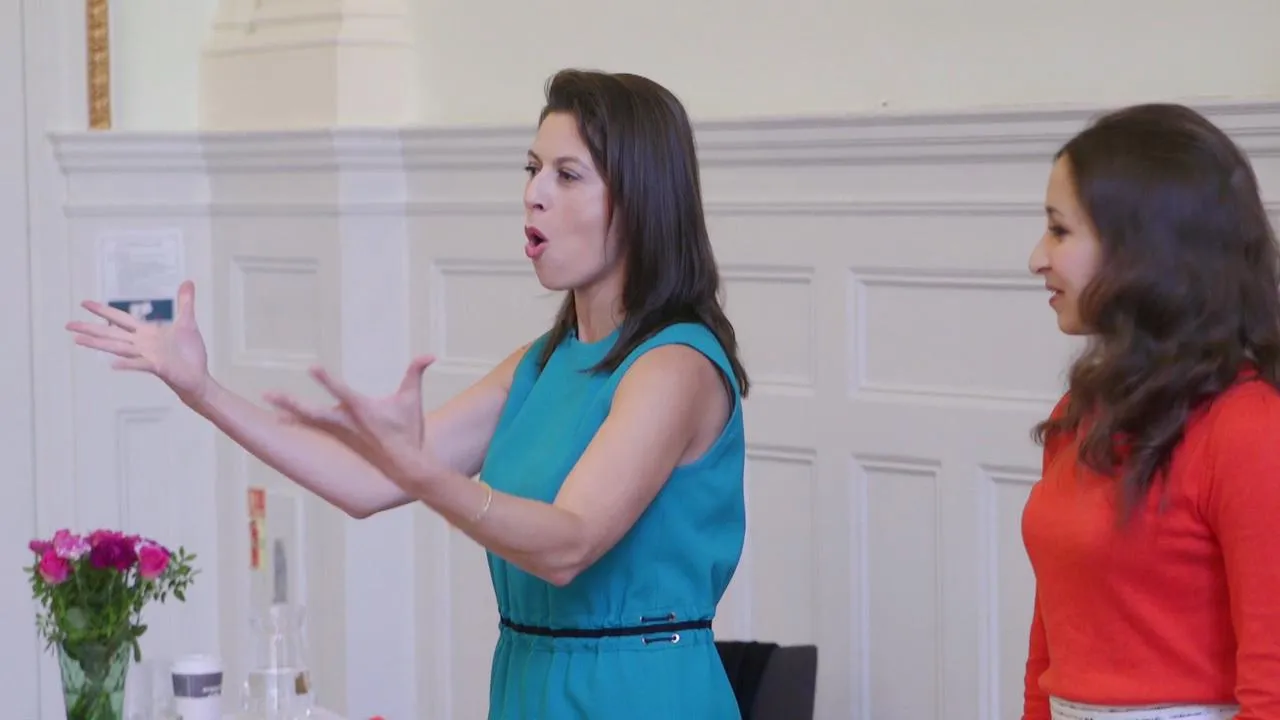
Israeli soprano Chen Reiss has sung leading roles on many of the world's great opera stages, including: Wiener Staatsoper Bayerische Staatsoper Théâtre des Champs-Élysées Teatro alla Scala Semperoper Dresden Deutsche Oper Berlin Hamburgische Staatsoper Wiener Festwochen Maggio Musicale Fiorentino Opera Company of Philadelphia The Israeli Opera Her opera repertoire includes, among others, Pamina, Adina, Gilda, Nannetta, Oscar, Rosina, Servilia, Blonde, Susanna, Zerlina, Despina, Euridice, Marie (La Fille du régiment), Sophie (Der Rosenkavalier) and Adele. On her latest album, "Die Nachtigall und die Rose", she presents a romantic programme together with the renowned pianist Charles Spencer. In concert she has appeared in Salzburg, Lucerne, the Wiener Musikverein, Berlin, Leipzig and Munich. She made her Wiener Staatsoper debut in 2009 as Sophie, and has since sung roles there including Pamina, Elvira, Waldvogel, Adina, Servilia, Ilia, Xenia and Füchslein Schlaukopf. read more