



Greensleeves - Minor keys
With
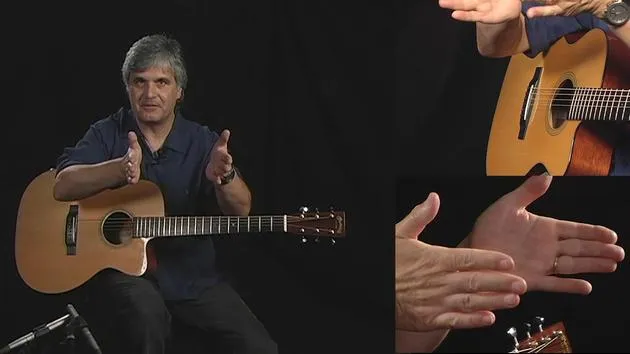
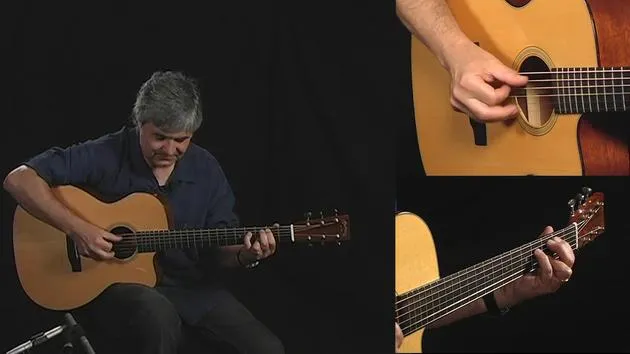
Laurence JuberLaurence Juber uses the traditional 'Greensleeves' to explain how minor keys work, including the natural and harmonic minor.
What's in the course
11 lessons (1h 58m) · 1 free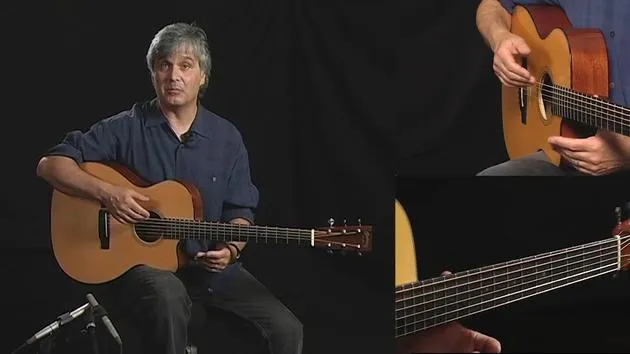
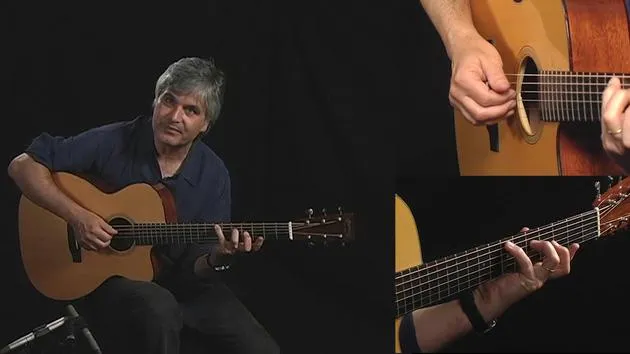
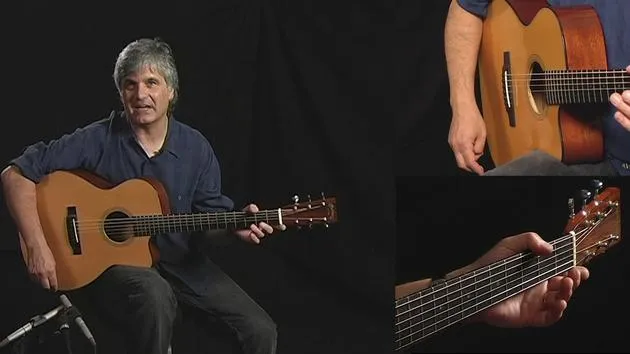
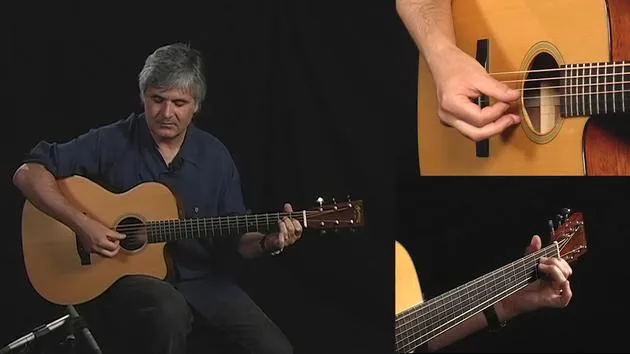
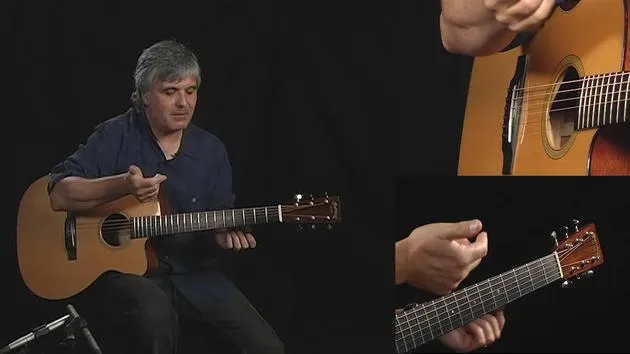
Lesson transcript
Understanding Minor Keys in Music
Little taste of Henry VIII there with the traditional English Green Sleeves. In this segment, we're going to talk about minor keys.
Overview of Minor Keys
We've looked at harmonizing major scales, but we haven't really discussed what happens with the minor. Minors get a little tricky, especially unless we're in A minor.
Playing A Minor
Let me just play the A minor. If we stick to the C key signature (which is no sharps, no flats), everything is natural.
- You actually don't have a scale here; you have a kind of a natural A minor mode, but it's not a scale.
- In an A scale, the seventh will always lead you up to the tonic. It's the leading note.
A Harmonic Minor
However, if we apply this to A minor, we arrive at what is known as the A harmonic minor.
- In the harmonic minor, the sixth degree of the scale (an F) is natural, but the seventh is sharp, giving it an Eastern sound.
- This appears outside the norms of Western classical music, and thus, the committee that formulated these rules decided that as we ascend the scale:
- You make the sixth degree major (F sharp)
- You make the seventh natural when descending (leading towards the tonic).
Melodic Minor
This gives us the melodic minor, which introduces interesting choices when harmonizing the scale.
- For example, my G (the seventh of the A scale) can be either sharp or natural, meaning it can be G sharp or G natural.
- My sixth can be either F sharp or F natural.
Chord Variations
This variability means any chords containing those notes could have either variation:
- D minor chord or D major chord (depending on F).
- E minor chord or E major chord (depending on G).
Example Progressions
So, I could have:
- A minor → D → G → E minor
In a sense, the chords I'm playing with here almost feel like I'm in the key of G since I have G, D, and E minor, but the tone center still revolves around the A.
More Chord Options
I can also incorporate an F natural chord:
- A minor → F → E major
In this case, the E major is the dominant chord in A minor.
- Progressions:
- A minor → E minor → E major
- This gives me the I, V, I sound.
Exploring C Chord
When I go to the C chord, it feels like I've moved to the key of G because I'm introducing another C into the harmony.
- Notice how I create a D sus chord:
- When you have a D chord with an F sharp, playing the fourth instead of the third gives what we call a sus four (suspended fourth).
Melodic Movement
This type of suspension delays resolution to the third. For example, a familiar sound in pop music goes from the fourth to the third, second, and back to the third.
- This showcases how scale tones can work into a chord without changing the fundamental underlying tonality.
Final Thoughts on Greensleeves
Returning to Green Sleeves, I feel like I'm going through:
- 4, 5, 1, 6 in the key of G.
Even though all the notes in those chords are common to our A minor tonality, I can extend the ending for a more medieval sound by shifting from G to F to E, creating a softer relationship.
- This results in:
- A minor → G (common in pop music), but lacking the dominant-tonic relationship of E to A.
Conclusion
So, there's an introduction to how minor keys work. It becomes more complex with jazz harmony, where sometimes the sixth and seventh can coexist as either major or minor within the same chord.
- Later, we'll explore the character of those kinds of chords further.
11 lessons
1h 58m of structured video lessons
Advanced video features
Slow down, loop a passage, follow along
Mobile, tablet & desktop
Practise wherever you are
100% satisfaction guarantee
30-day money-back guarantee
Meet your guru
Meet your guru
Laurence Juber first became known as lead guitarist in Paul McCartney's band Wings. Since then he has built a career as a fingerstyle guitarist, composer and arranger, working largely in the DADGAD tuning that earned him the nickname 'the Duke of DADGAD'.
He has been voted Guitarist of the Year by readers of Fingerstyle Guitar Magazine and named among the top guitarists by Acoustic Guitar magazine, alongside a long list of solo albums and worldwide touring.
In his courses he teaches his fingerstyle technique and the DADGAD tuning he's known for, how to arrange melody, harmony and bass together for solo guitar, and the pieces - like his signature 'Wooden Horses' - that bring it all together.







