



Plus de techniques rythmiques
Avec
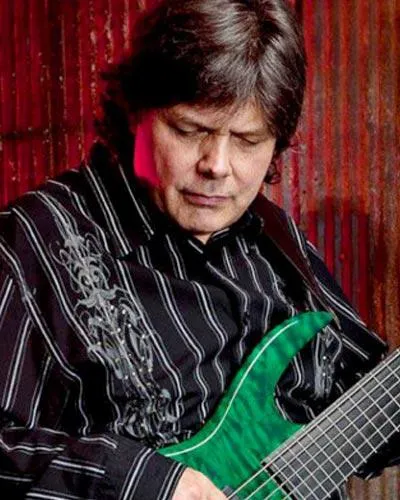
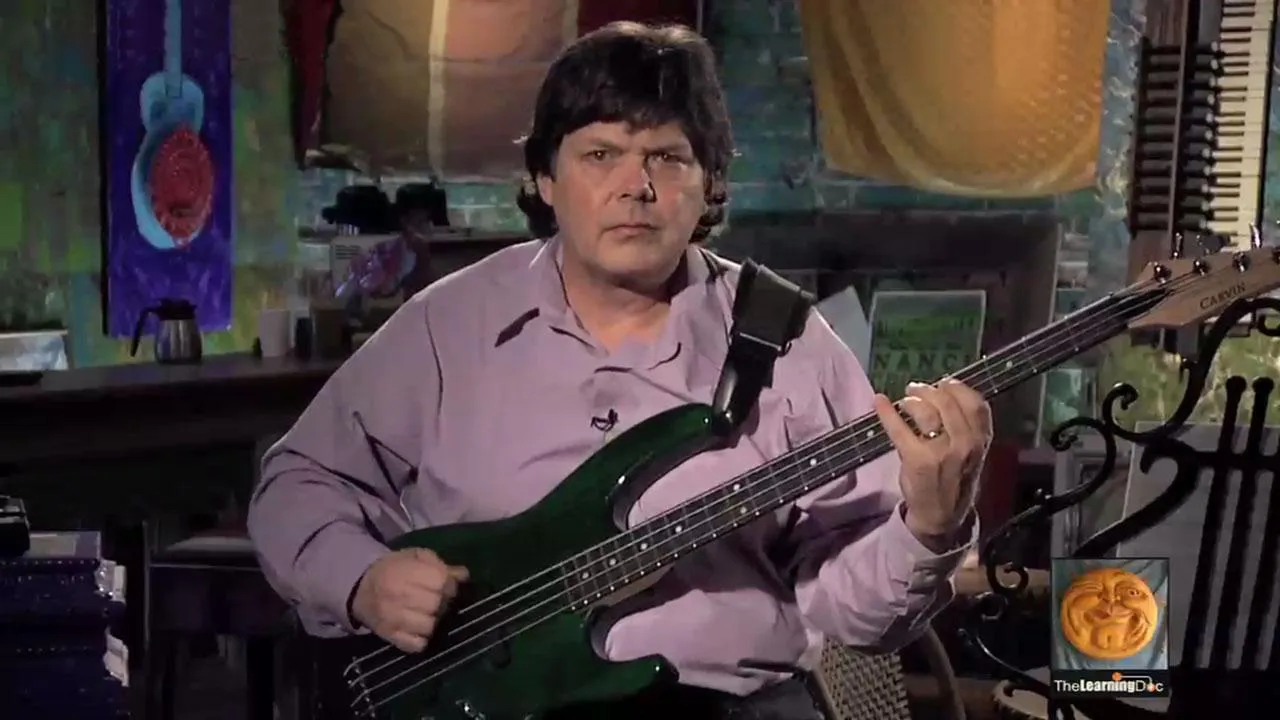
Roy VogtRoy Vogt aborde les syncopes de croches et le système du pied qui bat la mesure pour lire et compter le rythme, avec des astuces mnémotechniques pour ancrer les feels funk et R&B.
Le contenu du cours
5 leçons (3h 21min) · 1 gratuites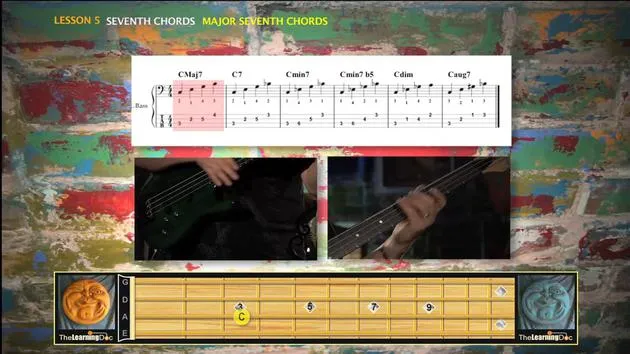
Transcription de la leçon
Now what I can use is three groups of two beats, which allows me to get all the possible combinations of eighths and quarters. I have these little memory devices and shorthand for these particular rhythms.
First Pattern: Quarter and Two Eighths
The first one is going to be a quarter and two eighths.
- 1, 2, 3, 4:
- Down, down, up, down, down, up, down, down, up, down, down, up.
What that is: 1, 2 and 3, 4.
- I think of this one like the old heart song, Barracuda or the Bonanza theme, it's that gallop rhythm.
Second Pattern: Two Eighths and a Quarter
The next one is two eighths and a quarter.
- 1, 2, 3, 4:
- Down, up, down, down, up, down, down, up, down, up, down.
This corresponds to 1 and 2, 3 and 4.
- The rhythmic shorthand I use for that is Jingle Bells. The first few notes of Jingle Bells have that rhythm: down, up, down, down, up, down.
Syncopation
Now, I'm measuring this totally from my foot. I'm not thinking of it in terms of "one anything." I'm just thinking about what my foot is doing.
- If it's a whole number, my foot's down on the ground.
- If it's an upbeat, my foot is up in the air.
I look at this as either a downbeat or an upbeat.
Syncopated Rhythm
This next one is a syncopation that will emphasize the upbeats. Sometimes these are called weak beats. I don't think they're weak; they actually make things sound rhythmically interesting.
This is going to be down, up, up.
- I'll count you in: 1, 2, 3, 4.
- Down, up, up, down, up, up, down, up, up, down, up, up.
If you're familiar with old Motown music, there's a song called My Girl. The bass line goes down, up, up, down, up. That's my little clue for these down, up, up syncopations.
Practice with Notation
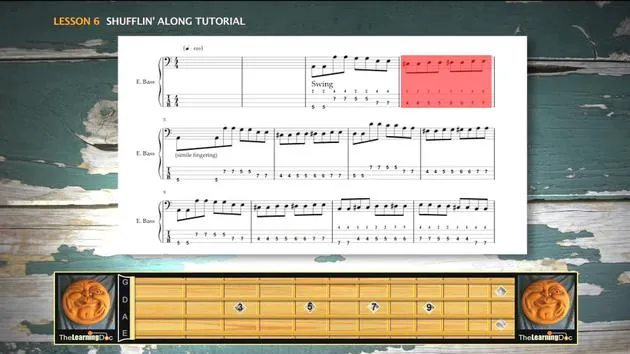
I'm going to play a series of these at quarter equals 60. I want you to follow along in your music and play along with me, just follow along on the notation under the screen.
- I'll count you in: 1, 2, 3, 4.
- Down, up, up, down, up, up, down, up, up, down, up, up, down, up.
- Down, down, up.
- Down, down, up.
- Down, down, down, up.
- Down, down, up.
- Down, down, up.
- Down, down, up.
- Down, up, up, down, down, up.
- Down, up, up, up, down, up, down, up, down, up.
- Down, down, down, up.
There are a lot of those measures, and if you look back at your music, you'll see that there are many measures where the only downbeat is beat one.
For instance, this measure right here: 1, 2, 3, 4.
- Down, up, up, up, up.
If you look at your music, you see that's an eighth note, a quarter, an eighth tied to the next eighth, and another quarter and an eighth. Basically, that's one and.
You hear this a lot in music, like the Memphis soul bass lines of Duck Dunn.
Practicing Syncopation
So, it's a good pattern to get under your belt. You can take the practice loops and work with these rhythmic drills.
I want you to try taking one of these measures and improving it, playing a chord in that rhythm. For instance, if I were doing a dominant seventh chord, that's a lot more interesting than just playing straight quarter notes.
Playing with a Drummer
Okay, that should get you going with the rhythms that we're going to need for this tune.
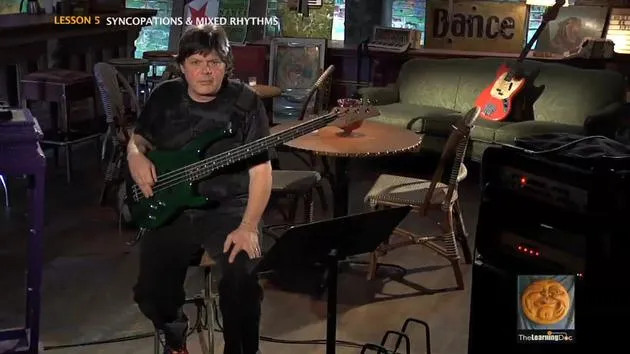
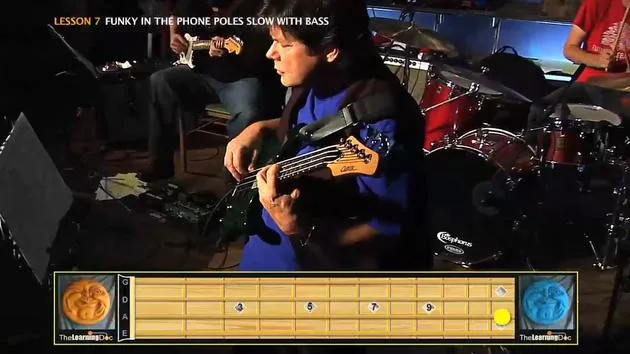
Let's talk a little about playing with a drummer. You're getting the chance to play with a really excellent one over there, Brian Lawrence.
What I'm going to do is play a simple groove on this drum machine. Let's listen to what's going on with parts of the drum set.
- Notice: The lowest drum, the bass drum (kick drum) is playing this rhythm: 1, 3, and 1, 3.
- The snare is on 2 and 4: 1, 2, 3, 4.
- The hi-hat is playing every eighth note: 1 and 2 and 3 and 4.
Locking with the Drums
If I want to really lock with the drums, I'll just double what the bass drum is playing.
- 1, 2, 3, 4.
- This gives me a good foundation.
If I want things to feel a little unsettled, I might answer with something like:
- See, that really sounds unsettled.
- I wouldn't want to do a bass line like that, but maybe for a little break or solo idea.
Now, I can measure what I'm playing against the eighth notes of the hi-hat and lock in with everything: the bass drum, the snare, and the hi-hat.
Playing Together
This is a good way to do eighth note lines. You can mix this stuff up. If you're jamming with a friend and the volume's up a lot, and you can't really hear what the kick drum or bass drum is doing, just position yourself where you can see his foot and try to play with what his foot's doing.
It'll really make a big difference in the way that the band feels.
First Tune: On the Good Foot
Speaking of the foot, let's get to the first tune. This is called On the Good Foot.
This is an old-school James Brown line. We're going to use some of those rhythm rudiments: the My Girl lick, the Jingle Bells lick, and the Gallop to create a rhythm and blues groove.
I'll take this really slow. You need to practice feeling these downbeats and upbeats, so we'll start at 40. I'll play this through once at 40, just follow along with the music. Then we'll try it at 60.
Playing Together
- 1, 2, 3, 4.
Did you notice how many upbeats there were? There were many parts of this line where I was using that Duck Dunn syncopation, where the only downbeat is the first lick: Down, up, up, up, up.
Here's what it would sound like with a click:
- 2, 3, 4. Down, up, up, up, up.
If you look carefully at your music, you'll notice components of the Jingle Bells lick: Down, up, down. The gallop: down, down, up. And then the My Girl syncopation: down, up, up.
Brighter Performance
Those patterns are all throughout this piece.
Let's do this a little brighter, and then we'll take it over to the club and jam with the band.
- 1, 2, 3, 4.
Final Tune: California Pop
Okay, now let's head over to the club and sit in with the band.
Here's a tune inspired by California pop rock that my teacher and mentor, Carol K, played with bands like the Beach Boys and Sonny and Cher, as well as later California rock bands like The Eagles and Poco.
This is going to be a little more melodic with a brighter sound. We're going to use some major seventh chords in it, mixed with major, minor, and dominant seventh chords.
Playing Choices
When I play this down, you're not going to always hear all four notes of a chord. You don't have to do that. You can just play a root, or you can play just a root and a third or a root and a seven. You have lots of choices for what will work.
Let's check this out. This is called the California pop tune.
- 1, 2, 1, 2, 3, 4.
Key Points of Interest
Let's look at a few points of interest in this tune.
- The first part of it, when I play the C major 7 chord, I start on just the root.
- Then I run the seventh chord backwards.
- There's that little Duck Dunn syncopation.
When I go to the E minor, I'm going to play the root and the seven.
- In the second measure: I play the root, the flat three, the root, the seven, and back to the root.
See, I didn't have to play every note out of that chord; I just played the root, the seven, and the three. You don't have to play the fifth, and if you go through the rest of this, you'll see similar things.
When I get to the bridge, I run the whole chord in that A minor section: A, C, E, G, E, C.
Rhythm Focus
What makes it sound like a bass line instead of just running the chord is that I've started playing with the rhythm: 1 and 2 and 4, and 1 and 2 and 4.
I do the same thing on the F major 7: 1 and 2 and, slightly different line because I'm going root, 3, 5, 7, root, 7, 5.
So you don't have to play every note of the chord. If you want to play every note, that's fine too. Rhythmic interest will make it sound less like you're just playing a chord and more like you're making a bass line.
Final Performance
Let's do this one more time a little quicker, then we'll take it to the bandstand.
Remember, if this is a little bit tough for you initially, you can always go to the practice loops and play along with me.
- 1, 2, 3, 4.
Now, let's go back to the club and play again with the guys.
Here's one that's in the style of California soft rock bands like the Eagles.
Let's have fun with this. This is the slower tempo: Imagine yourself driving down that Pacific Coast Highway as we play the California pop song a little quicker.
Cool Down
Alright, nice job, guys. Now it's your turn.
Okay, now for the cool down.
What we'll do is take a major 7 shape, and just play that all over the neck.
You don't have to play where I'm playing. Just put your fingers down. I'm going to turn my bass off.
This is more about just the stretch and just working a shape. I don't want you to copy me, just find a spot on the bass and play:
- 2, 1, 4, 3.
- 2, 1, 4, 3.
Just stretch. Take your time.
Okay, I'll see you at the next session.
5 leçons
3h 21m de leçons vidéo structurées
Fonctions vidéo avancées
Ralentissez, bouclez un passage, suivez la partition
Mobile, tablette et ordinateur
Pratiquez où vous voulez
Satisfaction garantie à 100 %
Garantie remboursement 30 jours
Rencontrez votre guru
Rencontrez votre guru
La carrière de Roy Vogt couvre un éventail extraordinaire de scènes, du Headbanger's Ball de MTV, du Montreux Jazz Festival et du Montreal Jazz Festival jusqu'au London Palladium, au Grand Ole Opry et au Kremlin. Du punk au funk, de la simplicité du country et du blues à la complexité du HyperJazz et du World Beat, il a tout joué.
Roy a été la première personne à obtenir un master en interprétation de basse électrique, à la prestigieuse école de musique de l'University of Miami, et il poursuit l'art de la basse depuis plus de quarante ans. Il a été le mentor de dizaines de professionnels reconnus, dont le légendaire Willie Weeks. Électrique, fretless, contrebasse - tu l'imagines : si ça joue des notes graves et que ça a des cordes, Roy en est un maître, et il excelle à l'enseigner aux autres.
Au cours de sa carrière de quatre décennies, Roy a enregistré ou joué avec une liste stupéfiante de grandes stars, dont Larry Coryell, Victor Wooten, Dave Weckl, Tom Scott et le LA Express, Chester Thompson, Miroslav Vitous, Glen Campbell, BJ Thomas, Chet Atkins, Engelbert Humperdinck, Dickey Betts, Tony Joe White, Charlie Daniels, Jerry Reed, et des dizaines d'autres.
Roy enseigne au niveau universitaire depuis trente ans. Depuis 1983, il occupe la chaire de professeur de basse à la prestigieuse Belmont University (Nashville, TN), l'une des très rares écoles à proposer un cursus diplômant en musique commerciale conçu pour transformer les étudiants en musiciens professionnels travaillant au sommet de l'industrie. Les élèves de Roy ont tourné et enregistré avec des stars de renom telles que Trisha Yearwood, Faith Hill, Little Texas, Michael W. Smith, Lady Antebellum, Chick Corea, Sir Tom Jones, Blood Sweat and Tears, Yanni et d'innombrables autres icônes de la musique.
Sa série Teach Me Bass Guitar t'apporte cette même approche de niveau universitaire, te menant d'un démarrage rapide pour débutant complet (vol. 1), en passant par les fondamentaux du rythme (vol. 2), la recherche de ton propre style (vol. 3) et une musicalité sérieuse (vol. 4), jusqu'à une boîte à outils de joueur pro (vol. 5), afin que tu développes de vraies compétences étape par étape.







