



Analyse, explication et démonstration avec Håkan Hardenberger
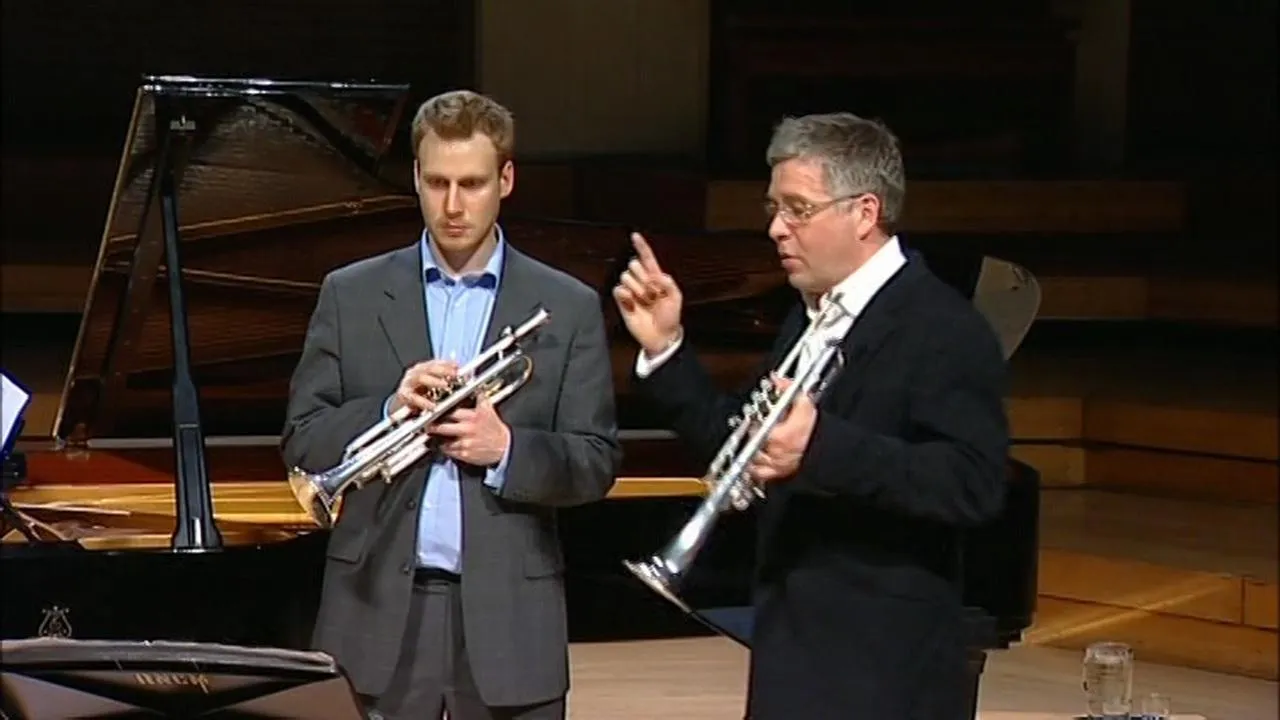
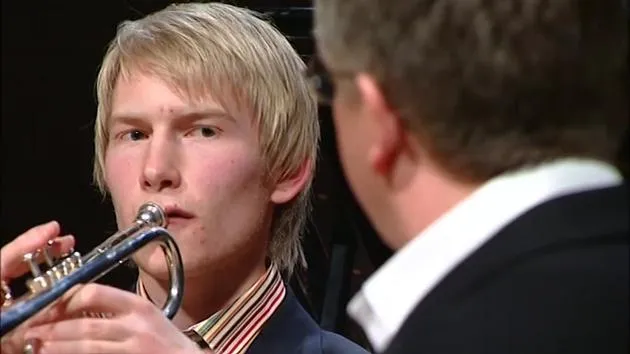
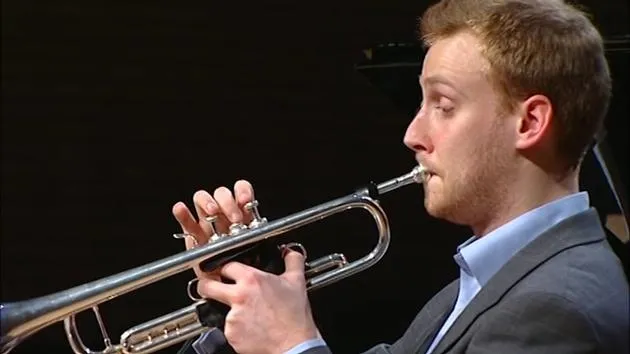
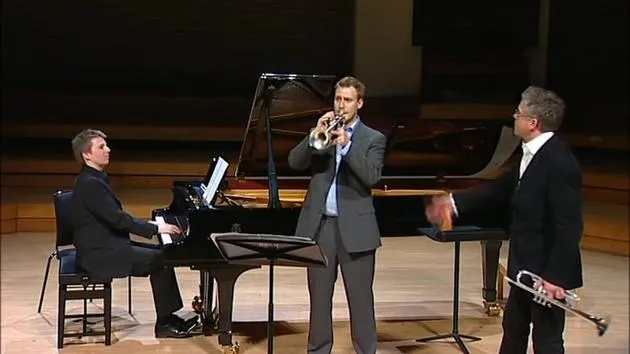
Håkan Hardenberger accompagne un élève à travers la Sonatina pour trompette seule de Henze, couvrant le tempo, la précision et comment dominer la scène dans une pièce sans accompagnement.
Le contenu du cours
6 leçons (2h 13min) · 1 gratuites
Transcription de la leçon
Music Lesson
Introduction
"That's good. I see also that you have the good edition. Yeah, it's great. They made a second one that's full of mistakes, sadly. But this one is good."
Solo Performance Insights
"You know, when you have a solo piece like this, it's a very unusual situation, I'm sure, for you to have a completely unaccompanied one. You should do more of your... you know, once you start playing it more in public, also for your own sake, you know, collect the silence and then explode.
It's very funny, this little first movement, you know, because we want it to be really precise. It's vital to find the right tempo for you, which I think you did very well.
Now, it's easy to sort of go that stumble in that you did very well. But you could do more, you know, when you come on stage and you take your bow and then use the silence, you know, so that... what is going to happen? You have to make them wonder, 'What is this?' That's what I would like you to do. And that comes with experience. But think about what it means to them that you are standing there alone. Yeah. And enjoy that."
The Importance of Silence
"He specifically writes. Again, he writes a silence first. Now, what do you think that means? It's arrest, isn't it? So the piece begins with silence. Yeah, but what does that imply? I don't really know if I played without.
If I ignore this. Okay. Oh, it implies that it's a pop. Pop. Pop it. Yes. And that's also, you've written a three above it.
Oh, I didn't write that. That was already there. Oh, sorry. Okay. But I meant it, you know, it sounded a bit like you played it without the sound. When you played, you played. You know, it sounded like that."
Embodying the Toccata
"Now I would like it to sound. It's a difference, isn't it? Yeah. Because then it leads to the... be natural, like an upbeat and no looking back.
And you know the meaning of 'toccata'? No? You should. I should. Yeah, I know it's one of your responsibilities, learning a piece of music. There's one indication.
Is it dance? No, sorry. Good guess. But it's not. It comes from 'tocare,' which means touch or, you know, hit. Right. Okay.
It's a bit more percussive, the style. And a little bit. You're right with the dancing. I like that image. You could do more of the reason he writes, you know, groups. He writes the little crescendos. Do them."
Technical Aspects of Playing
"Yeah. I haven't practiced this for years. Now, take your tempo. I mean, I'm not going to force you to. What is your tempo? Start with that. I just want to hear that.
Yes. You know, it's too sloppy. And don't forget your trigger because if you don't pull the trigger out, it sounds like something else. You know, that's the problem with so-called modern music. If we disrespect the things that should always be there, people think it's rubbish. But if we play it as any music, which you, you... you were doing a good job with that."
Continuing the Process
"So I shouldn't. Yes, good. Yeah, it's very good if you can get the C sharp. Yeah, good. You see? Then it starts to dance.
Yeah. That's the first one of each group. It's coming. You have to be a little... it's a difficult balance because you have to be very firm and loose at the same time.
It's better. Can you keep the same quality of articulation all the way? It's a bit harder work. And give yourself a good trampoline.
It was going really well. Are you doing that? No. Do the... Yes. Yeah, good. Now, so that becomes the point then that you come from there, you know, and there's... it shouldn't be a smile.
I think you had a very cute smile. But I think for this, it makes a big impact if you do that."
Phrasing and Rhythm
"Yeah. And it is. He writes for... and you know, it should be tough. Okay, so next phrase.
So, one, two, three. One, two, three, four, five. One, two, three, four, five. Yeah. Beam bomb. Play with the rhythms more. We're getting there.
Sounding good. It comes too early. Now when you do the slurs, it's a little bit out of rhythm and crescendo. But nice notes.
It's hard to do like this, splitting it all up. I know. Now again you do the G sharp on one. Okay. Because if you have the crossed instrument in this, it's not good.
Yeah. So you need... are you doing it all double? I was singling it then, but I'm... yeah. Then do it also slow double."
Practicing with Precision
"And then give the top one bit more. More accent on that one. And then. Are you playing the right notes? It's very important when you do the slow practice that you don't let any fish through the net. Not even the small ones.
Right? Yeah, yeah. Good. So even in the slow practice, you have the same. You know, you get used to where the impulse comes a little faster.
Yeah, it's just strange doing it like that. But it's a lot easier. Yeah, it is. Yeah. You know, you're not doing that one at all. Anyway, the end."
Concluding Thoughts
"Yeah. So don't play that too like you did before. You played it very freely. Yeah, I think it's much more effective.
It comes. If you like, you can do just the C and the B flat. That's what I should have done if I was clever. And then don't do what you just did.
Now, that's again, that's like the beginning, you know? And then you take your mute or whatever you do slowly. Move slowly. The piece is still. The ideal is, of course, if you have the mute very close by, so you keep the tension, you know."
Rhythm and Blues
"Now, this movement, also be a little bit more strict about rhythm first. And it will work better. It's like a mixture of the blues and the wooden trumpet.
In Tristan, you cut one beat, you know. Sorry. Be natural.
Yeah, yeah. Keep the beat moving. There's no hurry, you know? And the wobbliness should have a meaning.
Yeah. You know, not sa. Don't hurry, sa. It's completely normal music. Sing the dynamics. Now here, it's like it doesn't know where it's going.
So that you create something for the ending. Now you're starting to build up for that. If you're going to play pianissimo here, you can't play pianissimo there. They're not so fast, you know?
And you can sh. Take time there. Yeah, very good. Now, physical things like this, it's so much easier if you know exactly what you're doing.
Yeah. It's like karate, you know, there's no doubt. Boom. Yeah."
Final Adjustments
"Now, I don't like your choice of mute, by the way. Okay. I think it's much nicer with a Harmon without stem or something like that for this one.
No, for the previous one, and for this one, you need something that sounds more metallic. Yeah. Fortissimo. You know, it's a...
How are you tonguing that? Those. No, these double. I'm going. Yeah, that's good. You can do. You can prepare it a little bit more. You can do.
Now you have to nail the low one. Just confusing me now. Yeah, do it slowly once. No, it's your F sharp.
F sharp, yes. So that you can really do it. Fortissimo. You know, your mind has to be very, very simple. Thomas Stevens always said, 'To be a trumpet player, you should not be intelligent.'
Yeah. Practice it like that. More. Yeah, much more measured you were doing. Now it's a simple march. Yes. No, and then.
That's too early. I'm your metronome. But you, you're not starting with my beat. You're starting anywhere. One, two. That's it. N. No.
Pa, pa, pa, pa. You see, that's the danger with unaccompanied modern music. We think we can do what we want. They're not going to hear it anyway.
Surprise, surprise. You know, if they feel uncomfortable because you are not, you know, then that's what we get then.
Yeah, we don't like modern music. Make them like it. Sing it. Sing it. Sing it. That's it."
Closing Remarks
"One too many. 1, 2, 3, 4, 5. Do you know how many you're playing? Almost. So that's like the first movement, yeah?
Yeah. Yes. Good. Yeah. So the work is very good, but you, to take the next step, you know, really look what is there. Because as the karate, when you know exactly how to time it, that's when you'll be able to play it. Really impressive.
Yeah. Yeah, I know. You will do it. I will, yeah. Good. Cheers. Thanks very much. Thank you."
6 leçons
2h 13m de leçons vidéo structurées
Fonctions vidéo avancées
Ralentissez, bouclez un passage, suivez la partition
Mobile, tablette et ordinateur
Pratiquez où vous voulez
Satisfaction garantie à 100 %
Garantie remboursement 30 jours
Rencontrez votre guru
Rencontrez votre guru
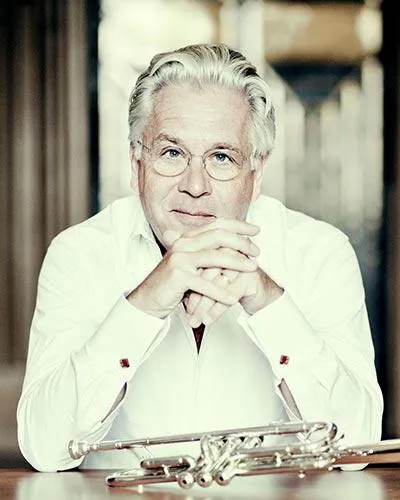
Håkan Hardenberger est né à Malmö, en Suède. Il a commencé à étudier la trompette à l'âge de huit ans avec Bo Nilsson à Malmö et a poursuivi ses études au Conservatoire de Paris, avec Pierre Thibaud, ainsi qu'à Los Angeles avec Thomas Stevens.
Il est considéré comme le plus grand soliste de trompette d'aujourd'hui. Outre ses interprétations du répertoire classique, il est le pionnier le plus reconnu des œuvres nouvelles pour trompette. Beaucoup d'entre elles, écrites pour Hardenberger et défendues par lui, comptent aujourd'hui parmi les jalons majeurs du répertoire, notamment des œuvres de Sir Harrison Birtwistle, HK Gruber, Hans Werner Henze, Rolf Martinsson, Olga Neuwirth, Arvo Pärt et Mark-Anthony Turnage.
Parmi les œuvres nouvellement commandées de la saison 2007/08 figuraient un concerto de Luca Francesconi avec l'Accademia Nazionale di Santa Cecilia dirigée par Antonio Pappano (coproduction avec la VARA/Netherlands Radio Philharmonic et la Gothenburg Symphony), un concerto de Kurt Schwertsik créé et commandé par la Tonkünstler Orchestra et Kristjan Järvi au Musikverein de Vienne, et une nouvelle œuvre de HK Gruber pour trompette, banjo et orchestre de chambre (commandée conjointement par l'Amsterdam Sinfonietta et la Swedish Chamber Orchestra).
Håkan Hardenberger se produit avec les plus grands orchestres du monde, dont le Los Angeles Philharmonic, le Chicago Symphony, le Vienna Philharmonic, le London Philharmonic, le London Symphony Orchestra, l'Orchester des Bayerischen Rundfunks, l'Orchestre National de France et le NHK Symphony Orchestra. Parmi les chefs avec lesquels il collabore figurent Pierre Boulez, Thomas Dausgaard, Alan Gilbert, Daniel Harding, Neeme Järvi, Ingo Metzmacher, Esa-Pekka Salonen, John Storgårds et David Zinman.
En récital, Hardenberger entretient plusieurs partenariats essentiels : avec les pianistes Aleksandar Madžar et Roland Pöntinen ; une collaboration unique avec le poète suédois Jacques Werup et le pianiste de jazz Jan Lundgren ; et avec le percussionniste Colin Currie. Hardenberger et Currie peuvent être entendus sur un CD paru en 2007, et il s'est produit aux côtés de Currie pour la première fois aux États-Unis (San Francisco), où il revient également jouer avec le Cincinnati Symphony et Paavo Järvi.
De la vaste discographie de Hardenberger chez les labels Philips, EMI et BIS Records, deux disques supplémentaires sont parus en 2006 : des œuvres solo pour BIS, et un disque d'œuvres de Turnage, Gruber et Eötvös avec la Gothenburg Symphony Orchestra et Peter Eötvös pour Deutsche Grammophon, qui a justement reçu de grands éloges.
Dans sa masterclass de trompette, Hardenberger partage l'art qui sous-tend cette réputation, travaillant Bohuslav Martinů, Hans Werner Henze et Georges Enescu pour te montrer comment il façonne la sonorité, le phrasé, la respiration et l'interprétation, afin que tu puisses apporter la même pensée musicale à ton propre jeu.







