



L’horloge des tonalités + doigté de la gamme majeure

Avec
Tim Richards
Le contenu du cours
24 leçons (1h 30min) · 1 gratuites
01. Arpèges et renversements de septième de dominante
2:49
02. DOWN THE LINE Interprétation
1:46
03. Conseils d'improvisation
3:59
04. La séquence de blues à 12 mesures, les tritons et les shells
5:49
05. Gammes mixolydienne, par tons entiers et chromatique
5:51
06. Interprétation de STRAIGHT NO CHASER
1:34
07. La gamme pentatonique à tierce bémol
3:25
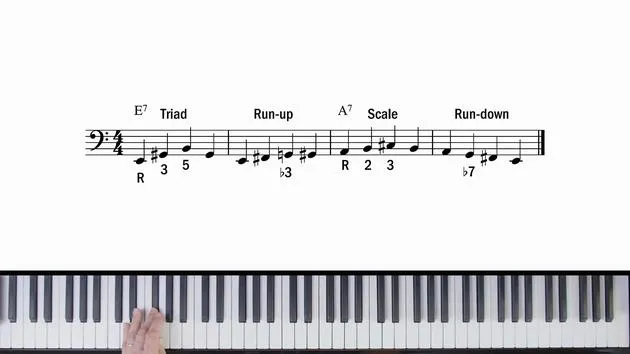
08. Apprendre les septièmes de dominante dans toutes les tonalités
5:37
09. DOMINANT SEVENTH WORKOUT #1 Interprétation
1:48
10. Motifs d'accords brisés
5:22
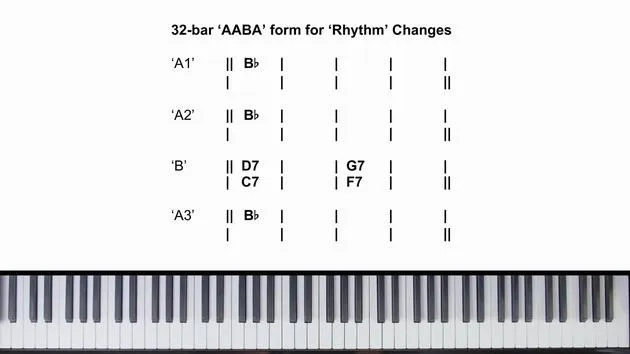
11. Rhythm changes et le cycle des septièmes de dominante
3:50
12. THE THEME Interprétation
2:22
13. Improviser sur l'accord de tonique
5:42
Transcription de la leçon
Major Scales and Fingering
All right! By now, you should be getting familiar with most of your major scales. In this lesson, we're going to check the fingering and the way they all relate to each other around the key clock.
Understanding the Key Clock
- The key clock organizes the sharp keys clockwise:
- Starting with C at 12 o'clock
- Moving up a fifth gives you the first sharp key: G major (1 sharp)
- Continuing up in fifths leads to D (2 sharps)
Every time you go up a fifth, you're adding a sharp to the key signature. This method is how most people learn their scales during piano lessons. They primarily learn these scales first in this order because all of these scales utilize C major fingering:
- 2
- 3
- Thumb underneath
This fingering holds for the following keys: C, G, D, A, and E. In fact, for the right hand, it also works for B. If you're not 100% confident with those fingerings, now is a chance to review them.
You can see the chart I've provided, which includes all the fingerings for both the left hand and the right hand for all the sharp keys. There's also another chart for all the flat keys.
Fingering for Flat Keys
People typically don't learn the flat keys first because each flat key has its own unique fingerings.
- Going anticlockwise around the key clock:
- From C (no flats) up a fourth gives you F (1 flat).
- Up another fourth takes us to B flat (2 flats).
Each time you go up a fourth, you're adding a flat.
Important Fingering Notes
You can't use 1, 2, 3, 1 for the F major scale; it doesn't work with the C major fingering. You must use 1, 2, 3, 4.
If you've had classical piano lessons, this won't be news to you, but it's beneficial to revise these fingerings again. You've got a chart there for all the fingerings in the flat keys as well.
Tips for Scale-Based Improvisation
Now, I'm going to wrap up by giving you a few tips for your scale-based improvisation applicable to Major Seventh workouts and other pieces:
-
Avoid Starting on the Root:
- Don't develop the habit of always starting phrases on the root note. Be versatile! Start phrases on any note of the scale.
-
Variety in Beat Timing:
- Don't always begin on the first beat. Experiment with starting phrases on one, two, and three to introduce variety.
-
Lock in with Rhythm:
- Sync with the rhythm of the backing and tap your foot as you play. The rhythmic aspect is often more crucial than the notes themselves.
- Remember: "If it ain't got that swing, it don't mean a thing."
-
Mix Up Note Values:
- Vary your note values. You don't have to stick to the same values all the time; incorporate quarter notes, eighth notes, triplets, and longer notes. Include rests, gaps are equally important as the notes you play. Sometimes, less is more.
-
Use Motifs:
- Create lines and use motifs. There's no harm in repeating an idea, especially if you do so in a different key or over a different chord. This is a strong method for developing your solo and telling a story.
-
Explore Scale Patterns:
- Don't forget to explore scale patterns; avoid sounding like you're merely practicing scales.
-
Target Note:
- Finally, consider the last note of your phrase (the target note). This should be a note that sounds good with the chord you're playing.
Example: If you're playing over G major and end your phrase on a C, it may sound like you don't know what you're doing. Instead, start on F sharp to make that target note compatible with the chord.
By reviewing these points, you will enhance your scale practice and improvisation skills!
24 leçons
1h 30m de leçons vidéo structurées
Fonctions vidéo avancées
Ralentissez, bouclez un passage, suivez la partition
Mobile, tablette et ordinateur
Pratiquez où vous voulez
Satisfaction garantie à 100 %
Garantie remboursement 30 jours
Rencontrez votre guru
Rencontrez votre guru
Salué par la critique, le pianiste et compositeur de jazz Tim Richards est l'un des pédagogues de jazz les plus expérimentés de Grande-Bretagne, enseignant le piano en privé depuis plus de 30 ans, ainsi qu'au Morley College, au Goldsmiths College, à l'University of Surrey, aux Premises Studios et dans d'autres lieux au Royaume-Uni et à l'étranger. Il a produit de nombreux titres pour Schott Music, dont les best-sellers en deux volumes Exploring Jazz Piano, Blues, Boogie & Gospel Collection et le très apprécié Improvising Blues Piano. Il est également coauteur, avec John Crawford, de Exploring Latin Piano et Brazilian Piano Collection.
Plus récemment, Schott a publié Jazz, Latin & Modern Collection (15 pièces pour piano seul), réunissant des originaux de Tim Richards aux côtés de pièces de Duke Ellington et Thelonious Monk, ainsi que le coffret en deux volumes Beginning Jazz Piano (désormais un cours MusicGurus en deux parties).
“La véritable joie de la musique de Tim… c'est qu'elle est à la fois extrêmement pédagogique et tellement amusante à jouer. Quiconque a le moindre intérêt pour apprendre à jouer ou à enseigner le piano jazz devrait vraiment se procurer un ensemble des ouvrages de Tim.” PianoDao
En tant qu'interprète, Tim est une figure de la scène jazz britannique depuis les années 1980, jouant aussi le blues avec des légendes britanniques et américaines telles qu'Otis Grand, Earl Green, Dana Gillespie, Larry Garner, Joe Louis Walker et Mojo Buford. Il a sorti plus d'une douzaine d'albums en tant que leader (avec bon nombre des meilleurs musiciens de jazz de Londres, dont Pete King, Gilad Atzmon, Tony Kofi, Jason Yarde, Seb Rochford, Ed Jones, Dick Pearce et beaucoup d'autres) et a tourné dans toute l'Europe avec des formations allant du duo au nonette. Son dernier enregistrement, l'album ‘Telegraph Hill’ du sextet Hextet, a été décrit dans The Observer comme "Un pur bonheur du début à la fin".
Plus d'informations sur son site web www.timrichards.ndo.co.uk







