



Red Baron – Billy Cobham (Análisis)
Pete Riley desglosa el clásico de fusión de Billy Cobham 'Red Baron': la improvisación, el groove principal y el solo de batería de 16 compases en la letra G.

Qué incluye el curso
29 lecciones (3h 3m) · 1 gratis
01. All Of You – Cole Porter
3:13
02. Last Time – Moderat
2:50
03. Red Baron – Billy Cobham
5:11
04. Some Skunk Funk – Brecker Brothers
2:49
05. Hit Me – Dirty Loops
2:55
06. Bonfire – Knife Party
2:47
07. Meet Darth Ear
3:02
08. Mind the Gaps
3:47
09. Lead Sheet
3:09
10. Freightshaker
Lección gratis3:14
11. Nosso Samba
3:15
12. Dark Matter
3:11
01. Last Time – Moderat (análisis)
10:31
02. All Of You – Cole Porter (Análisis)
14:36
03. Bonfire – Knife Party (Análisis)
14:02
04. Some Skunk Funk – Brecker Brothers (Análisis)
12:09
05. Hit Me – Dirty Loops (Análisis)
14:23
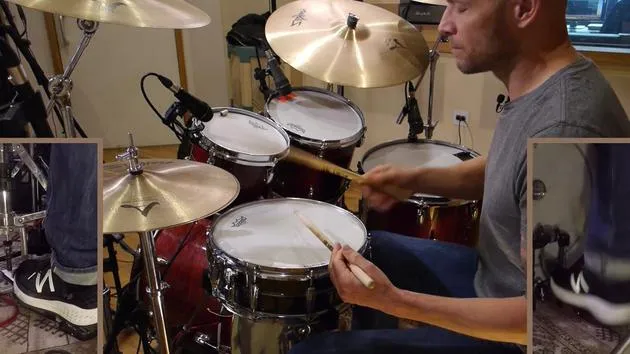
06. Red Baron – Billy Cobham (Análisis)
Estás aquí12:19
07. Meet Darth Ear (Análisis)
10:56
08. Mind the Gaps (Análisis)
5:22
09. Lead Sheet (Análisis)
9:09
10. Freightshaker (Análisis)
8:14
11. Nosso Samba (Análisis)
8:31
12. Dark Matter (Análisis)
5:55
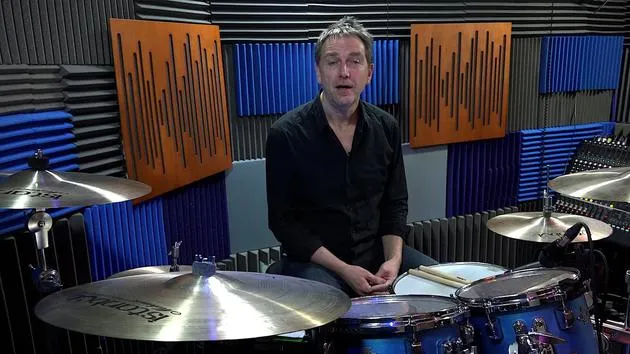

Transcripción de la lección
Music Lesson: Exploring Billy Cobham's "Red Baron"
Hi everyone! Here we're looking at Billy Cobham's fusion classic, Red Baron.
Improvisation is Key
- This piece features a lot of improvisation.
- Within your chart, you'll see specific parts notated, but the vast majority will involve improvising around those themes.
The Drum Solo
- A main feature of the piece is the drum solo that we reach at letter G, which is going to be 16 bars long.
- We will play an improvised solo over the vamp played by the band.
- More on that later!
Main Groove and Feel
Let's take a look at the main groove and feel of the piece.
It's interesting to note that:
- If you listen to the original version, Billy plays it with a straighter feel.
- The 16th notes are played more like this, whereas in this take, it adopts a much more swing feel.
During many parts of the track, it takes on a half-time shuffle quality:
- Essentially, we're swinging all of the 16th notes notated as straight 16ths.
Example from Letter A
Let me play the first two bars of letter A from the two-beat pickup that leads us into it:
- Notice how we move between the 8th note and the 16th notes.
- Occasionally, there are broken 16th notes, and sometimes there are continuous 16th notes.
Here's how it sounds:
"First two bars of letter A."
You'll notice the 16th note movement in the second bar:
- Playing "two E and" and "four E and" on the hi-hat.
As we reach the third and fourth bars of letter A, we start to adopt this almost half-time shuffle quality.
- In that fourth bar, there's a 16th note triplet movement as well.
If I play that feel around a little bit, you'll see that we include a ghost note added before the backbeat on beat two.
Letter B
Moving on to letter B, we encounter one of the most interesting features of the piece:
- A 16th note triplet movement played between the bass drum, snare, and hi-hat, along with the rest of the band.
Let's look at Bar 9 (the fourth measure of letter B):
- This pattern is essentially a paradiddle played in reverse (double stroke first):
"Right, right, left, right, left, left, right, left."
Next:
- We add the bass drum with all of the right-hand notes and accentuate the left hand after the first two bass drum notes.
The Main Challenge
- The primary challenge is to play it through a 16th note triplet subdivision.
- I'll move between measures 8 and 9 so you can hear how that pattern falls relative to the main groove.
Structure of the B Section
- The B section is nine bars long.
- An important feature is what happens during the last four bars, played in unison with the band, with some improvised fills around the kit.
I will now play from the last four bars of letter B (from Bar 11).
Guitar Solo at Letter D
Next, we reach letter D where we've got the guitar solo:
- There's a basic pattern notated:
- 1 and 3 on the kick, 2 and 4 on the snare, with ghost notes after the first eight bars.
Transitioning over to filling in the 16th notes gives us that almost half-time shuffle feel:
- On the third repeat, the bass drum moves to quarter notes, and on the fourth time around, it heads over to the right cymbal.
After the 32-bar guitar solo, we get:
- A 16-bar keyboard solo, followed by an 8-bar bass solo.
The Drum Solo
Then we reach the important bit:
- The drum solo, where we play for 16 bars over the same vamp.
When you have a vamp like this, a good starting point for creating a solo is to begin by phrasing those figures on the kit.
Suggestion for Practicing:
- Start by placing that rhythm (beat one and the end of beat two) within the groove, maybe crashing it at first, and then see if you can fill between those crashes.
Let's build from just the crashes, playing the basic vamp, and then develop more elaborate ideas while keeping that theme in mind.
Letter H and Conclusion
After the drum solo, we reach letter H, which essentially mirrors letter B and is nine bars long once again.
- The important part that differs is the last four bars, with a similar theme, but with different ideas played on the kit.
I'll play that slowly and then break down a couple of the figures you can hear.
Key Notated Parts of "Red Baron"
One of the figures that appears several times during those last few bars is the hand-foot movement:
- Played between the right hand and bass drum, first between the snare and bass drum, then down the toms, all within a 16th note triplet rate.
In conclusion: As you can see, a good percentage of Red Baron is about improvisation.
I encourage you to:
- Familiarize yourself with the written parts, but also have fun exploring your own ideas, especially during the drum solo!
- Play with accents and try some ideas that cross over bar lines.
This is a great track to play along with, and I'm sure you're going to have a lot of fun doing exactly that!
29 lecciones
3h 3m de lecciones en vídeo estructuradas
Funciones de vídeo avanzadas
Ralentiza, repite un pasaje, sigue la partitura
Móvil, tablet y ordenador
Practica donde quieras
Garantía de satisfacción 100%
30 días de garantía de devolución







