



La mano izquierda de la sección 'A'

Con
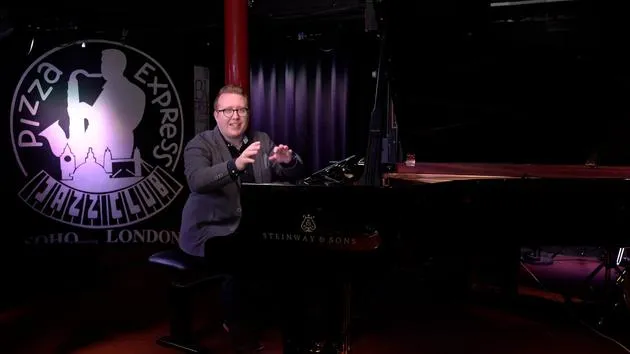
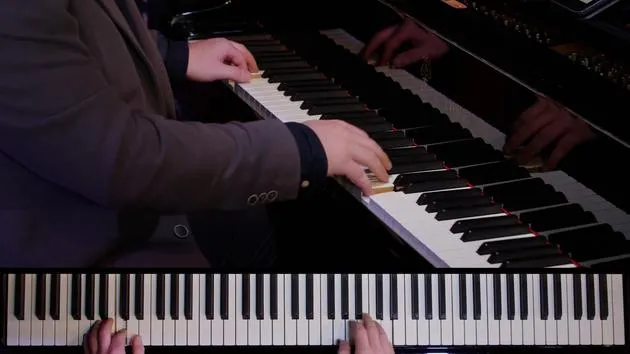
Tom SealsTom Seals construye la parte de la mano izquierda para la sección A, convirtiendo una posición de G6 en un walking bass que asciende hasta el acorde de D.

Qué incluye el curso
23 lecciones (1h 39m) · 1 gratis
01. Introducción a Jumpin' At The Woodside
1:19
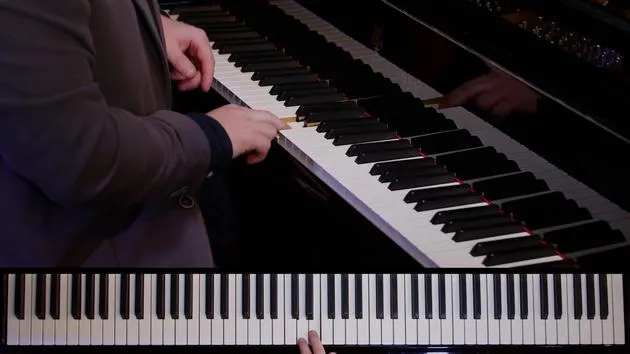
02. La melodía de la mano derecha de la sección 'A'
Lección gratis1:19
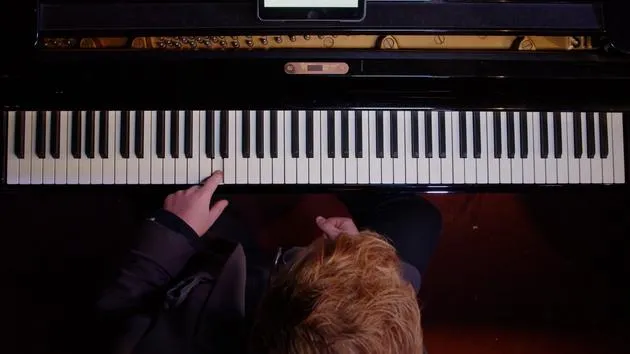
03. La mano izquierda de la sección 'A'
Estás aquí8:09
04. Practica la sección 'A' con Tom
3:31
05. La sección 'B' en la mano derecha
6:48
06. La sección 'B' de Jumpin' At The Woodside en la mano izquierda
1:23

07. ¡Practica la sección 'B' con Tom!
3:17
08. Practica Jumpin' At The Woodside con Tom
4:16
09. Comping con la mano derecha
6:17

10. Ideas para el adorno
7:05
11. Interpretación de Jumpin' At The Woodside
2:08
01. La melodía de la mano derecha de la sección 'A'
5:13
02. La mano izquierda de la sección 'A'
5:31

03. Añadir las 'horn lines'
9:22

04. La sección 'B' en la mano derecha
4:56
05. La sección 'B' en la mano izquierda
9:17

06. Practica Don't Get Around Much Anymore con Tom
6:18
07. Consejos para improvisar
1:38
08. Ideas para solos
5:47

09. Don’t Get Around Much Anymore: interpretación
3:11



Transcripción de la lección
Left Hand Walking Bass Pattern
Okay, so the right hand is done. As simple as that. Now let's look at the left hand.
First Four Bars
For the first 1, 2, 3, 4 bars, it's just a G.
Starting setup:
- Little finger on the G
- Third finger, middle finger on the B
- Second finger on the D
- Thumb on the E
Together, we have G, B, D, and E, which forms a G6 chord. While we won't play it as a chord, these notes create the chord:
Notes breakdown:
- G
- E
- D
- E
This arpeggiated pattern leads us into a walking bass.
Chord Progression
We will start with the first chord being G, played four times:
- G (4x)
- A minor 7 chord
Instead of playing the chord this time, we will walk up to the D chord, as shown on the chart.
Walking up:
- A
- B
- C
- C sharp
- D
So, altogether, that makes:
Notes Sequence:
- Four bars of G
- A, B, C sharp, D
Finger Placement:
- Third finger on the A
- Second finger on the B
- Thumb on the C
- Second finger moving to C sharp
- Thumb lands back on D
So we pivot on the thumb, and then this finger exercise will help in moving down the piano.
Transition to D
We will go back to D after reaching G:
- Start at D
- Move thumb to G
Progression note movement:
- Thumb (D)
- Third finger (E)
- F
- F sharp
- G
Notes sequence (slowly):
- A
- B
- C sharp
- D
- E
- F sharp
- G
Now, let's speed this up:
Speed sequence:
From A to D, down to G.
Moving Forward
From the top:
- Four bars of G
- To A minor (up to the D)
- Down to G
This takes us to bars 1, 2, 3, 4, 5, and we start bar seven.
Last Two Bars of the First Section
The last two bars go like this:
- G
- E minor
- A minor
- D
1-6-2-5 Progression
This chord progression is known as 1-6-2-5, and while it sounds complicated, it's simply a counting exercise.
- G is the 1 (root note).
- Count 1-6: E (6 becomes E minor 7).
- 2: A (A minor).
- 5: D.
Hence, the progression:
- 1 = G
- 6 = E
- 2 = A
- 5 = D
Practice Sequence:
Sequence:
- G, E, A, D
- G, E, A, down to D
- G, E, A, D
Now, let's add passing notes in between.
Passing Notes:
- From G to E, add F sharp.
- From A, we could use G sharp down to D.
Revised Sequence:
- G, F sharp, E, A flat (or G sharp) down to E flat to D.
In simple form:
- G, E, A, D
- And again G, E, A, D.
With passing notes:
- G, F sharp, E, A flat, A, E flat, D.
Putting It All Together
This may seem complicated, but it flows smoothly once we integrate the right hand.
Loop Example:
- G, F sharp, E, A flat, A, E flat, D, back to G.
Finger Placement for the Left Hand of the Entire A Section:
- Thumb, second finger, third finger, second finger, thumb, third finger, fourth finger, second finger, thumb.
I will now play it all the way through, showcasing both versions: one with the simplified 1-6-2-5 progression and one with the additional passing notes.
First Version:
- Four bars of G, A minor to D, down to G.
Now with Passing Notes:
- Start with 4 bars of G.
23 lecciones
1h 39m de lecciones en vídeo estructuradas
Funciones de vídeo avanzadas
Ralentiza, repite un pasaje, sigue la partitura
Móvil, tablet y ordenador
Practica donde quieras
Garantía de satisfacción 100%
30 días de garantía de devolución
Conoce a tu gurú
Conoce a tu gurú
El título de Piano Man del Reino Unido lo han ostentado durante mucho tiempo Elton John, Jools Holland y Jamie Cullum. En las últimas cinco décadas nadie más se ha acercado ni remotamente... ¡hasta ahora!
Recién salido de su gira con las entradas agotadas "Let The Good Times Roll", Tom Seals -"posiblemente el futuro del jazz y el blues"- tiene el mundo en la punta de los dedos. Su virtuosismo como solista, sus excelentes dotes para la improvisación y su voz personal han llevado a destacadas figuras del sector a aclamarlo como el mejor pianista y vocalista de boogie woogie y blues del Reino Unido.
Con apenas veinticinco años, Seals ya ha ofrecido conciertos con las entradas agotadas por todo el mundo, incluido el legendario Ronnie Scott's de Londres, una actuación deslumbrante en el Birdland Jazz Club de Broadway, en Nueva York, y trabajos junto a Jools Holland.
Apariciones destacadas:
- 'Gregory Porter & Friends' del Cheltenham Jazz Festival
- 'Boogie Woogie & Blues Spectacular' de Jools Holland
- Birdland Jazz Club, Nueva York
- British Summer Time - Hyde Park
- Ronnie Scott's Jazz Club
- Gisburne Park Pop-Up
- Montreux Jazz Festival
- Cropredy Festival
- The Steinway Two Pianos Festival
- Glastonbury
- Newark Showground "Drive-In"
- Blenheim Palace
En su curso, Tom desvela los secretos que hay detrás de su forma de tocar -mostrándote cómo dar swing a los estándares al piano, construir líneas auténticas de boogie woogie y blues, y encontrar la libertad para improvisar- para que tú también puedas convertirte en el Piano Man definitivo.
Puedes leer la biografía completa de Tom en www.tomseals.co.uk.







