



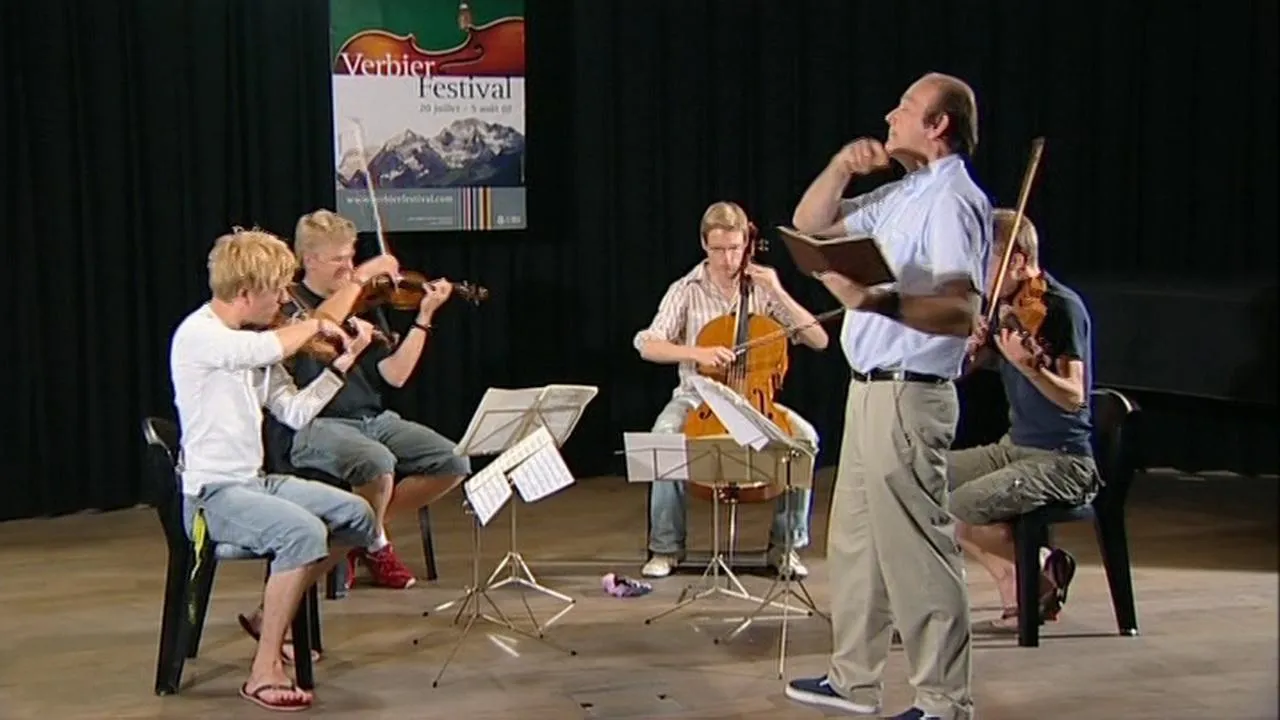
Análisis del Cuarteto de cuerda n.º 5 con Gábor Takács-Nagy
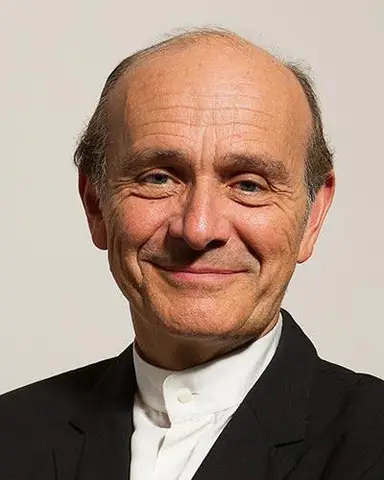
Lesson time: (61min 38sec)
Course preview
This lesson is part of the course Bela Bartok - Cuarteto de cuerda n.º 5
Watch a preview of the full course below.
Lesson transcript:
Music Lesson
Introduction
Bravo! Many, many things are excellent. I'd like to say something. You have to listen to Bartok at the piano Hungaraton bro on the 6 compact discs.
Bartok's Musicality
Because somewhere, even if he's very rhythmical, he's not tata something speaking ability. He was collecting lots of folk music, folk songs. He realized that a folk musician, like I heard you yesterday brilliantly playing your Danish folk music, it's not a mathematical thing, see? It's somewhere improvisative.
- For example, when you did not follow those kinds of things, and when he does not write points, it means you should play on the string.
- Carl, you played Tata Papi Du du du du du du.
Because he was fascinated with how the folk musicians played. He told somebody in a letter that a peasant who is working 12 or 14 hours in the field, strongly physically, cannot do all kinds of unbelievably rough muscle gestures.
So they keep their bow most of the time on the string. The beginning pizzicato is good. But recently, I realized something: it's written piano espressivo, but don't take it as vibrato. You don't need vibrato. The espressivo here means there is a kind of line that you should follow. This is espressivo, and it would sound better if you're not making vibrato. Okay, try it.
Thumb is clinging better; also you play Pam Pom. Try, try it. But push down the fingers very strongly and play with a little bit more flesh.
Pizzicato Technique
Also, the pizzicato is not there, but put it on. I mean, I would play with the third finger for the pizzicato.
- When you play one note, prepare the next note already. Like in life, you hardly realize the present; the present hardly exists.
Pam, not Pam, but Pam Pam Pam. This is a kind of espressivo. Also, try this: don't start anything before you imagine it. So, it's not painful. It's not bad.
Can you make it resonate longer?
- Pam, then look! Not pianissimo. Not vibrato. Exactly. Did you hear that? It's resonating better without vibrato.
- But it means that this and to him. Yes. You can also pizzicato.
Also, as an artist, which also I know, but it taught me in school. It's strange; everybody talks a lot about bowing, but how to play pizzicato? There are so many things possible, but it depends on how you are clinging better, how much flesh you have to use.
Bartok's Influence
Here, Bartok was also, according to Sigheti, who played with him, and also Zoltan Sekai whom I met. Bartok was fascinated by glissando and always starting immediately. It's not. Again, play this.
- Please run a little bit more flash video.
- Oh yeah!
Okay, you can lose a little bit of tempo; nobody is checking you with a metronome. What's happening?
- But the seventh bar, ask Bjorn, get back the tempo; you were too slow.
We can sometimes lose a little bit of position, but we have to know when to get it back. Okay, just play.
Once again: From the beginning, question and answer! Very good, very good.
- But, but, but... Pardi, it's faster than this; yours is a little bit lazy.
- More improvisative, again, and forte!
The first, who is this? No, pardon; it's Fred Drum. The first is fortato and after mezzo piano.
The Importance of Dynamics
When I met Dennis Korumzai or Sandor Weig, they told me they played and worked with Bartok personally on this piece, and he was really very precise.
- Like an engineer! No, this is forte. This is mezzo piano.
So he wanted everything first, considered all the details. He was very, very precise. And after, if you know everything and you've considered it, you could be a creative artist. So you are not a prisoner of everything, but you have to know.
Try again this, and the mezzo forte could be more into the string. Not too nice; it was too perfumed, a feminine thing. But it's rustic and nearer to the earth. Try this mezzo forte.
Emotional Improvisation
Yesterday, when you played the Danish folk music, I realized something in common: you don't think if it's good or not. You're just leaving your emotions in front of us, improvising. Of course, it's easier, more difficult with this. But still, don't try to be good.
- Don't try to please me.
- Don't look at what I'm saying!
Look at this, and imagine that it just came out. It's you who improvised these two bars. Try this. You can do anything now, of course, within the frame of what you can see. Not too restricted, but this is here as a kind of freer bar. Nobody's giving a pulsation here.
If you see the two bars, visually, you can see it. Try this. Just this mezzo forte. Subito. Mezzo forte.
Practicing Resonation
Excellent! Better. But you know what is missing? It's too fast, the bow and ti to t. When you played your Danish folk music, it was like you were holding on to the earth. Yes, this, this.
If I'm saying morforte is not good, I mean because you will say, "Okay, he wants louder." Not the characterization.
Folk Music and Performance
Yes, excellent! Lasting is not a T. No, no. You are singing folk music; even speaking with it. Yes, this is a letter. It's very important. Bartok wrote to somebody: I realized that all of the great classical music artists, performers playing like the folk musicians, they're not showing what they practiced in.
Of course, there's huge work behind, but on the spot, on the stage, the public is feeling that something beautiful is happening in front of us.
And he's writing this: Even me. If I am playing three nights my own same piece, I do not play it the same way every time because I am a live person. This is the most characteristic of somebody who's alive, it's changing every day.
So I'm saying things, but this is also important. So you have to know things, this is the frame, and inside it, you are a creative artist.
Dynamics in Performance
Try once again and only mezzo piano. Yes, now. Okay! Bartok wrote this arpeggio and obviously the most important in this De chi chi ha.
So, I would suggest starting a little earlier. Bravo, bravo, bravo! The only thing is most expressivo here. If you sing this, you're getting a miniature ecstatic feeling, it should be a little bit more ecstatic to see!
- It's not just playing the violin; it's about feeling the music.
But this will be, yes, exactly! And again: Aha!
Just small things, just small things. But again, Rune, this one mezzo forte espressivo is not faster; obviously, it is faster. You can see.
- And forte moto espressivo, no diminuendo! Please subito!
After that, please don't brake the car too early. I mean, the poco slarganto is only with you. So you started to get earlier with the ritenuto.
Bartok's Precision
You know, I saw one of my friends, a famous pianist, gave me the autograph of the proof of Bartok's sixth quartet. You know, before the editing, the printing of the score, last time, the composer can look if everything is right.
I could see from this autograph text that he was unbelievably punctual, I mean, he would have corrected not here at tempo, but above this note. Or if he wants only poco slargando, he writes it above here.
- It means he's not only detail-oriented, he uses red and blue ink for corrections.
But on the other hand, when Menuhin played for him the Bartok first sonata, Menuhin told me he just played through the whole piece and Bartok went to him saying, Thank you very much; it's great. He didn't say anything.
The next day, he wrote to somebody that if a really great artist plays somebody's piece, you don't have to say anything.
So, it means that on one hand he was unbearably precise, but with this, you can be free.
Dynamics and Emotion
So do not just play the message for the priest once.
Dynamics and Connections
Yes, yes, exactly! Excellent, excellent. Fred, you Tati to you are changing to the original. And now, it was much better, you know, but because you give a little more speed.
So it's not ta ta ta ta ta ta ta ta. So not, don't think only about technical issues. Be together, but how? What is the jest?
Suddenly, you're not even thinking about the technical issues, but the musical issue, and suddenly the technique is better. This is so interesting.
Just play a little more speed, but not pianissimo! You can see espressivo, and the espressivo is at the contact point, not here. Tpn, Yes, exactly!
Because I'm always saying how to make a sound, how to imagine always the combination of speed, weight, and the contact point. And what you did was too much from the stomach, not from here.
Connecting with the Music
Yes, just this! Piano from here! Thomas Christoph also talks about this with singers. Maybe we should listen to more singing lessons. Yes!
Actually, this is it. You have to do everything he's saying. Just think about this, and let it happen with the,
You know, Rune, you know, why are we practicing? What is the goal of practicing?
Not to make mistakes. The goal is to get away all the obstacles and be as free as possible with your imagination when you are in a stressed situation.
So, somewhere the goal is not, "Okay, not making mistakes." Got it now?
Performance Techniques
But nobody told you that you have to change the tempo. Same page, continue. This is very, very important.
- So not, but because it's continuing.
Again, this is the technique. So not okay; it was together next: Ooh, not bad!
Actually, it's harmonies that are connected to each other. From A till B, you have to create a big line from A to B, my friends.
Did you see something else also there? Yeah. Now because there is a question, if you don't do it, I will think about it. Your only goal is being together.
Did you hear what Fulton told in an essay? He said the goal is not being together; this is not the goal. The goal is to put everybody on the same wave of the music, intellectually, emotionally.
If everybody is on the same wavelength, it will be together. If not, still music. So, for instance, here: hear the harmony.
Breathe together! Feel together the crescendo and par da da da da. I swear it will be together; I would bet money on it.
So play now again. Feel the same pulsation, feel the line. Forgot this word: together! Bravo, bravo! Excellent.
Connecting with the Audience
Rune, give me the violin. I'm not playing!
No, it's not criticism. Please, from the 39th bar. Sing it for me, how you imagine this? Show me what you feel.
Just try. So it means you did. So it's not okay; I'm exaggerating. But it was, you made an island.
Next: don't stop the action. You are ice skating and saying words. You are still going! So the C sharp, you are arriving!
Somebody is not stopping the action. So it means, don't focus only on the technical aspect.
Never stop the bow, just try this. And please don't slow down yet, I mean, you can say something. So just from here. Bravo! It's much better.
The Flow of Music
But you did something. No, I'm a little bit exaggerating because obviously, in teaching, I can be a bit exaggerated.
It was beautiful! But it's still going on. Because, do you know until when it's going? Till B? Because with this, somewhere instinctively, he will feel your friend that it has stopped.
So always feel till when it is going. The whole thing, perfect. Okay, okay. If Bartok would have been here, I think, I hope he would say, Very good. But don't go slower than the piulento!
Because he told ralentando till piulento. Everything perfect, but nobody should feel that your friend is suddenly going slow.
Connection to the Score
Faster! But go from here now, just to know. This is also important. Okay? Letter. Bravo! Bravo! Bravo! Beautiful. Very good.
So it's a dialogue between you.
In the Bartok archives in Budapest, I've seen an original Bartok letter where he is writing, "I have four types of accent."
- The biggest accent is sf.
- The second biggest is this line.
- The third one is like this.
- The fourth one is the tenuto marks.
But the tenuto is not a bowing instruction, but something.
Flexibility and Expression
So when you see here something in the Hungarian word or satir, it was a little bit too run.
Can you start with a little bit more flexible body? It's not T, but breathe a little with your oxygen. Suddenly be a little bit more flexible like a cat before jumping!
No, because this was missing, play from B.
Warmth in Sound
Yes! Super! Very good!
And here, could you do a little bit warmer sound? So don't lift this too much; it's a little bit too narrowed. Your sound is nearer to Brahms.
It was too vegetarian this, but it's fine. This is it. I could feel that you told the story without words, but just because now it was all the legato were speaking, not ironing them.
Just to end, please, 51. Mezzo piano but with a little bit more gravitation, not on the surface! Don't ice skate on the surface; go a little bit under!
Only from here. Yes!
- No, wait, wait, wait, wait. Everything is good. But I could suddenly hear a technical-oriented break.
Seamless Transitions
You know what I heard? Not tira boom!
- I mean, you have to show it.
But this was something that came from B together.
So boom! It was a military break, but it should go. I don't know if you understand. I should not hear your organization like a magician.
You shouldn't see what you're doing many, many times in string quartet competitions.
And two days, it's a modern quartet playing. When you don't hear the piece, you hear how they organize it. I mean, it's very, very high level, but still materialistic somewhere.
To do this, understand how to just flow into this.
The Emotional Spectrum
He did not write any accent on it, so you don't need it. But there is an attack today that could have been crazier! You showed in your Danish folk music yesterday quite crazy things!
- Yes, after half a bottle of wine, anyway!
But three, be crazier here!
But the beginning 54 is also writing pianissimo for you, so this suggests creatures are starting to come or I don't know what!
But you should feel threatened. What the hell are we doing? It's really threatening.
Try this color; try this color: 54!
Once again. Once again. You're right there! You have a Fort Sato.
Engaging with the Score
But not, not, you should be in the old. What do you mean? Forte, because he writes pianissimo after the sforza! Yes, it's the original dynamic! So it's,
But my point is not that.
We have a strange profession where we are talking about Doo and you can even kill yourself, kill each other with this.
Not tu, but du. Strange! Try this! Try this!
Maybe playing one bar before 53!
Precision in Performance
- Yes, yes! But not pianissimo! Okay, no, no, no!
He's very clear, again, only from here.
- Yeah, yeah, yeah! But the C before te, not tira!
So finish it! Fortississimo! Send it till the sound, not twitching, not hearing!
And the other thing, it was fine!
Artistry in the Details
Actually, this attack could be a little bit flat. Just do one before C, and don't change together the bowing. Because of course, Bartok wrote a long one. But if you're doing the same time, it's, I've seen it with Carlos Kleiber conducting Brahms Symphony.
- Not changing at the same time, it's phenomenal legato!
It's unbelievable, so don't synchronize it! Yes. Just to say.
A Creative Mindset
Yeah, exactly!
So even! Even more crazier! Waves! The sea noise! You have the sea in Denmark, you can see!
And the other thing is: speak like crazy with the left hand.
Can you play for me the three Tari revita de bow? I'd like to hear everything, even crescendo!
Please, try it! Yes! Okay, but at the end, you will see if you're really working here!
Put down the fingers vertically, I mean! Because on the tip of the finger, the skin is harder; if it's going down, it's provoking more the articulation. This is my experience.
So, very good. So from C,, yeah, but somewhere, listen to your friend! So forte, but your waves shouldn't be over him because it's suffocating in a second!
Listening in Music
So, I mean, forte, but listen if it's not more. Listen is the magic word in this music!
Listen to who is more important and then you won't be louder. Did you try? No, no, sing! Sing it for me, Papa! Yes, so you don't diminish!
The long note is not Tara, Tari, Rory or Rain. Almost a crescendo!
I think Thomas Fastoff even saying this to keep a line somewhere. Put an extra hit in it somewhere to keep the line much better.
And here piano agitato! So agitato is not paramount, but is too professor-like!
Imagining the Music
I realize another little idea. I'm sorry in your imagination you can't think desperately!
But it's three doodoodoo la la ram, three doodoodoo doodoo!
If you would listen to Bartok at the piano, it would be so symmetrical.
But don't do it just because I am asking!
And don't do it because, Aha! He was there!
It has to be rubato!
No, this is the nature of it! So it should be somewhere natural!
Actually, this is difficult about teaching because I'm not saying you should not say what to do exactly.
Emotions in Performance
Because Aha, he told this to do! You have to get why, why. And because this is the character, approach it from the musical side!
Yes, yes! Excellent! Much better!
And now we are at the lake, or the storm went away. But still, some tension is remaining. It's not Tata Papa.
The Rhythm and Flow
So the rhythm is Papa ta ta! A laser light is over the calm sea! Yes, yes, yes!
So 80. This is again waves, not bowing and cello playing! So don't finish!
Try, no, 80! Yes! Yes!
But I see that it would be better if you finish Abu and it's still open! Exactly!
The Abu has the power, not power, but question. Open and not finish because the daan is binding M and me. Pardon me! Yes!
And how to get a homogeneous sound should be the same bow place and a little gong!
Clarifications with the Score
So, not we don't need to tune together. No, no! I mean feel the parallelization.
But you can a little bit release the, yes, yes. A clean sound.
I just have a question because. Yeah. My small things: it's a quarter note and then the next is swirled.
Yeah? And then when precise, what does it mean? Where is it here?
And then it goes like that. So it means longer!
Yeah, but it's the same, not the same!
Because he wanted slightly!
The Essence of Bartok
Yeah, okay. I mean, he just wanted longer! It's not the same length.
If he would've wanted longer, he could have just done this!
Because the ha was contradictory with his harmony, which he wanted between them.
And if the half would have been longer, it would have been a terrible dissonance!
I mean, a dissonance! He didn't want dissonance here, but obviously, the ah was corresponding with his idea of harmony!
Okay, something like this.
Understanding Bartok
So he didn't want that dissonance!
Oh, I'm saying it's very important! If you want to know about Bartok even more, I mean what kind of person he was, how he lived, what were his ideas and philosophy in life, his son, Peter Bartok, wrote a book My Father.
This is the title! You can order it from the Internet!
A Fascinating Read
It's unbelievably interesting! This is in English. I read it in the Hungarian translation. He's still alive; he's living in Homosassa, Florida, United States.
But it's a phenomenally interesting book! So Peter Bartok, My Father! You cannot put it down, it's like the best creamy dessert!
No, last time 80, everything is good! But Carl, you are doing, I can hear this, Tata!
It sounds like one: So yata. But Papa, Papa!
So not Tata, because everybody will sing it on the beat, but it's Papa, Papa, not Tata!
The Nuances of Expression
Usually, Hungarians always say Papa, Godai, Buddha, titi. But here: Tata!
Because this is, it could be a little bit more... Because it's not pianissimo that he a little bit healthier, soft, but healthy!
And the more light of it is too much, not your accent! Yes! Good, good, but don't want to prove now that just Papa!
No, it was that. Hey, it's too much, too much! Medicine is poison!
This is poison now! So just take one small pill, Papa, but it's much nicer the quality.
Connecting the Notes
Not, is it in tune or not! You know, it was a little bit angry rabbits playing!
But no, it's this artist playing piano, right?!
Yes! And try the same bow speeds, shorten, and you can arrive there! Bravo! Much better!
Two small things also for you: Asbjorn is not Tata, but Papa!
No, no, he was, you know, he could have written easily a different rhythm!
Natural Connections
But Papa! I realize what is a little problem! Look, you're doing this very well, very professional way, but this,
I hope you will see what I'm doing!
But actually, this is so. I mean, how you, so when you finish.
It's an, it's a watch! Oval watch! And Papa!
So when you finish it, finish the note already organically! You have to prepare the next one.
Otherwise, it's one note, Papa! You didn't have connection between them!
It sounds a little complicated, but actually, it's that easy, that natural thing!
Try this! So it's a bow, it's not a stick! Try once!
So when you're doing, yes! And on the other hand, you don't have to go till the end!
Flowing Sound
It's appearing! Yes, and it's natural!
And bo! Yes, yes, yes!
I tried to...yeah! Exactly! No, this was good!
So somebody is connected! Okay, very good, very good!
And now please play the 90th bar! One second!
I have to say that this was the famous story when the New Hungarian quartet asked Bartok at the concert, "How did you like your playing?"
The Challenge of Perfection
And the fourth movement, 90th bar was out of tune. Goodbye!
It was strange. I mean, strange, but it's extremely difficult!
So G major; he should listen somewhere that we can do it in tune!
So 90. Yes! Super! It's one line! Give speed! Yes, very good, very good!
I like to show, I mean, don't stop it like this. So you play!
If I think about it, it will tremble!
It will actually start to tremble gently, take away, or hear speed somewhere, it's the question of!
So if you are doing a very slow bow in a concert, it will be such a ricochet; you cannot imagine it will be this!
But if you're doing, and at the end, diminutive should go organically to the silence!
And if you are lucky, nobody's coughing! If you're unlucky, they're coughing and breaking the whole cathartic thing!
Maintaining Focus
But if it's really if you're doing magnificently or really beautifully, somewhere everybody feels!
And it's really bad luck if some very not sensitive person there, no!
Excellent! Can you play it now? We've worked with it.
Can you play the movement now? But you know what? Play it.
But try not to prove how good you are! Just be friends with the piece and somebody is already there, what I told you!
And if something is not happening how you wanted, forget it immediately that it didn't happen!
And keep the creativity! Now, this is also very important in our profession! Always have things happening.
We are human beings, but what happened, happened! Go on, go on! Keep the creativity!
Final Performance
So, fourth movement of Bartok's Fifth! Bravo! Bravo! It's much better!
Many things, but sometimes still, came back your habits which you did before!
And suddenly, I remember something with my part that was very, very fruitful and helpful: that if you have a possibility to work not in a small room, a little bit bigger room,
three should play and one should go away for 10 meters, 15 meters, hard as it sounds!
Because it's also so! Somewhere the goal is that one of your ear should be here and the other is at the end of the hall!
And I remember, always believe who is far away will be the mirror.
You should also work like this and suddenly your work will be more creative and more interesting!
So thank you very much! Bravo!
About the instructor
Gábor Takács-Nagy nació en Budapest, donde empezó a aprender violín a los ocho años. Siendo aún estudiante en la Academia Franz Liszt, ganó el Primer Premio en el Concurso de Violín Jeno Hubay en 1979, tras lo cual continuó sus estudios con Nathan Milstein. De 1975 a 1992 fue miembro fundador y primer violín del Cuarteto Takács, que ganó primeros premios en los concursos internacionales de Evian (1977) y Portsmouth (1979). El cuarteto actuó con Sir Georg Solti, Lord Menuhin, Isaac Stern, Mstislav Rostropovitch, András Schiff, James Galway, Paul Tortelier, Mikhail Pletnev, Joshua Bell, Zoltan Kocsis y Gidon Kremer, e hizo varias grabaciones para Decca y Hungaroton. En 1982 recibió el Premio Liszt. En 1996 fundó el Takács Piano Trio, con el que grabó obras de Franz Liszt, Laszlo Lajtha y Sandor Veress, y la BBC del Reino Unido ha emitido su grabación del Trío Archiduque de Beethoven. En 1997, Gábor Takács-Nagy fue nombrado Profesor de Cuarteto de Cuerda en el Conservatorio de Ginebra y en el Conservatorio de Sion, en Valais, y ofrece con regularidad clases magistrales en academias internacionales. Desde 2001 también dirige orquestas, y en 2005 creó su propia orquesta de cuerda, la Camerata Bellerive. En sus clases magistrales, Gábor convierte toda una vida dentro del repertorio de cámara en orientación práctica, mostrando cómo el fraseo, la afinación, el carácter y el diálogo de conjunto se moldean desde dentro de la música. Aquí aborda dos pilares del repertorio: el Cuarteto con piano n.º 3 en do menor de Brahms y el Cuarteto de cuerda n.º 5 de Béla Bartók, compartiendo las decisiones interpretativas que dan vida a estas partituras para que puedas aplicar el mismo pensamiento a tu propia manera de tocar. read more