



Análisis, explicación y demostración por Frans Helmerson
Lesson time: (42min 4sec)
Course preview
This lesson is part of the course Dvořák - Concierto para violonchelo en si menor
Watch a preview of the full course below.
Lesson transcript:
Music Lesson
Introduction
You're a strong guy. And, you know, I think it's very important that when you are strong already in your physique, you don't use it. You don't need to use it. It's a little like with an athlete; in the performance of an athlete, you don't have such a strong impression of the muscular activity behind it. It's more about the movement and the motion in it.
Physical Strength and Technique
For us, when we have to play, we need to have muscles, whatever size the musician, whether it's a short person or a tall person, how broad or how thin; it has no importance.
Actually, we need to have muscles in the right places:
- Fingers: We have to have muscles in our fingers.
- Bow Movement: We need enough muscles to sustain the movement of the bow on the string.
- Endurance: We must be able to move for 35 or 37 minutes, like in the Dvorak Concerto.
However, during the performance, nobody should think about the strength that is behind our playing.
Finding Balance in Playing
I like very much the power in your playing in the Dvorak Concerto, but you might be using too much power in each movement of the bow and each vibrato and each longer note. Try to find a power based on the line you're making:
- Singing the Line: Focus on how you sing the line.
- Changing Vibrato: Adjust how you change the vibrato in a longer singing line.
- Pronouncing Rhythm: For example, in the first part, consider how you make me feel the rhythm in the two 16th notes and the dotted quarter note.
When the cello plays the theme, it feels like the movement hasn't started yet. It hasn't gained a real tempo.
Strategic Thinking in Performance
It says forte, but it doesn't say fortissivo. Many cellists try to give everything because they feel the need to prove themselves after the orchestra's development, but actually, the more you know how to use strategic thinking, with temperament behind it, of course, the better.
Remember, it says forte, quasi improvisando. "Quasi improvisando" doesn't mean to play like you're actually improvising. Can you play with some kind of direction in the beginning?
Experimentation with Sound
Let's test the bar before. Very good, it's more singing now, more with the line. Try to make an experiment: play with feeling like a sack of potatoes on the chair, and see what comes out, don't make an effort.
Now, that wasn't softer in the forte; it was an impressive forte. Maybe you can play even less fortissimo but with more expression. The player with the biggest sound is not always the one that plays the loudest, it's the one who feels the strongest.
Rhythmic Treatment
Can you treat rhythm differently? Every statement belongs to a line. Many times, in this first movement, the more you can feel the lines, the directions, and the shapes, the better it is for the music. Focus on the symphonic quality; the cello's voice is always integrated into the music.
Either the cello voice leads the development or accompanies another solo instrument. Be aware not to take too much freedom with time; it needs a strong sense of direction.
Further Rhythmic Exploration
Can you give me the feeling of these two bars? "Thumb, pada, dee, dee, dee, taka, tika, tika tkado." Don't let the beat feel interrupted; the quarter note should be longer.
Glissando Considerations
I am not so crazy about the glissando you played, it sounded like a decision rather than a natural expression. When wanting to sing expressively, imagine how a great singer would handle it.
Now, also approach the other voice differently, don't be in a hurry to get to the G. Avoid stress, as each bow should initiate a different type of contact.
Sound Projection Techniques
Sebastian, with long arms, use them! You move as if you're going half around the corner. The bowing should go 90 degrees on the string; that makes the best sound.
Again, think about how the arm serves the line. You need direction and control over the bow changes, not to change speed or contact beforehand.
Building Tension in Music
The music of the Dvorak Concerto has to show development. You must manage the balance without playing at the top of your strength all the time; otherwise, the orchestra will play louder, leading to tired ears and poor musical development.
There's always tension between the first and the last note in the piece; it grows and relaxes.
Conclusion and Final Thoughts
Do you think you can make different expressions in each note? Be a little eccentric with it. Try to get sensitive to the varying musical expressions, and not just play the theme.
Let your bow feel limitless as it flows, it shouldn't just go from here to there. Use more bow than you think you can; try different expressions and vibratos.
Remember, play from a calm place like standing by a still lake, and let the music develop naturally.
Let's finish with finding that heavy power, maintaining flexibility and rhythm without tension in the upper body.
Final Practice
Make sure you use every millimeter of the bow. Thank you for your hard work today!
About the instructor
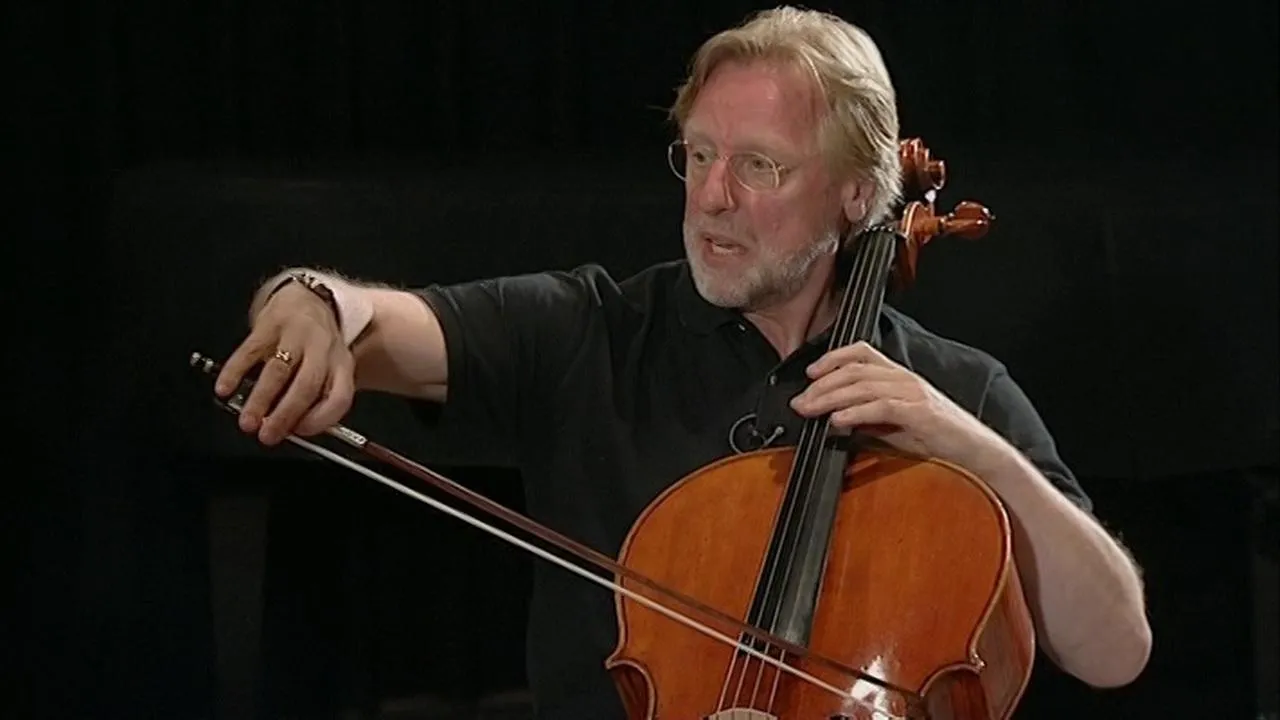
El violonchelista sueco Frans Helmerson nació en 1945 y empezó a tocar el violonchelo a los 8 años. Tras estudiar en Gotemburgo, Roma y Londres, seguido de un debut en Estocolmo, su carrera como solista lo ha llevado a innumerables giras por toda Europa, así como por EE. UU., Asia y Rusia. Ha actuado con muchas de las mejores orquestas bajo la batuta de algunos de los más grandes directores de la actualidad. Un aspecto importante de la musicalidad de Frans Helmerson es la música de cámara, y es invitado habitual de algunos de los festivales europeos más importantes. Es el director artístico de los Umeea-Korsholrn International Chamber Music Festivals en el norte de Suecia y Finlandia. Frans Helmerson trabaja con regularidad con orquestas escandinavas como director. También ostenta cátedras en la Musikhochschule de Colonia, donde reside, y en la Escuela Superior de Música Reina Sofía de Madrid. Sus grabaciones están disponibles en el sello BIS, incluida una versión del Concierto de Dvorak aclamada por la crítica como una de las mejores grabaciones de la obra. Su grabación para Chandos de los dos Conciertos para violonchelo de Shostakovich con la Russian State Symphony Capella, dirigida por Valery Polyansky, ha recibido elogios de la crítica musical de todo el mundo. Como profesor, Helmerson aporta esa misma profundidad al alumno. Recorriendo el repertorio para violonchelo frase a frase, comparte el arco, la producción de sonido, el fraseo y las decisiones interpretativas que hay detrás de una línea verdaderamente cantabile: las percepciones ganadas a pulso de toda una vida en el escenario de concierto. read more