



Escalas mixolidia, de tonos enteros y cromática

Con
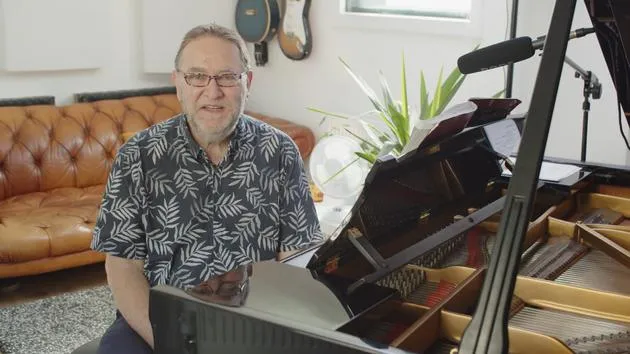
Tim RichardsTim Richards explora las escalas mixolidia, de tonos enteros y cromática que puedes tocar sobre los acordes de séptima dominante de 'Straight, No Chaser'.
Qué incluye el curso
24 lecciones (1h 30m) · 1 gratis
01. Arpegios e inversiones de séptima dominante
2:49
02. DOWN THE LINE Interpretación
1:46
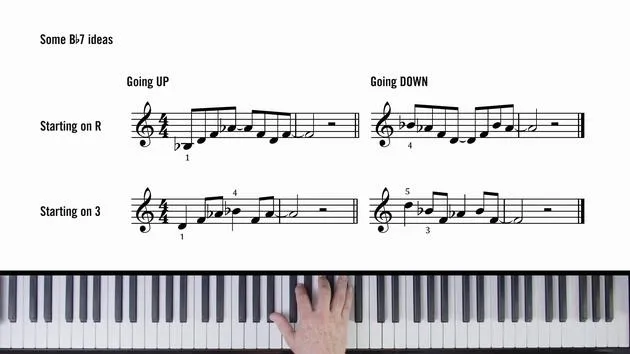
03. Consejos de improvisación
3:59
04. La secuencia de blues de 12 compases, tritonos y shells
5:49
05. Escalas mixolidia, de tonos enteros y cromática
Estás aquí5:51
06. Interpretación de STRAIGHT NO CHASER
1:34
07. La escala pentatónica de tercera bemol
3:25
08. Aprender las séptimas de dominante en todas las tonalidades
5:37
09. DOMINANT SEVENTH WORKOUT #1 Interpretación
1:48
10. Patrones de acordes quebrados
5:22
11. Rhythm changes y el ciclo de séptimas dominantes
3:50
12. THE THEME Interpretación
2:22
13. Improvisar sobre el acorde de tónica
5:42
Transcripción de la lección
Music Lesson: Scales and Chords for Straight No Chaser
In this lesson, we're going to look at some of the scales that you could use in Straight, No Chaser.
Chords and Scales
- No Chasso or any blues in F:
- Remember that in blues, the tonic chord is dominant.
- For example, if it was a blues in C, you wouldn't play the C major chord; you'd have to play C7 and flatten the seventh in the scale as well.
Mixolydian Mode
- This scale has a name: it's called the Mixolydian mode.
- Alternatively, think of it as a seventh scale or a dominant scale.
- The only difference between Mixolydian scales and major scales is the flat 7.
Application in Blues in F
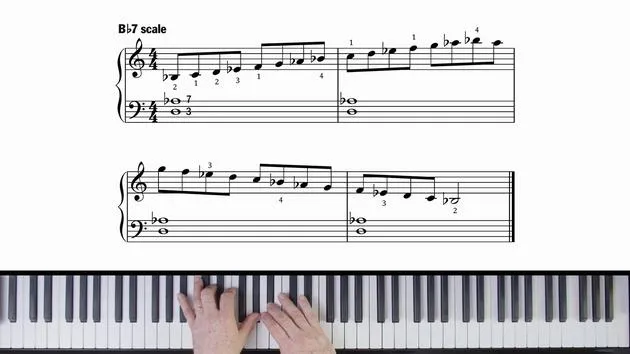
- Here's the Mixolydian scale on F.
- On F7: same fingering as F major but with an E flat.
- Notice I'm playing the chord on the one; this was a two-bar loop.
- Let's do a similar loop for B flat: 3, 4.
- I chose to play a tritone there.
- You could have played a chord instead.
Getting Fluent
- To become fluent with those scales, you need to learn them as scales in their own right:
- B flat Mixolydian
- C Mixolydian
Whole Tone Scales
However, Monk has a little trick that he uses all the time.
- It's a very recognizable part of his style: the use of whole tone scales.
- For instance, on the C, instead of playing the Mixolydian scale, he might play this:
Scale Characteristics
- This scale has only six notes:
- Three white notes and three black notes.
- If we did it on F, it would be like this:
- That has four white notes and two black notes.
Application on B Flat
- B flat is the same as the previous scale.
- In fact, there are only two whole tone scales:
- This C scale is the same as:
- D scale
- E scale
- F sharp scale
- A flat scale
- B flat scale
- This C scale is the same as:
So, you only need to learn two of them.
Solo Observation
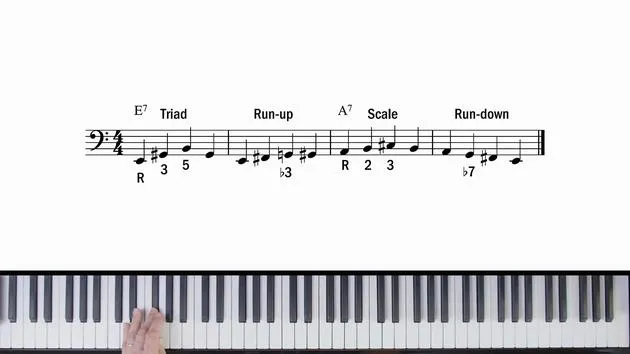
When you listen to the solo that I do on the Straight, No Chaser track, you'll notice I play a scale pattern in the C7 bar featuring this whole tone scale.
Triad Pattern
- This is the pattern I play:
- It's a triad pattern I'm using.
- You'll see there's an augmented triad in there, they are all augmented triads.
Terminology
It's worth mentioning that terminology can be confusing.
- You need to know that:
- Raised fifth, sharpened fifth, augmented fifth, they all mean the same thing.
- In chord symbols, they may be expressed as:
- Sharp 5
- Plus 5
- Or just have a plus sign (+).
Similarly, a flat five, diminished fifth, or lowered fifth also mean the same notes.
- For an F chord, if you want to play F7, flat five or diminished fifth would have a B in place of a C.
Chord Symbols
The chord symbol could be written as F7B or F7b5 in some situations.
- Either way, that's a whole tone type chord.
- So, whether you have sharp 5 or flat 5:
- If you put both in these chords, the chord symbols imply the whole tone scale.
Implying Whole Tone Scale
- C7 could have:
- If you're going to play sharp 5 or flat 5, that implies a whole tone scale.
Ending of the Piece
You'll notice the ending of the piece in the coda.
- I finish it like this:
- There's your flat five chord.
- The fill at the top is also whole tone, although it's up here.
Chromatic Scale
There's one more scale which is actually used in the melody of Straight, No Chaser, and that's a chromatic scale.
- This is also in the C7 bar.
- You probably know how to finger these already, but just in case, here's the normal fingering:
- Use your thumb and third finger, and second finger on F.
- If you have two white notes in succession, use the second finger.
Practicing
- Otherwise, just alternate thumb and third finger.
- Practice that up and down several octaves to become fluent with it.
Ready to Play
Okay, ready to play Straight, No Chaser!
24 lecciones
1h 30m de lecciones en vídeo estructuradas
Funciones de vídeo avanzadas
Ralentiza, repite un pasaje, sigue la partitura
Móvil, tablet y ordenador
Practica donde quieras
Garantía de satisfacción 100%
30 días de garantía de devolución
Conoce a tu gurú
Conoce a tu gurú
Aclamado por la crítica, el pianista y compositor de jazz Tim Richards es uno de los educadores de jazz más experimentados de Gran Bretaña, y ha enseñado piano de forma privada durante más de 30 años, además de en el Morley College, el Goldsmiths College, la University of Surrey, Premises Studios y otros centros del Reino Unido y del extranjero. Ha producido numerosos títulos para Schott Music, entre ellos los superventas en dos volúmenes Exploring Jazz Piano, Blues, Boogie & Gospel Collection y el aclamado Improvising Blues Piano. También es coautor, junto con John Crawford, de Exploring Latin Piano y Brazilian Piano Collection.
Más recientemente, Schott ha publicado Jazz, Latin & Modern Collection (15 piezas para piano solo), que reúne originales de Tim Richards junto a piezas de Duke Ellington y Thelonious Monk, y el estuche de dos volúmenes Beginning Jazz Piano (ahora un curso de MusicGurus en dos partes).
“La verdadera alegría de la música de Tim… es que resulta a la vez enormemente didáctica y tremendamente divertida de tocar. Cualquiera con el más mínimo interés en aprender a tocar o a enseñar piano de jazz debería hacerse sin falta con una colección de los libros de Tim.” PianoDao
Como intérprete, Tim ha sido una presencia en la escena del jazz británico desde la década de 1980, tocando también el blues con leyendas del Reino Unido y de Estados Unidos como Otis Grand, Earl Green, Dana Gillespie, Larry Garner, Joe Louis Walker y Mojo Buford. Ha publicado más de una docena de álbumes como líder (con muchos de los mejores músicos de jazz de Londres, entre ellos Pete King, Gilad Atzmon, Tony Kofi, Jason Yarde, Seb Rochford, Ed Jones, Dick Pearce y muchos otros) y ha girado por toda Europa con formaciones que van del dúo al noneto. Su última grabación, el álbum ‘Telegraph Hill’ del sexteto Hextet, fue descrita en The Observer como "Una auténtica delicia de principio a fin".
Puedes encontrar más información en su sitio web www.timrichards.ndo.co.uk







