



Formación y digitación

Con
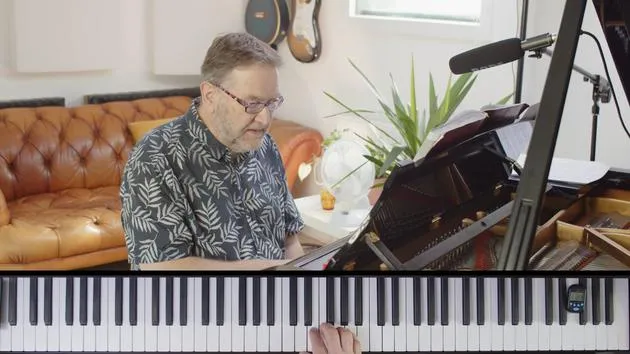
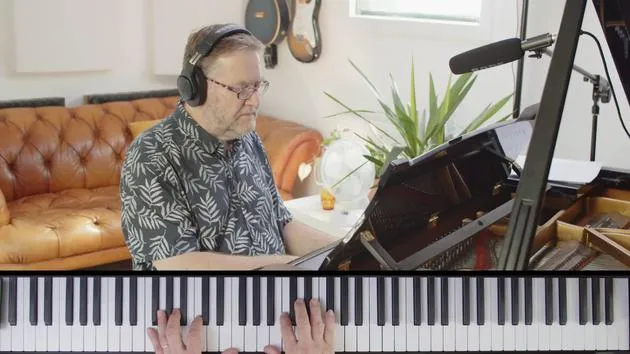
Tim RichardsTim Richards muestra cómo usar la escala pentatónica de Re menor para improvisar sobre los tres acordes de 'Montuno for Monty', y cómo se relaciona con la pentatónica de Fa mayor.
Qué incluye el curso
23 lecciones (1h 23m) · 1 gratis

Transcripción de la lección
Montuno for Monty
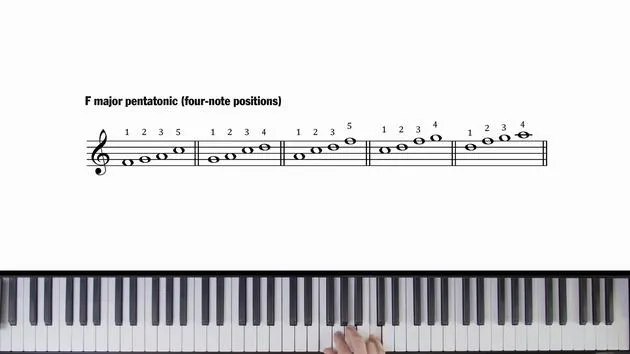
In this lesson, I'll guide you through using the minor pentatonic scale in D minor for your solo.
Minor Pentatonic Scale in D
You'll notice that I suggested using a minor pentatonic in D minor for your solo.
- Notes in the D Minor Pentatonic:
D, F, G, A, C
It's important to understand that this is the same set of notes as the F major pentatonic. They are modes of each other.
Relative Minor Relationship
- Key Signature:
Both F major and D minor share the same key signature. - Pentatonic Scale:
- F Major: Root, 2, 3, 5, 6
- When starting on D, these same notes sound minor.
Chord Context
Because we're playing a minor chord in the left hand as well, this creates a cohesive sound.
Scale Construction
Let's examine the construction of the D minor pentatonic scale:
- Intervals:
- Minor third between D and F
- Tone (D to E)
- Tone (E to F#)
- Minor third (A to C)
There's a kind of symmetry here that can help you remember the scale.
Memorization Tips
Make sure to memorize the actual notes that you're playing as well, not just the names:
- D Minor Pentatonic Breakdown:
- Root: D
- Flat Third: F
- Fourth: G
- Fifth: A
- Flattened Seventh: C
Note: The F and C are flatted because we're relating this scale to D major, which would normally have F# and C#.
Improvisation Tools
The minor pentatonic can be used to improvise over minor triads as an alternative to the regular scales we discussed earlier.
Expanding Your Toolkit
Now you have another tool in your musical toolbox, in addition to:
- Arpeggios
- Five-finger positions
- Broken chords
- Regular scales
You've now got the minor pentatonic scale as well!
23 lecciones
1h 23m de lecciones en vídeo estructuradas
Funciones de vídeo avanzadas
Ralentiza, repite un pasaje, sigue la partitura
Móvil, tablet y ordenador
Practica donde quieras
Garantía de satisfacción 100%
30 días de garantía de devolución
Conoce a tu gurú
Conoce a tu gurú
Aclamado por la crítica, el pianista y compositor de jazz Tim Richards es uno de los educadores de jazz más experimentados de Gran Bretaña, y ha enseñado piano de forma privada durante más de 30 años, además de en el Morley College, el Goldsmiths College, la University of Surrey, Premises Studios y otros centros del Reino Unido y del extranjero. Ha producido numerosos títulos para Schott Music, entre ellos los superventas en dos volúmenes Exploring Jazz Piano, Blues, Boogie & Gospel Collection y el aclamado Improvising Blues Piano. También es coautor, junto con John Crawford, de Exploring Latin Piano y Brazilian Piano Collection.
Más recientemente, Schott ha publicado Jazz, Latin & Modern Collection (15 piezas para piano solo), que reúne originales de Tim Richards junto a piezas de Duke Ellington y Thelonious Monk, y el estuche de dos volúmenes Beginning Jazz Piano (ahora un curso de MusicGurus en dos partes).
“La verdadera alegría de la música de Tim… es que resulta a la vez enormemente didáctica y tremendamente divertida de tocar. Cualquiera con el más mínimo interés en aprender a tocar o a enseñar piano de jazz debería hacerse sin falta con una colección de los libros de Tim.” PianoDao
Como intérprete, Tim ha sido una presencia en la escena del jazz británico desde la década de 1980, tocando también el blues con leyendas del Reino Unido y de Estados Unidos como Otis Grand, Earl Green, Dana Gillespie, Larry Garner, Joe Louis Walker y Mojo Buford. Ha publicado más de una docena de álbumes como líder (con muchos de los mejores músicos de jazz de Londres, entre ellos Pete King, Gilad Atzmon, Tony Kofi, Jason Yarde, Seb Rochford, Ed Jones, Dick Pearce y muchos otros) y ha girado por toda Europa con formaciones que van del dúo al noneto. Su última grabación, el álbum ‘Telegraph Hill’ del sexteto Hextet, fue descrita en The Observer como "Una auténtica delicia de principio a fin".
Puedes encontrar más información en su sitio web www.timrichards.ndo.co.uk







