



Clase magistral de András Schiff
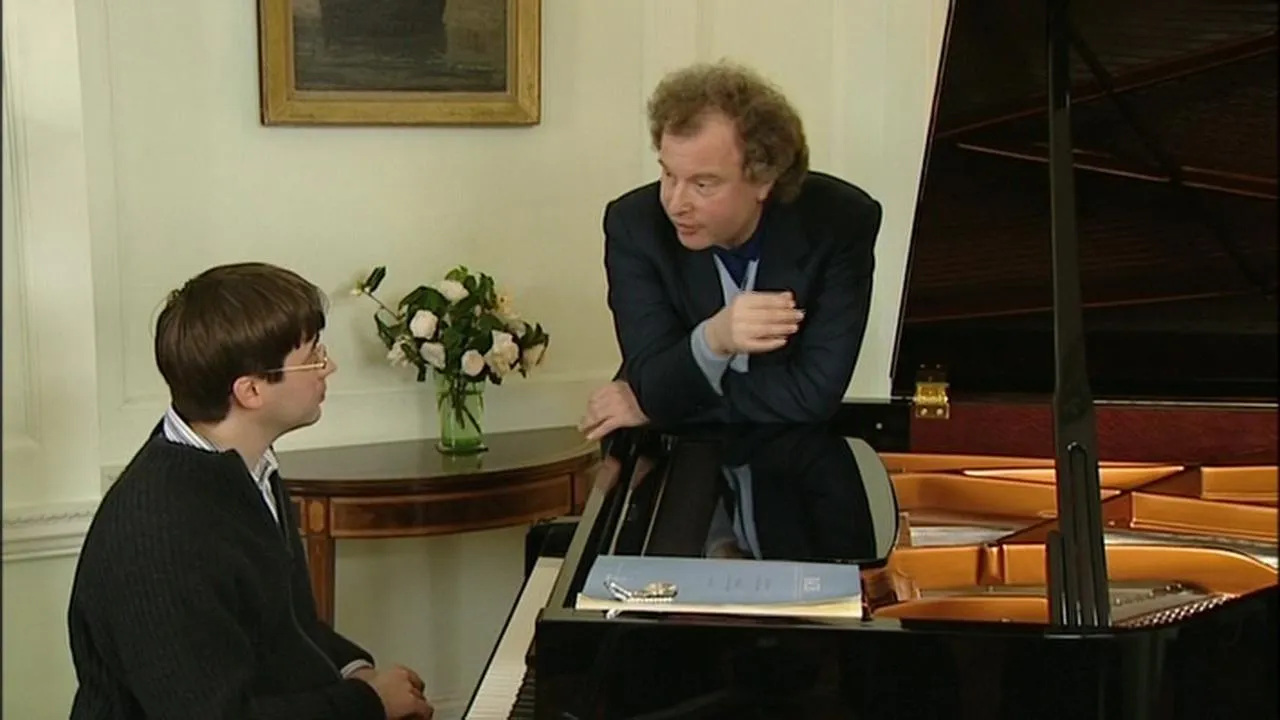
Qué incluye el curso
2 lecciones (0h 45m) · 1 gratis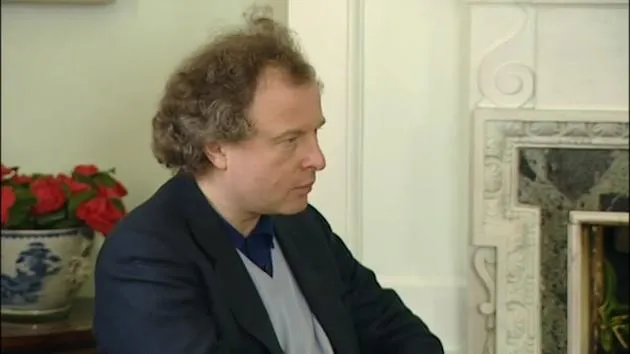
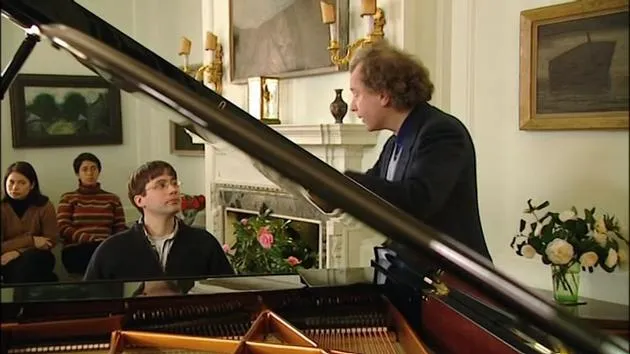
Transcripción de la lección
Bach on the Piano: A Music Lesson
I'm very glad that you play Bach on the piano and so well, because there is still this opinion some people would like to hear it on the harpsichord.
However, as we know, this instrument didn't exist in Bach's time. While it's totally legitimate to play it on the harpsichord, I would be very sad if we pianists were deprived of this music, which is the greatest music there is.
The Greatness of Bach
To me, Bach is a composer who stands alone on a level, and then there is a gap, and then come all the other composers. I think there is no question about it, as all the later composers learned so much from Bach.
Practical Application
Very good! May I just show you a few things? It's excellent that you do this baroque double dotting in the Symphonia, but think of it as a cathedral.
- The structure rests on columns, pillars.
- There are the columns, and then there are all the arches and all the little ornamental elements.
- The pillars must be in place, and that gives us a pulse.
So, one, two. And let's try this. It's grand, not loud, but it's very good. Except for the beginning, because before you start the piece, you have to breathe.
- Now, gentler. Yes.
This double dotting should not be mechanical. Sometimes it's sharper, and then it's a little more lyrical, with this thrill in the bass, like an earthquake!
The Nature of Bach's Music
Now, something quite different comes to you. This is like an aria from one of Bach's passions. If I think of the St. Matthew Passion, which you probably know, the oboe plays this, and then the tenor sings.
In Bach, the sacred music and the secular music go hand in hand. This is a partita, an instrumental piece, but we must associate it with the passions and the cantatas because Bach was a deeply religious person. He didn't think of himself as a great genius, but as a simple human being who was a faithful servant of God.
And this shines through in his music.
Performance Insights
So please play this arioso. It can be more beautiful. Yes, cantando e parlando.
- And we close the sentence now.
- New paragraph.
Very good. Again, we have the C minor and E flat major, parallel keys. You know, it's like a hidden polyphony. There are only two voices here, but Bach creates the feeling that we have a whole orchestra.
Thank you for playing that C. Because some people play, and it's not good. So go from here and always keep the movement going. No pause. And breathe, but it continues.
Yes, very good.
Exploring Techniques
Now see? Chromatic, left-handed. Don't stop because it's a long sequence. Now comes the Neapolitan.
All right, very good! This Symphonia, it's called this opening movement. All of Bach's partitas, as we know, start with a big orchestral movement. They are called Symphonia, Toccata, or Fantasia.
Transition to the Third Section
It's in three sections. Now we reach the third section, and before that, it's a cadenza. So, you can do it even more capriciously.
I quoted the St. Matthew Passion, and it's passionate music. The intervals get larger and larger. You can do a trill.
Okay, just do the current. Very good. Maybe double it in and here it's a hemiola. We are going:
- 1, 2, 3.
- 1, 2, 3.
- 1, 2.
- 1, 2.
Just here, I even phrase it. But you don't have to do that slur; just give it a little emphasis.
Very good! You see, again, this is a fugue, but this is an oral illusion, like in paintings, an optical illusion. We have only two voices, but it sounds like five.
After we hear two themes, then we have intermezzo, and you can change the color.
Color in Music
That's something we cannot do on the harpsichord. But this music is not black and white; it has red, blue, green, yellow, orange, violet, and whatever color you want.
Now it's one of those choirs in the turbas, in the Matthew Passion, when you have the whole folk singing.
- It's like, "Put him on the cross." It's terrifying.
Now, we heard the themes. Now drop back into the concertino. Always, yes, you have to play.
All right, very good.
Conclusion and Final Techniques
But, remember to modulate. Yappa y bing. 1, 2, 3. Finished. You know, last note, you have to hold it. Or is it a quarter note?
All right. It's like a snake. And then we have the C minor, D flat major. It's Neapolitan. Sixth chord.
Okay, just do the snake, it's an innocent snake, but it's dangerous.
Very good. Together. Very good.
Now, please, the Sarabande. Beautiful, but much too slow. I mean, we are losing the attention. If it could still move somehow... We must always keep the C minor sonority; it's a profound sound.
The Sarabande, as we know, is a Spanish dance, which is your mother tongue. At a certain time, it was banned by the Spanish court because it was considered too erotic.
So please, make more of that voice. The alto voice, which is all right. And I don't want to change your view, but if it could flow a little bit, it gets stuck.
Thank you. Very good.
Praise and Ornamentation
I have to praise you because you do very well with the repeats. One should play the repeats in Bach, but as you very well demonstrated, we need to do something.
We must ornament it, which you did in perfect taste, in my opinion. And it's very good because if one does a repeat, it must be justified. It cannot be like a photocopy of the first time.
The Rondo Movement
Now, let's do this Rondo movement, which, as the word suggests, is a French-inspired movement. It's inspired by Couperin's Rondos, where you have a main section and then a couple.
You have to imagine the Rondo: some people are dancing in a circle, the whole group, and then two people or just one person jumps into the middle of the circle and does something as a solo.
So, follow the structure:
- A, B, A, C, A.
All right, just a little more character. It's after this very profound Sarabande, and out of this comes a very na?e melody with a childlike simplicity.
Alright, first couple. One more to the second couple.
But here, we come back to the A section, and this is the variation again.
- 1, 2, 1, 2, 1, 2.
It's more horizontal here, and this plays this interval of a seventh descending from one to one tone.
Very good! Left hand more passionate. Leggero.
Very good! Only the last couple must be gentle.
Finale of the Lesson
Now, please, the alto voice, because it's a pre-echo of the last movement.
Good. Give more!
Now, this alone in the Bach partita is called Capriccio. It usually ends with a jig, an Irish dance, but this is a Capriccio.
So what do we do? It has to be capricious.
And what's capricious about it? These big leaps in the melody. It's almost comic because it's like a bear dance.
Here you have also these wavy lines; you know they are cascades of sound towards the end.
Let's do this one. That's very difficult, but you played it very well.
Now, what happens here? Everything is turned upside down. What we had here is now turned around.
It's fantastic because it's not just a mathematical device; it's also a musical one. If everything...
This is why Bach is a great scientist as well, he can juggle musical concepts. So do the inversion, but with a little less sound.
It's always the last one. That last theme is too heavy.
You know, it's not staccato enough. The first note here... do it once more.
And then, we are very good. Bravo! Thank you.
2 lecciones
0h 45m de lecciones en vídeo estructuradas
Funciones de vídeo avanzadas
Ralentiza, repite un pasaje, sigue la partitura
Móvil, tablet y ordenador
Practica donde quieras
Garantía de satisfacción 100%
30 días de garantía de devolución
Conoce a tu gurú
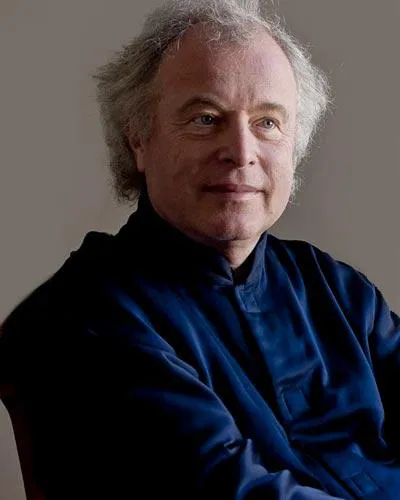
Conoce a tu gurú
András Schiff es uno de los miembros más destacados de una generación de pianistas húngaros nacidos en los años posteriores a la Segunda Guerra Mundial, junto a artistas como Zoltán Kocsis, Dezso Ránki y Jenő Jandó. De este notable grupo, Schiff ha alcanzado la mayor reputación internacional, no solo por su decisión de desarrollar su carrera fuera de Hungría, sino también gracias a su sentido del toque finamente matizado y a una memoria impresionante que le permite presentar, en conciertos y grabaciones, amplias porciones de la obra de un compositor.
Schiff nació en Budapest el 21 de diciembre de 1953 y estudió con el compositor húngaro Pal Kadosa y Ferenc Rados (que también enseñaron a Kocsis y Ránki), y con el clavecinista inglés George Malcolm. Debutó en Budapest a los 19 años, seguido de apariciones en concierto por toda Europa y Estados Unidos. Su reputación creció con actuaciones galardonadas en el concurso de Moscú de 1974 y en el Leeds Festival de 1975.
András Schiff trabaja con la mayoría de las grandes orquestas y directores internacionales, pero él mismo dirige la mayor parte de sus interpretaciones de conciertos para piano de Bach, Beethoven y Mozart. En 1999 creó su propia orquesta de cámara, la Cappella Andrea Barca, con la que trabaja cada año como director y solista, como hace también con la Philharmonia Orchestra y la Chamber Orchestra of Europe.
El estilo de Schiff, en el que un toque inusualmente sensible se combina con una atención a la claridad contrapuntística, lo ha convertido en uno de los principales intérpretes de Bach de la actualidad. Ha grabado la música completa para teclado de Bach, así como las sonatas completas y los fragmentos de sonata de Franz Schubert, cuya introspectiva música para teclado se adapta bien al temperamento de Schiff. Completó un ciclo de sonatas de Beethoven en ECM en 2009, y en 2011 recibió el Premio Schumann de la ciudad de Zwickau por su interpretación y difusión de la música de Schumann. En 2001, Schiff comenzó a revisar y regrabar las obras de Bach. Además de las esperables obras románticas centroeuropeas, la música de Béla Bartók y Leos Janácek ocupa un lugar destacado en el repertorio de Schiff.
En sus cursos de MusicGurus sobre los Moments Musicaux n.º 1, 3 y 4 de Schubert, la Partita n.º 2 de Bach y las últimas sonatas para piano de Beethoven, Schiff te introduce en ese mundo interpretativo, compartiendo cómo piensa el fraseo de voces, el toque, la claridad contrapuntística y la estructura para que puedas aportar verdadera profundidad y comprensión a estas obras en el teclado.







