



Mosaic (Lektion)
Das steckt im Kurs
13 Lektionen (1h 28m) · 1 gratis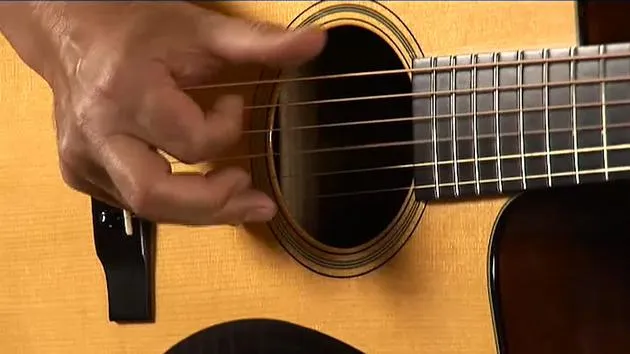
01. PCH (Aufführung)
3:09
02. PCH (Lektion)
Gratis-Lektion11:01
03. Liquid Amber (Aufführung)
3:50
04. Liquid Amber (Lektion)
9:19
05. Gardenia (Performance)
3:41
06. Gardenia (Lektion)
13:37
07. Mosaic (Interpretation)
3:49
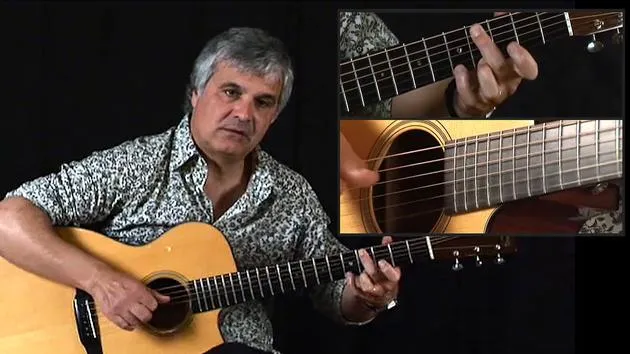
08. Mosaic (Lektion)
Du bist hier10:21
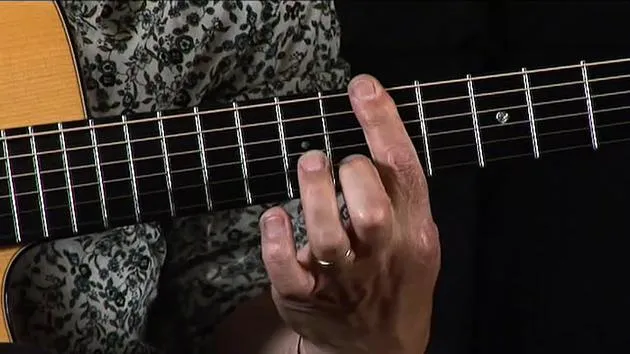
09. Stolen Glances (Interpretation)
3:51
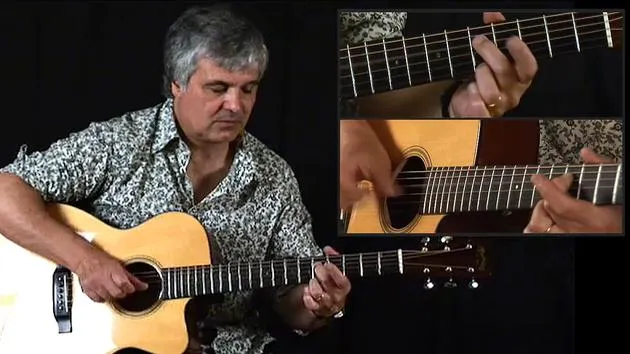
10. Stolen Glances (Lektion)
11:20
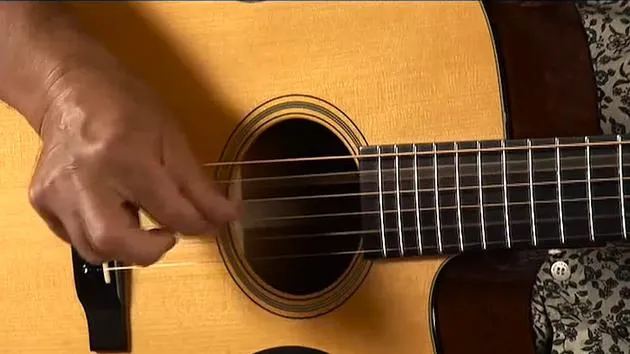
11. Bullet Train Boogie (Performance)
3:52
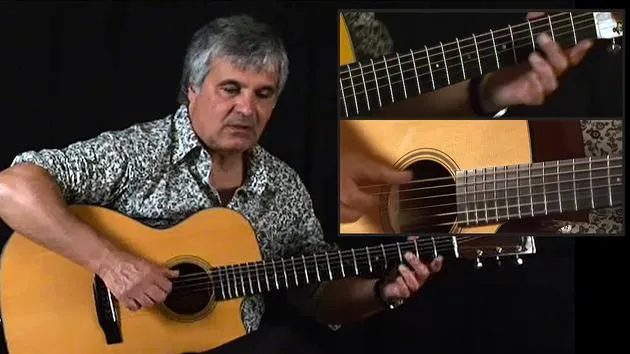
12. Bullet Train Boogie (Lektion)
8:42
13. Abschlusslektion
1:30
Transkript der Lektion
Mosaic: A Guitar Lesson
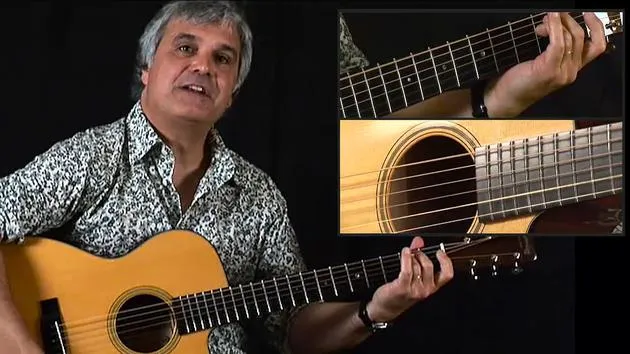
That's called Mosaic from the album of the same name.
Tuning
It's in CG dgad tuning, a little different from DADGAD. The top three strings remain the same, but the bottom two strings go down a whole step:
- C
- G
- D
- G
- A
So, now I have:
- C, G, D, G, A
- D, C, G, D, G, A, D
The bottom three strings are the same as cello tuned in fifths. This tune is in the key of G.
G Chord Position
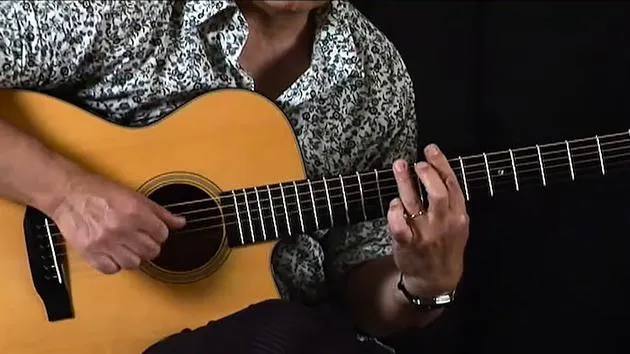
My resting position for a G chord is like this:
- My fifth through third strings give me a G, D, and a G.
This is my kind of G power chord, as it were. When I go to the four chord (C), it gives me a C bass note, which gives me a C chord.
Introduction and Technique
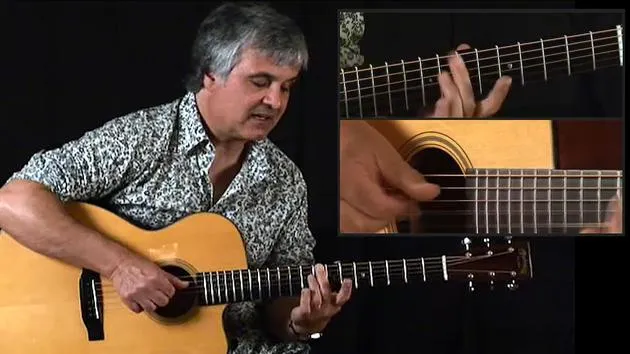
This tune starts off with a little flourish. Now, let's look at this from a technical point of view.
- I have a hammer, a pull, and another pull, followed by a pick note and a pull, then holding the bass note and a variation on that hammer pull.
This showcases a very cool voicing of an E minor.
It's an E minor E with an F sharp (which is a 9th) and the 7th D on top, so it's an E minor 9th.
Then, moving to the next chord, I go to an E flat major 9, where both the G and the D are common tones.
- With the E flat chord, that G becomes the major third and the D becomes the major seventh.
I actually do a pull off here, so that E flat major 7 also has a slight Lydian tonality to it.
Lydian Tonality
Lydian being the sharp four, plus I have three adjacent scale tones in:
- F
- G
- A
Then, resolving to the D. Now I do a slide in fourths, combined with a pull off, and then 2/3 with the G bass note moving into the next section.
Chords and Voicings
I walk up to the first string to this chord:
- D
- A
- D
- E
- A
It's like a D sus 2, these are very rich chords.
What do we have here?
- A flat
- D flat
- A
- D flat
- E flat
- A flat
I wonder what that really is. You know what? Let's not give it a name; it'll be in the tab. But right now, let's just call it a very cool chord.
Walking Up
Now, moving up:
- G, B, G, A B (with a B in the bass and an F sharp on top) creates a first inversion G major 7 chord, progressing to an E minor chord.
One thing that's really important, something I've touched on in my other videos, is that when you're in an altered tuning, you want to pay attention to familiar intervals, even though the fingerings may not be.
Example of Intervals
For example, this relationship is a tenth:
- I have a C in the bass with an E above it, filling it in with a bar over the first three frets.
Then back to the G, repeating all that.
Next is the tenths, walking up using the two top strings open as a pedal, and then hitting a slap harmonic on that, which gives me a C69 chord (C, G, E, G, A, D).
The whole thing will repeat.
Bridge Section and Improvisation
Moving into the bridge section, I'm pedaling on the bottom two strings open with the melody moving up on the fourth string, then back to the G, and walking up again.
Again, I have tenths, but this time, they're between the fifth string and the second string.
At the end, I do a little breakdown section, walking down the bass line but with this little rolling thing.
Then I go into some improvisation, something like this:
- E minor, but now doing a full bar to play melodic material on top, then moving down from there.
So here we go:
- E minor, then whatever I would do over that E flat.
Then here's that E minor again, but now in a higher voicing:
- E flat → D, then walking down in thirds to the G.
Finally, I repeat the melody from the very introduction and end on the G with a pair of harmonics at the 7th fret and 12th fret.
Conclusion
Now, in concert, I would most likely do some improvising over that chord sequence, because the basic sequence is:
- G
- E minor
- E flat
- D
- G
But each time, I may be playing a different voicing of it.
And that's Mosaic!
13 Lektionen
1 Std. 28 Min. strukturierte Videolektionen
Erweiterte Videofunktionen
Verlangsamen, Passagen loopen, mitlesen
Handy, Tablet & Desktop
Üben, wo du willst
100 % Zufriedenheitsgarantie
30 Tage Geld-zurück-Garantie
Lern deinen Guru kennen
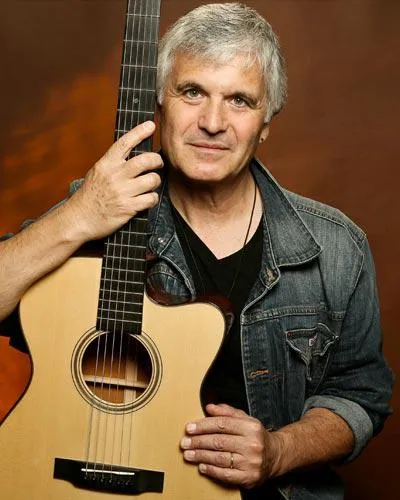
Lern deinen Guru kennen
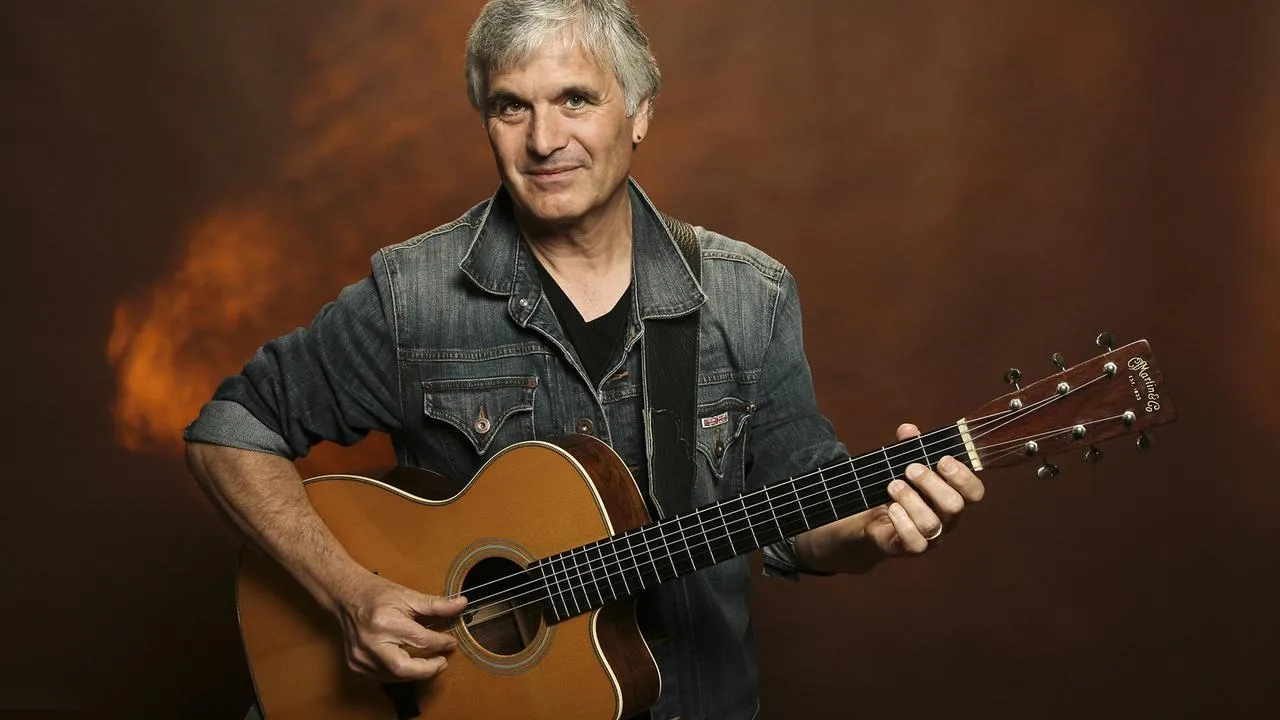
Laurence Juber wurde zunächst als Leadgitarrist in Paul McCartneys Band Wings bekannt. Seither hat er sich eine Karriere als Fingerstyle-Gitarrist, Komponist und Arrangeur aufgebaut und arbeitet vorwiegend in der DADGAD-Stimmung, die ihm den Beinamen 'the Duke of DADGAD' einbrachte.
Von den Lesern des Fingerstyle Guitar Magazine wurde er zum Gitarristen des Jahres gewählt und vom Magazin Acoustic Guitar zu den besten Gitarristen gezählt – dazu kommen eine lange Liste von Soloalben und Welttourneen.
In seinen Kursen vermittelt er seine Fingerstyle-Technik und die DADGAD-Stimmung, für die er bekannt ist, wie man Melodie, Harmonie und Bass für die Solo-Gitarre zusammenführt, und die Stücke – wie sein charakteristisches 'Wooden Horses' –, die all das vereinen.







