



Akkordfolgen und einen Song „faken"
Mit
Roy VogtRoy Vogt zeigt dir, wie du einen Song nach Gehör 'fakest', indem du gängige Akkordfolgen wie die 2-5-1 nutzt, um spontan eine Basslinie zu finden.
Das steckt im Kurs
5 Lektionen (2h 17m) · 1 gratis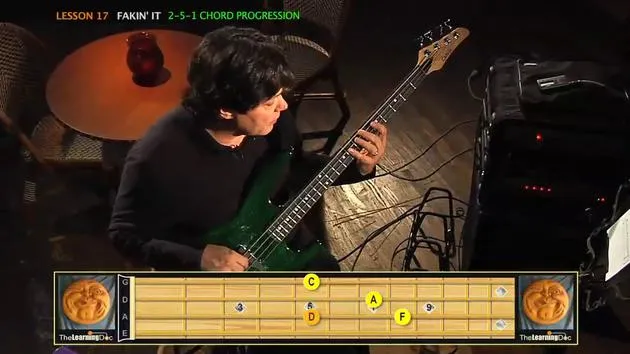
Transkript der Lektion
Music Lesson: Understanding Chord Progressions
Okay. Now, a lot of times when I'm working in a live music situation, I'll have to hear a chord progression and come up with a bass line on the spot. This is what's called faking a tune. It sounds like it's going to be a really difficult thing, but there are a few formulas that we can use to help hear the chord progressions.
These are called standard chord progressions, and they really do help you organize these tunes.
The 2-5-1 Progression
The first one is what is called a 2, 5, 1 progression.
- If we go back to our modal section, there was a two chord on the C, which was the D minor seven.
- There's your diatonic two, here's your diatonic five, and then here's your diatonic one: D minor seven, G seven, C major seven.
Common Use
A lot of standard tunes utilize this progression over and over again. For example, I just played:
- D minor 7
- G7
- C major 7
- C minor 7
- F7
- B flat major 7
- B flat minor 7
- E flat 7
- A flat major 7
- A flat minor 7
- D7
- G flat major 7
Playing Tips
When I start hearing those progressions, I don't really have to grab the third. If I can hear it, great! But one of the things I can do is just play roots and fifths.
- That's a good way to kind of get around this.
- If I have a chance to hear the third, I can put that in as well.
- Once again, just get used to hearing the two, five, ones, and so forth.
Turnaround Progressions
There are two different kinds of progressions that we call a turnaround that are used in different tunes.
1-6-4-5 Progression
One of them is called a 1, 6, 4, 5 progression.
- If you listen to a lot of 50s and 60s rock and roll, you'll hear this one.
- Essentially, a 1, 6, 4,5 progression in the key of C would be:
- C major (1)
- A minor (6)
- F major (4)
- G major (5)
Adding Sevenths
If I want to add sevenths to that:
- C major 7
- A minor 7
- F major 7
- G7
Chord Sound
Here's how the chords sound. That's how you might hear it in a 50s rock tune. A lot of times, you can hear that, and within a couple of passes, you'll be able to kind of figure out where things are.
Positioning with Piano Players
If there's a piano player, a lot of times I'll try to sit close to where his left hand is. This is particularly useful if the piano player is more familiar with the tune than I am; he can kind of feed me the roots.
- It's also a good idea to get some familiarity with the piano keyboard so that you can read the notes and then match once again.
- You can start with just the roots and you can add approach tones, particularly if you're walking.
1-6-2-5 Progression
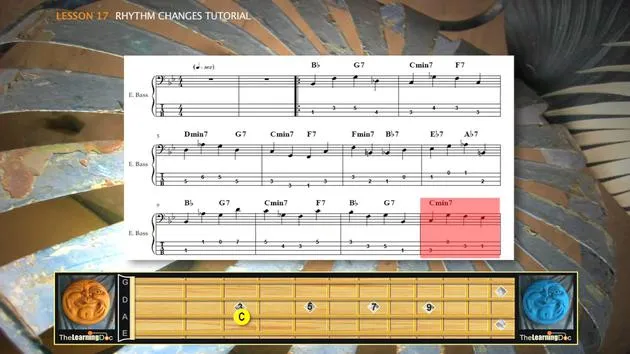
Now, there's a cousin of this that you see more of in standard tunes. This is called a 1, 6, 2, 5 progression.
- I'll play one in B flat.
- This is sometimes called a rhythm changes progression because it's based on an old Gershwin tune called "I've Got Rhythm."
- Many jazz musicians use this as a standard progression for their tunes.
Examples
You get tunes like:
- The Theme by Miles Davis
- Olio by Sonny Rollins
- A lot of the 30s and 40s pop tunes as well
Walking Through Chords
If I'm going to be walking through that, a safe choice immediately, if I can hear the 1, 6, 2, and 5, would be to either play just roots.
- You want to break up the rhythm to avoid sounding repetitious.
- With a swing line, you want to randomize that stuff.
Adding Complexity
The next step here would be to add the fifth, followed by adding an approach tone (half step, half step, half step).
The 1, 6, 2, 5 can either be:
- A major to A minor: so it's like one major (B flat major seven) to six minor (G minor seven) to a two minor (C minor seven) to an F7.
Secondary Dominants
You can also use what would be called a secondary dominant.
- A secondary dominant is just kind of a five chord that leads to another chord.
Example
If I go from a B flat major 7 to a G7, that G7 is really functioning as a V chord of the C minor 7.
Even though we're still in the key of B flat, you would have: G7, C minor 7, and F7.
5 Lektionen
2 Std. 17 Min. strukturierte Videolektionen
Erweiterte Videofunktionen
Verlangsamen, Passagen loopen, mitlesen
Handy, Tablet & Desktop
Üben, wo du willst
100 % Zufriedenheitsgarantie
30 Tage Geld-zurück-Garantie
Lern deinen Guru kennen
Lern deinen Guru kennen
Roy Vogts Karriere umspannt eine außergewöhnliche Bandbreite an Bühnen, von MTVs Headbanger's Ball, dem Montreux Jazz Festival und dem Montreal Jazz Festival bis zum London Palladium, der Grand Ole Opry und dem Kreml. Von Punk bis Funk, von der Schlichtheit von Country und Blues bis zur Komplexität von HyperJazz und World Beat - er hat alles gespielt.
Roy war der erste Mensch, der an der renommierten Musikhochschule der University of Miami einen Master in E-Bass-Performance erwarb, und er widmet sich seit über vierzig Jahren der Kunst des Basses. Er war Mentor Dutzender erfolgreicher Profis, darunter der legendäre Willie Weeks. Elektrisch, bundlos, Kontrabass - was auch immer: Wenn es tiefe Töne spielt und Saiten hat, ist Roy ein Meister darin, es zu spielen und anderen beizubringen, dasselbe zu tun.
Im Laufe seiner vier Jahrzehnte währenden Karriere hat Roy mit einer erstaunlichen Liste von Topstars aufgenommen oder gespielt, darunter Larry Coryell, Victor Wooten, Dave Weckl, Tom Scott und der LA Express, Chester Thompson, Miroslav Vitous, Glen Campbell, BJ Thomas, Chet Atkins, Engelbert Humperdinck, Dickey Betts, Tony Joe White, Charlie Daniels, Jerry Reed und viele Dutzend mehr.
Roy unterrichtet seit dreißig Jahren auf Hochschulniveau. Seit 1983 hat er den Lehrstuhl für Bass an der renommierten Belmont University (Nashville, TN) inne, einer der ganz wenigen Hochschulen, die einen Studiengang in kommerzieller Musik anbieten, der darauf ausgelegt ist, Studierende zu professionellen Musikern an der Spitze der Branche zu machen. Roys Studenten sind mit namhaften Stars wie Trisha Yearwood, Faith Hill, Little Texas, Michael W. Smith, Lady Antebellum, Chick Corea, Sir Tom Jones, Blood Sweat and Tears, Yanni und unzähligen weiteren Musikikonen getourt und haben mit ihnen aufgenommen.
Seine Serie Teach Me Bass Guitar bringt dir genau diesen Ansatz auf Hochschulniveau nahe und führt dich vom Schnellstart für absolute Anfänger (Vol. 1) über Rhythmusgrundlagen (Vol. 2), das Finden deines eigenen Stils (Vol. 3) und ernsthafte Musikalität (Vol. 4) bis hin zu einem Werkzeugkasten für Profispieler (Vol. 5), damit du Schritt für Schritt echte Fähigkeiten aufbaust.







