



Analyse, Erklärung und Demonstration mit Frans Helmerson
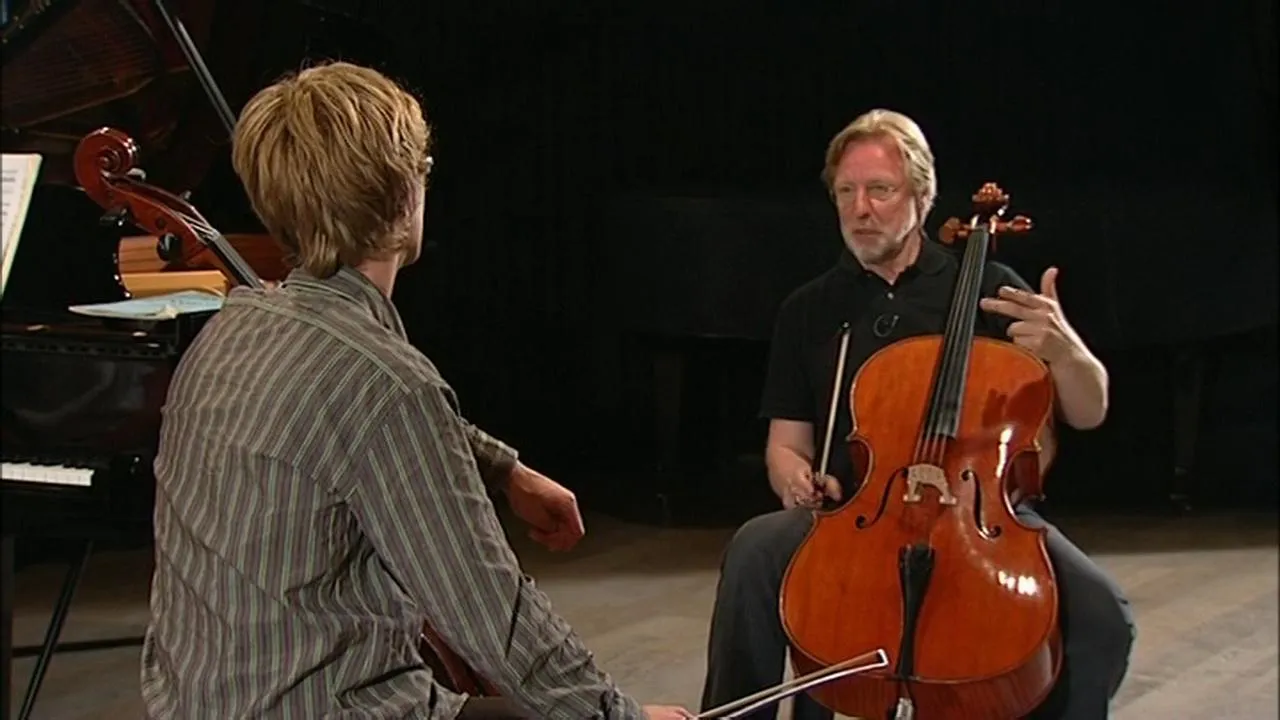
Das steckt im Kurs
2 Lektionen (0h 40m) · 1 gratis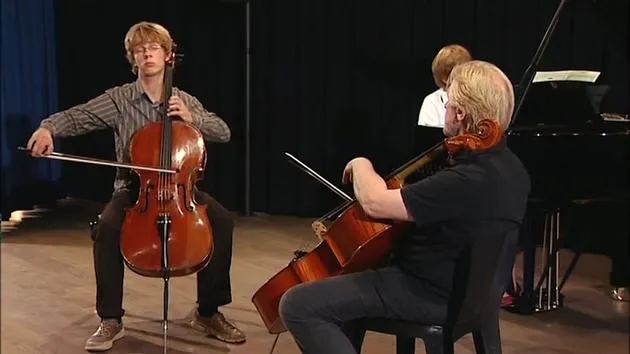
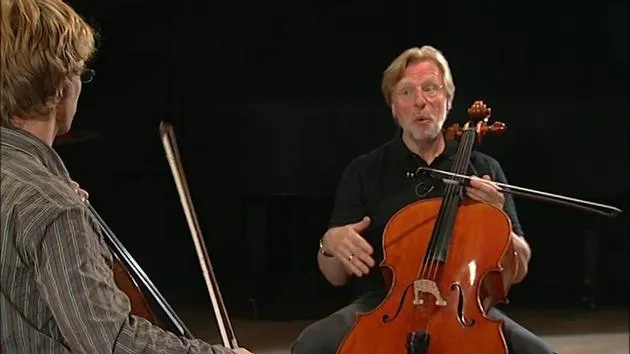
Transkript der Lektion
Music Lesson
Bravo. Beautiful.
I like very much. It's very musical and very honest playing. I think I like that.
Schubert's Unique World
You know, of course, Schubert is always such a special world, a world that belongs to Mozart, and to, in a way, Beethoven and Mendelssohn, several of the figures around Schubert.
But what he does with time, what he does with harmony is so incredible. What he does with the rhythmical language.
Transitions in Music
And this, in my opinion, is what creates problems. It is as if transitions... For example, when you get to a transition in the music, when you read the music, it's obvious. The phrase goes from there to there, and then the next phrase starts from there, and it goes until there.
But actually, when you get there, it's like it has already started the next phrase. And that's what is so difficult. You play is immediately there, and you have to close in a way, but at the same time, you must be so aware of how it continues.
When it continues, it is completely the right sound, the right emotional language, the right expression, the right dynamic.
Contrast with Beethoven
Of course, it's the opposite to Beethoven in many ways because, in some of his music at least, it is so crystal clear what is what. Here is this, here is this, and it contrasts with each other.
Here you have everything in transition. Everything is transition somehow, and that's what makes it a little difficult.
Musical Honesty and Phrase Shaping
Where I feel that you are so musical and where you are so honest is how you shape each phrase. But you're not yet on the stage where you connect in the transition.
Actually, I feel each phrase exactly where it goes, and I feel exactly where the next starts. And actually, it has already happened, so to speak.
You know, it's a little like in the language of dynamics in music. Many times when you have a hairpin in the music, it looks like it should grow crescendo, and there starts the diminuendo.
But mostly, you need to grow a little before that place. If you grow to that place, it's already too late, right?
Anticipation in Performance
It's a little the same with the shaping of the phrasing here in the music. You always have to anticipate everything.
Anticipation is the word that one needs to remember all the time when you play this very, very well. Let's try again.
As if already... When you play the first note, you have to be with your mind in the second note already. And when you play, you have to be there, now you have to be there, and you have to be there, and you have to be there. You are always in front of yourself.
Technical Aspects
Beautiful, beautiful beginning. Also, technically, it's like you need to be already on the bridge that takes you here, so that we don't have this kind of corners in the technique either.
Maybe you can do a little more technically. Can you avoid this obvious glissando? I think you have to be a little smart with a bow also.
You see, this has to have a clear color. This top note is the top note so far from here, and now we're there.
Dealing with Time
What I mean is, one of the things that are so important is how you deal with time. By the end of the shape or the phrase that you use, the stretch, you do the stretch where it's obvious that the stretch has to be.
But not by the end, because that is a bad habit. I think you can only live once, like summer. You can only experience it once a year.
Creating Intimacy
Exactly. Yes. And now we come into Schubert's salon a little. No, it's not... You know, this is a piece that I really feel is composed for a small group of people.
So, of course we hear it in Carnegie Hall also. But if you perform it in Carnegie Hall, you should not perform it for Carnegie Hall. You should make the audience in Carnegie Hall come to you simply; otherwise, it easily grows out of proportion and becomes a little aggressive. So be careful with that.
Expressive Movements
But yes, you make such beautiful movements with your head when you do this. Exactly, exactly the right shape with the head.
Can you do it with the bow?
Still sounds a little stiff. Tara, Tara, Tara, Tara.
Can you finish the taram with an M or an N?
Don't get serious. Don't make it sound serious just because it's more difficult.
Artistic Interpretation
No, not a rhythm of 2/8 notes, but a shape of 2/8 notes.
Y. Bravo. Very good, very good!
It just sounds like this. You forget about that last one; already we are in our thoughts. We have to be to the next, yes.
For the whole, you know, you're very musical in the way you think. But actually, in the piano, it doesn't... it's not like that. So go with that.
Can it sound not like... yes, not 1, 2, 3, 4?
1, 2, 3, 4.
It's better. It's better because I hear that you think about it, but it's still not artistic enough. That was my feeling.
Moving to the Next Stage
You see, when you played through earlier, it was very musical but not artistic. That's the next stage that you have to take it to: each articulation, each figure, each little motive, each theme here, it has to have its own world and its own character and its own emotion and expression or energy or whatever.
This takes anticipation.
Bow Techniques
Maybe you can find a closer way to get between the string and... no, you make a big angle here. Can you find a way to let the bow move more inside the hand like this, so that you don't fix your fingers too much on the bow?
Because then you have to do everything with the arm. The bow should do some of the work, and the arm does the rest.
Yes, it's like you need to know exactly which is the medium level that you go down from, and that you go up from, so that you don't go from down to up too much.
Exploring Emotions
Can you show suddenly, with this funny scale here, it darkens? But of course, like always in Schubert, it doesn't darken to real tears; it just darkens to seriousness, which is then resolved again.
There's always the interplay between the melancholy and the small smile. And in the smile, you have the melancholy and the sadness. You have the smile. You have both always.
Clarifying Goals
This really wants to... this E flat, I think. I don't know if you should stop here before. Tarata tatarata. It comes back.
Try to find another solution so that you do it a little earlier than what you want to do here.
Because it needs some time somewhere, but not that it's... yes. This note already doesn't feel like the goal. Yeah, because the goal is... I'm not sure where the goal is. It goes between levels here the whole time.
If you can feel that, how you shape, but also how you connect. It's very paradoxical, but that's how it is in Schubert.
Letting Go of Fear
Let it go. Don't be afraid of sentimentality. It has to be sentimentality with great feeling of taste in it. But don't be afraid of it.
You know, just to understand the difference between the harmonies when you are making the repeat or when you go on. The difference is important to feel, I think.
First time, when it is a clear dominant chord, it's important that, ah, this time it's more like putting a question mark.
Can you just do the chords a little more from you?
Yes, yes. Because otherwise, it gets lost in our ear, you see?
It is just like that shape... with her shape for her. Yes. Don't get stuck in figures of 8th notes. Don't get stuck in anything in the music which looks regular.
Playfulness in Performance
Can you do a game from change? Yes. Once more. Once more. Yes.
Also like talking. And this word is more important than... because it's like an appoggiatura. Right? Not both notes with the same sound.
More playful. It's a little too much. Little too much work from here, you see.
Find a better place on the bow where the bow can help you to do... I haven't practiced this. That's why I don't...
Yes, you don't need to be too stiff here. Directly, directly.
I think this time it's not a bad idea just to go right into it. Yes, it's like a magnet that pulls you to it, you see?
Dynamic Control
You choose, it's of course, diminuendo, but it's a little too simple with only diminuendo. Each note should be part of a diminuendo that just falls.
They have different places, I would say different vowels in them, you see?
Yes. When it comes to things like this, that move over the whole register on all four strings, I try to think like this.
I love the color, the very specific color of each string. Not always thinking to make the sound and the cello as equalized as possible, but really very different colors in the sound, like different voices.
Conclusion
Now G string. And now C string. Yes. Tell me, because I'm provoking you a little now to go forward.
Maybe you thought the other way around, because that's also possible. No, it should be, should be moved. Yes. Then move it. Move it with a sound.
Because you moved it with tempo somehow, but a little with this kind of bosom.
Yeah. Let a lot of air into the sound. Beautiful.
And she has the main thing, no, you do a little of the same thing each time. I think we need to feel the second and the fourth beat in the bar. Not taranta.
Yeah. This time, not. Yeah. Good, good, good.
Can you just... can you make sure that you just go with a pulse? You're always here in these bars that come now.
With the first and the third beat, you can be very free, but not with the first and third beats. You vibrate on the first note also, so that's okay already. But with a bow, you do something; you're a little too careful with the bow stroke.
Taking Risks
You need to take a little more risk. But you see, it's not as simple as you make it. I think like three sequences, that's more... a little more painful.
And again, I played just for the color, so just to change color. But this is possible also here. Not wary.
Closing Remarks
Thank you very much. Thank you. Thank you, Catherine. Thank you very much.
2 Lektionen
0 Std. 40 Min. strukturierte Videolektionen
Erweiterte Videofunktionen
Verlangsamen, Passagen loopen, mitlesen
Handy, Tablet & Desktop
Üben, wo du willst
100 % Zufriedenheitsgarantie
30 Tage Geld-zurück-Garantie
Lern deinen Guru kennen
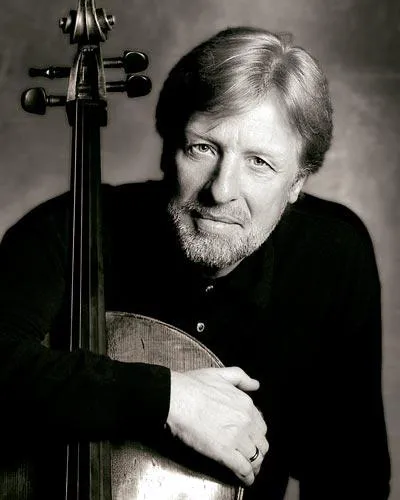
Lern deinen Guru kennen
Der schwedische Cellist Frans Helmerson wurde 1945 geboren und begann im Alter von 8 Jahren, Cello zu spielen. Nach Studien in Göteborg, Rom und London, gefolgt von einem Debüt in Stockholm, hat ihn seine Solokarriere auf unzählige Tourneen durch ganz Europa sowie in die USA, nach Asien und Russland geführt. Er ist mit vielen der besten Orchester unter der Leitung einiger der größten Dirigenten unserer Zeit aufgetreten.
Ein wichtiger Aspekt von Frans Helmersons Musikertum ist die Kammermusik, und er ist häufiger Gast bei einigen der bedeutendsten europäischen Festivals. Er ist künstlerischer Leiter der Umeea-Korsholrn International Chamber Music Festivals im Norden Schwedens und Finnlands.
Frans Helmerson arbeitet als Dirigent regelmäßig mit skandinavischen Orchestern. Er hat zudem Professuren an der Musikhochschule in Köln inne, wo er ansässig ist, sowie an der Escuela Superior de Música Reina Sofía in Madrid.
Seine Aufnahmen sind beim Label BIS erhältlich, darunter eine Wiedergabe des Dvořák-Konzerts, die von der Kritik als eine der besten Aufnahmen des Werkes gefeiert wurde. Seine Aufnahme der beiden Cellokonzerte von Schostakowitsch für Chandos mit der Russian State Symphony Capella unter der Leitung von Valery Polyansky wurde von Musikkritikern in aller Welt gepriesen.
Als Lehrer bringt Helmerson diese Tiefe auch dem Schüler nahe. Indem er das Cellorepertoire Phrase für Phrase durcharbeitet, teilt er die Bogenführung, Tonbildung, Phrasierung und interpretatorischen Entscheidungen hinter einer wahrhaft singenden Linie – die hart erarbeiteten Einsichten eines Lebens auf der Konzertbühne.







