



In den Groove kommen - Basslinien

Mit
Tim RichardsTim Richards geht die Basslinien-Stile durch, die dir in diesem Kurs begegnen — Walking Bass, Two-Feel und lateinamerikanische Grooves in geraden Achteln — und wie sie die Akkorde deiner linken Hand stützen.
Das steckt im Kurs
16 Lektionen (0h 31m) · 1 gratis
Transkript der Lektion
Exploring Bass Lines and Chord Voicings
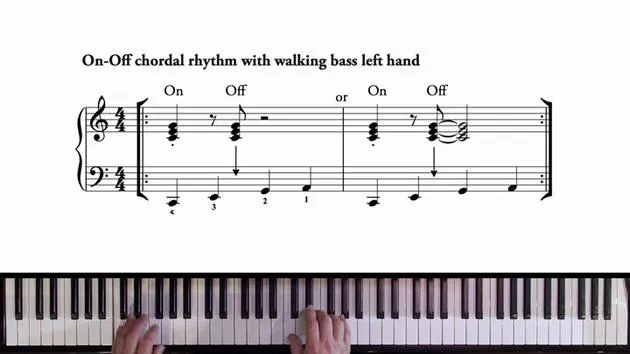
So, on the backing track, you just heard a bassline as an accompaniment for your left-hand chords. If you're playing with a friend or teacher, you can always get them to play this bassline , that makes it more fun!
Different Types of Bass Lines
Let's run through some of the different types of bass lines you're going to find in the pieces of this course:
-
Walking Bass Line:
That's four quarter notes, a bar kind of thing. There are many variations of this. -
Two Feel Bass Line:
This consists of two beats per note, usually using the root and fifth. It will sound more like this. -
Straight Eighths or Latin Groove:
Again, you might have roots and fifth played more like this. -
Syncopated Patterns:
Often occur and will sound something like the example I just played.
You don't actually need to play these bass lines at the moment because they're all on the backing tracks for you. But eventually, it would be nice if you learned them. We'll be doing that more in part two. For now, you can check them out on the attached PDF.
Adding Color to Your Playing
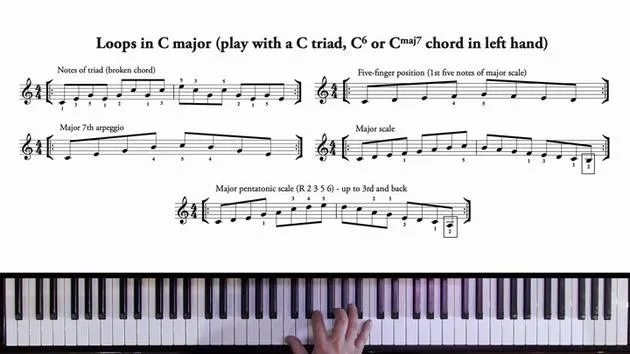
In Arpeggio Fun, if you restricted yourself to the root, third, and fifth of the chord as I suggested, there will be absolutely no dissonance. However, music without dissonance can be a little dull.
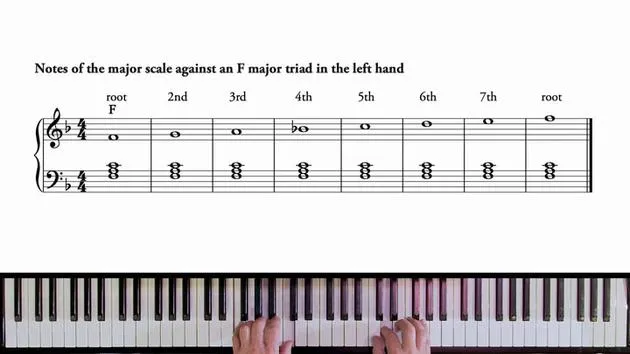
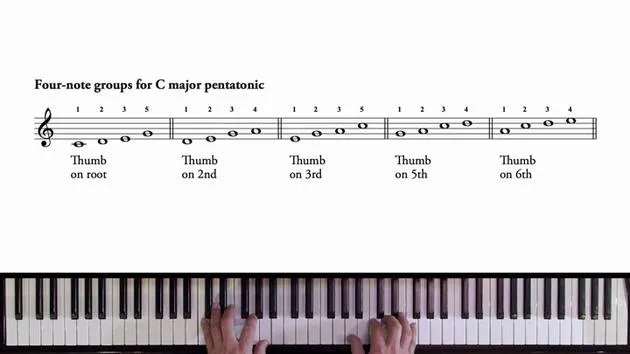
It would be interesting to experiment with adding extra notes from the scale. For instance, we can start in a five-finger position by playing the first five notes of the scale against the chord and seeing how they sound. This is kind of easy because you don't have to worry about the fingering , everything's taken care of!
Be Mindful of the Fourth
However, be careful that you don't get the fourth on the wrong foot. By that, I mean something like this: the fourth is on the beat at the same time as the chord. Some people would call that an "avoid note." That doesn't mean you should never play it; it just means you shouldn't stress it or come to rest on it.
There are lots of phrases used in jazz that include the fourth. For instance, consider this Charlie Parker lick. You can play that with a chord, no problem, because the fourth is a passing note.
Experimenting with Scale Notes
Let's try some of the other notes from the scale:
-
Second:
Let's see what it sounds like if you put that on the beat. Sounds pretty good to me! -
Sixth:
No problem. -
Seventh:
Again, these sounds are more interesting than just playing the root, third, and fifth. None of them create a clash like the fourth does.
One Chord Jam
The next piece, One Chord Jam, gives you a chance to apply this , not only using notes from the scale but still using the arpeggio. You can mix them up as you like!
16 Lektionen
0 Std. 31 Min. strukturierte Videolektionen
Erweiterte Videofunktionen
Verlangsamen, Passagen loopen, mitlesen
Handy, Tablet & Desktop
Üben, wo du willst
100 % Zufriedenheitsgarantie
30 Tage Geld-zurück-Garantie
Lern deinen Guru kennen
Lern deinen Guru kennen
Der von der Kritik gefeierte Jazzpianist und Komponist Tim Richards ist einer der erfahrensten Jazzpädagogen Großbritanniens und unterrichtet seit über 30 Jahren privat Klavier sowie am Morley College, am Goldsmiths College, an der University of Surrey, in den Premises Studios und an weiteren Orten im Vereinigten Königreich und im Ausland. Er hat zahlreiche Titel für Schott Music produziert, darunter die zweibändigen Bestseller Exploring Jazz Piano, Blues, Boogie & Gospel Collection und das gefeierte Improvising Blues Piano. Gemeinsam mit John Crawford ist er zudem Koautor von Exploring Latin Piano und Brazilian Piano Collection.
In jüngerer Zeit hat Schott Jazz, Latin & Modern Collection (15 Stücke für Klavier solo) veröffentlicht, das Originale von Tim Richards neben Stücken von Duke Ellington und Thelonious Monk vereint, sowie das zweibändige Set Beginning Jazz Piano (jetzt ein zweiteiliger MusicGurus-Kurs).
„Die wahre Freude an Tims Musik… liegt darin, dass sie zugleich enorm lehrreich und ein großes Vergnügen zu spielen ist. Jeder, der auch nur das geringste Interesse daran hat, Jazzpiano zu lernen oder zu unterrichten, sollte sich unbedingt eine Sammlung von Tims Büchern zulegen.“ PianoDao
Als Interpret ist Tim seit den 1980er-Jahren eine feste Größe der britischen Jazzszene und spielte auch den Blues mit britischen und amerikanischen Legenden wie Otis Grand, Earl Green, Dana Gillespie, Larry Garner, Joe Louis Walker und Mojo Buford. Er hat über ein Dutzend Alben als Bandleader veröffentlicht (mit vielen der besten Londoner Jazzmusiker, darunter Pete King, Gilad Atzmon, Tony Kofi, Jason Yarde, Seb Rochford, Ed Jones, Dick Pearce und viele andere) und ist mit Besetzungen vom Duo bis zum Nonett durch ganz Europa getourt. Seine jüngste Aufnahme, das Album ‚Telegraph Hill‘ des sechsköpfigen Hextet, wurde im The Observer als "Eine wahre Freude von Anfang bis Ende" beschrieben.
Weitere Informationen finden sich auf seiner Website www.timrichards.ndo.co.uk







