



Woh Yeah (Analyse)
Lesson time: (5min 9sec)
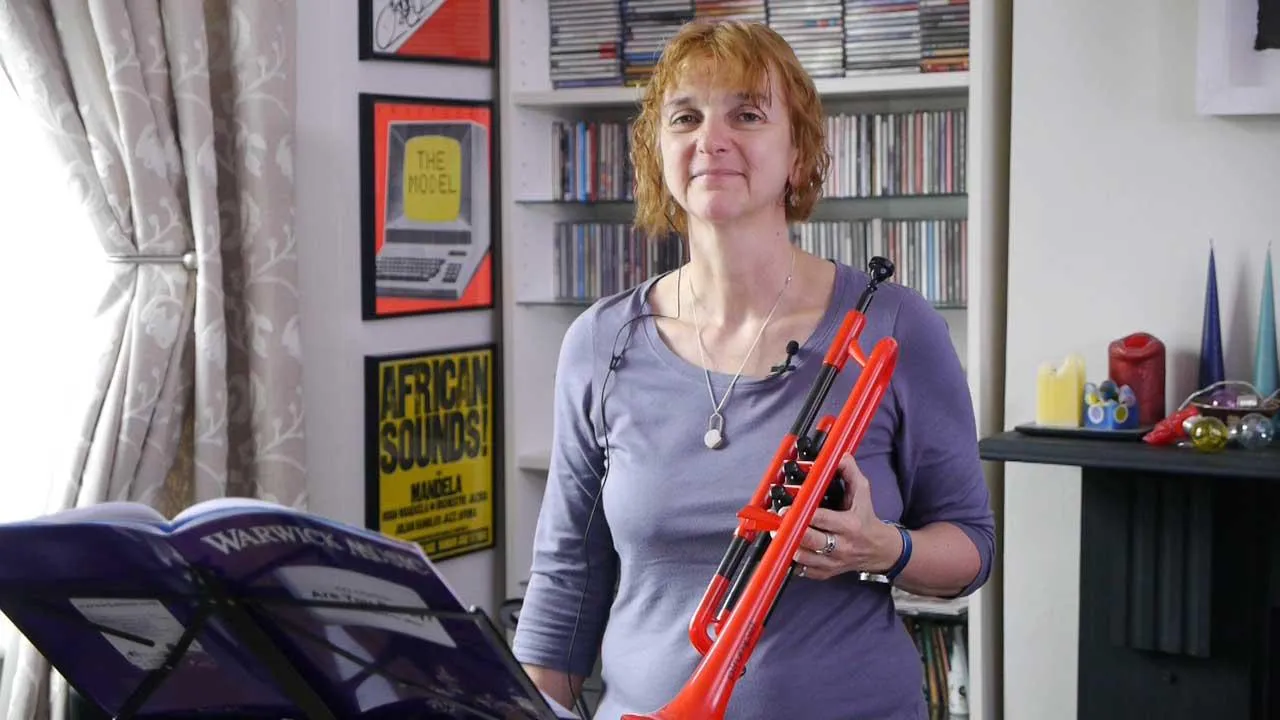
Kay Charlton nimmt 'Woh Yeah' auseinander, ein Trompetenstück für Anfänger, das nur zwei Noten verwendet, C und D, mit Bodypercussion in der Improvisationssektion.
Course preview
This lesson is part of the course Are You Ready Teil 1: 5 Stücke für Trompeten-Anfänger
Watch a preview of the full course below.
Lesson transcript:
Music Lesson: Exploring Two Notes
Introduction
So this song uses, again, two notes:
- C with no fingers
- D with two fingers
Don't forget to press that third valve all the way down quite firmly!
Body Percussion
This song also uses some body percussion, which means making up rhythms and sounds with different parts of your body. Here are some examples:
- Click your fingers
- Slap your knees
- Clap your hands
- Do a chest clap
These can all be part of your improvisation section.
Starting Actions
So let's get started! I'm just going to put my trumpet down because you need your hands free.
- Start with some simple actions.
- Click your fingers while pushing your hands forward and giving it a psh.
- Say "ta" each time:
"And every time we say ta or da in this song, you're practicing your tonguing as well."
So, when you get to play the song, your tonguing should be really nice and crisp.
Putting It All Together
The first bit is:
And then we do the title of the song with a crescendo. We're getting louder as we do this. Clapping. Whoa. Yeah. And put your hands up in the air for the.
Yeah! At the end of that, let's put that whole section together:
Count: 1, 2, 3, 4.
Oh, yeah, great!
This goes around twice.
Quick Instrument Transition
When you're doing that with the track, you'll need to pick your instrument up quickly. Practice doing that , putting it into your hand and getting your fingers ready.
Practicing Notes
The song uses two notes and again we've got some words.
- The first bit is:
- I'll put my fingers down while I sing it.
- Play in time.
Count: 1, 2, 3, 4, 5.
Now, that's quite easy because how many C's am I doing? I'm giving you a big clue.
- You play 1, 2, 3, 4, 5.
Let's just practice that bit. Get your tongue working:
Count: 1, 2, 3, 4.
Dynamics
Did you notice I'm getting a bit louder when I play that phrase? We call that a crescendo. Getting louder means you need to blow a bit more air through as you go through those five notes.
Listen to me again and try to get louder through those notes.
Playing Together
Let's play those four bars. Start on D.
Count:
Right after four:
1, 2, 3, 4.
2, 3, 4.
1, 2, 3, four, five.
Here we go.
And again.
Ready? Well done!
Next Part: Piano
The next part of the song, after four bars rest, is quiet.
So we're playing piano, thinking about our dynamics, playing softly.
Count: 1, 2, 3, 4, 5, 5.
Let me just play this bit:
- It's a D, then a C, then a D, and then we count to five.
Ready?
Count: 1, 2, 3, 4.
Well done!
Creativity Section
So that's the tune of the song. As with every song in this course, there's a section for you to make up your own music.
Sometimes I give you copybacks to inspire you, or you can just make up your own ideas. You can also create your own body percussion ideas.
Copyback Practice
Let's try some copybacks now! I'm going to play something for four beats and then you can copy it back.
Remember, we're only using C and D. Don't forget to tighten up the corners of your mouth when you go for the D.
Get ready to copy me!
Trumpet ready? Here I go:
1, 2, 3.
Well done!
When you're listening to the backing track, you can either use my ideas or make up your own. Remember to leave plenty of space; you don't have to play all the time.
You can imagine that you're playing a question phrase and then try an answer phrase using the same two notes.
Well done!
About the instructor
Kay ist Trompeterin, Komponistin und Lehrerin für Blechbläser und Lehrplanmusik, spezialisiert auf den Klassenunterricht in der Grundschule - KS2, First Access/WCET (Klassenensemble-Unterricht, bei dem eine ganze Klasse gemeinsam ein Instrument lernt) und Lehrer-CPD (kontinuierliche berufliche Weiterbildung). 2018 schloss sie einen Master in Musikpädagogik - 'Teaching Musician' am Trinity Laban Conservatoire ab. Kay spielt Trompete in der Bollywood Brass Band, einer neunköpfigen Band aus Blechbläsern und Schlagzeug, deren CD Carnatic Connection von 2017 für einen 'World Music Award' des Magazins Songlines nominiert wurde und im London Evening Standard eine 5-Sterne-Kritik erhielt. Kay komponiert und arrangiert für die Band und leitet ihre Bildungsarbeit; 2017 gründete sie die Bollywood Brass Academy. Kay hat ihre Forschung zum Klassenunterricht auf der Music Education Expo und beim First Access Forum präsentiert. Sie hat CPD für LSO Discovery, Trinity College London, Music Education Solutions und die Bollywood Brass Band konzipiert und geleitet und ist Bildungsberaterin für Warwick Music. Kays Buch mit Anfängerrepertoire, 'Are You Ready?', erscheint bei Warwick Music; 2017 wurde Kay von Warwick Music und Music Education Solutions beauftragt, Lieder für ein neues KS1-Unterrichtskonzept für das pBuzz zu komponieren, das von den 'Education Awards' als 'Education Resource of 2018' nominiert wurde. Zu weiteren Veröffentlichungen zählen Stücke für Trinitys Klavierlehrplan Initial (2015/2018) und Grade 1 (2018), Bollywood Blast! (Spartan Press) - eine Reihe von Blechbläser- und Bläser-Lehrbüchern mit Begleit-Tracks im Bollywood-Stil - und Whole Class Bollywood Blast mit David Rose (Bedford Music Hub), das sich an Lehrkräfte für Instrumentalunterricht in ganzen Klassen richtet und ein Arts-Award-Discover-Programm enthält. Ihre MusicGurus-Kurse bringen dir diese Unterrichtserfahrung direkt näher: von deiner allerersten Trompetenstunde über zwei Sammlungen von Stücken für Anfänger legt Kay genau dar, was zu spielen ist und wie man es spielt. www.kaycharlton.co.uk read more