



Maiden Voyage (Analysis)
Paul Elliott breaks down ‘Maiden Voyage’, a Grade 3 indie-rock piece in the vein of the Killers and Blondie, with tips on its ride-line variations and keeping a 16th-note feel.
What's in the course
26 lessons (2h 36m) · 1 free
01. Standard – Stormzy
1:28
02. You Really Got Me – Van Halen
1:36
03. Word Up – Cameo
1:55
04. Rapper’s Delight – Sugarhill Gang
1:56
05. Smooth – Santana
2:01
06. Play That Funky Music – Wild Cherry
1:57
07. Overrated
1:59
08. Old Bones Blues
1:57
09. Indecisive
1:53
10. Maiden Voyage
2:01
11. Reggae Island
Free lesson1:56
12. Fallout
2:01
01. Word Up – Cameo (Analysis)
8:13
02. Standard – Stormzy (Analysis)
10:23
03. You Really Got Me – Van Halen (Analysis)
10:31
04. Rapper’s Delight – Sugarhill Gang (Analysis)
11:17
05. Smooth – Santana (Analysis)
7:46
06. Play That Funky Music – Wild Cherry (Analysis)
10:26
07. Overrated (Analysis)
15:30
08. Old Bones Blues (Analysis)
11:41
09. Indecisive (Analysis)
15:20
10. Maiden Voyage (Analysis)
You are here16:46
11. Reggae Island (Analysis)
2:54
12. Fallout (Analysis)
8:39
Lesson transcript
Music Lesson: Maiden Voyage
Introduction
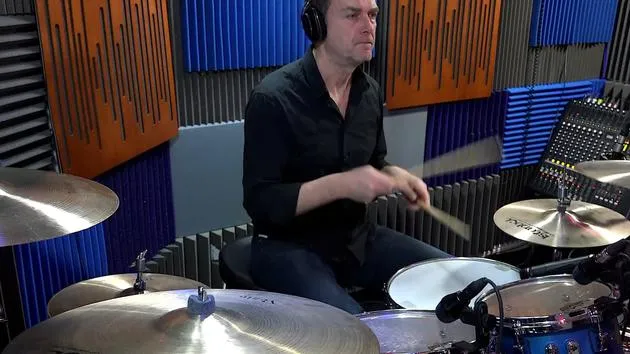
Okay, let's take a look at Maiden Voyage, which is an indie rock piece influenced by the likes of the Killers and Blondie.
- Blondie have been around a long time with the great Clem Burke on drums.
- In recent years, the Killers have kind of picked up that theme and stylistic approach with Ronnie Vannucci, another really great drummer.
Check out Ronnie and Clem with the Killers and Blondie, respectively, if you want to get a taste of this style.
Overview of the Piece
There's a lot going on in this piece:
- Sections: Many different ride lines
- Approaches: Various ways to play the time
- Rhythms: Floor tom ride lines, 8th notes, and 16th notes
We're throwing a lot into the pot here in this style, and I'll get through as much as possible to give you some tips on how to approach that.
Important Concepts
Feel and Internalization
- The first thing I would say, as always, is to get a good time feel in your mind right from the start of the count.
- I would be thinking 16th notes on this, because there are quite a lot of 16th notes in the tune.
Even when you're playing 8th notes, it's good to feel 16th notes if the tempo is not too fast. This is quite a nice tempo for feeling 16th notes even when you're just playing 8th notes.
Intro Section
We're coming straight in with this 8th note ride line feel on the tom, broken up between the snare and various tom hits.
- I won't explain what's going on; you can see from the chart what you need to play and watch my performance of it.
- It's important to set yourself up from the intro.
Think about the rhythm:
"1, 2, taka tiki taka tiki taka tiki taka taka boo doo da da da da da da da Badu do badu badu."
Really think about those intro bars.
- Sing the tune: "Do badu do badu badu bade do badu bad."
- This will give you a good start.
Practicing Techniques
When you're practicing, break it right down slowly and piece it together.
- When you practice the whole piece or even just the intro section, then sing that melody before it comes in: "1, 2, 3, 4, ding ba da da da."
You'll benefit greatly from doing this to piece it together.
Unison Feel
It's largely a unison kind of feel. Be careful not to flam.
- It's important to not have big flams when playing unisons.
- A very minor thickening of the note is okay in a unison, but we don't want it to flam too wide.
Dynamic Practice
As you practice, incorporate dynamics so it doesn't sound like a machine.
- It's crucial to build in some inter-dynamics to those parts, as this concept runs through a lot of sections like the E section and the development section.
Once you've got that coordination together, think about balancing those dynamics.
Transitioning Between Feels
We've got an 8th note hi-hat feel going into a 16th note feel as well. Remember:
- When moving from 8th notes to 16th notes, you can experience a speeding up effect that's very common.
Push Section
In the push section, we've got some cymbal pushes:
- The feel is groups of three: "1, 2, 3, 4, ba ba 2, ba ba ba 2, 3, 4."
You need to decide what sticking to use, which you should determine before you play the tune or practice.
Fills
Keep the fills simple and solid:
- 8th notes, 16th notes, or maybe even 8th note triplets.
- As always, play with conviction, nothing too flashy, just steady, setting yourself up for the next fill.
Practice Techniques
- Practice the 8th note feel into a 16th feel.
- Focus on maintaining a clean 16th note feel, playing on top of the hi-hat for the most part.
Development Section
We have a development section with:
- Floor tom feel
- High tom feels
Just keep the same style and dynamic in mind.
Conclusion
Importantly, as you prepare:
- Break everything down.
- Take your time and don't hesitate to practice any section repeatedly.
- Work with your teacher, think about good time, and always consider the physical technique and sound you're aiming for.
Check your gradebook for the overview in the walkthrough section, and you'll be fine.
It's a great tune with lots going on. Be methodical, break it down, and everything will work out just fine. Preparation is key in the examination.
Best of luck with Maiden Voyage! See you soon.
26 lessons
2h 36m of structured video lessons
Advanced video features
Slow down, loop a passage, follow along
Mobile, tablet & desktop
Practise wherever you are
100% satisfaction guarantee
30-day money-back guarantee







