



Si bémol grave, Mi bémol et Si bémol aigu - Doigtés et exercices
Avec
James RaeJames Rae aborde les doigtés du Si bémol grave, du Mi bémol grave et du Si bémol aigu au saxophone, avec des exercices pour faire sonner chaque note proprement.
Copyright © 2023 Universal Edition (London) Ltd., All compositions by James Rae except where otherwise indicated.
Le contenu du cours
22 leçons (0h 58min) · 1 gratuites
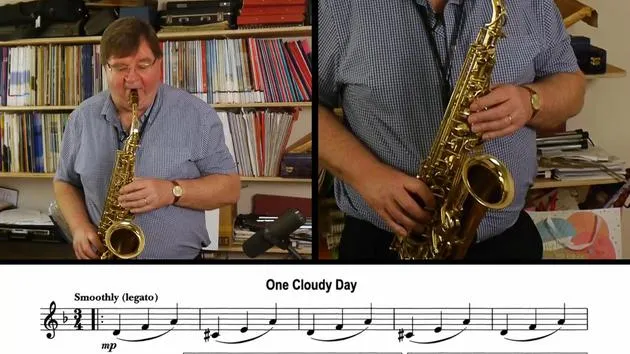
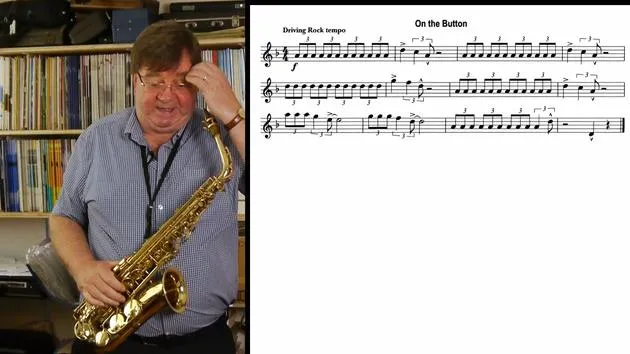
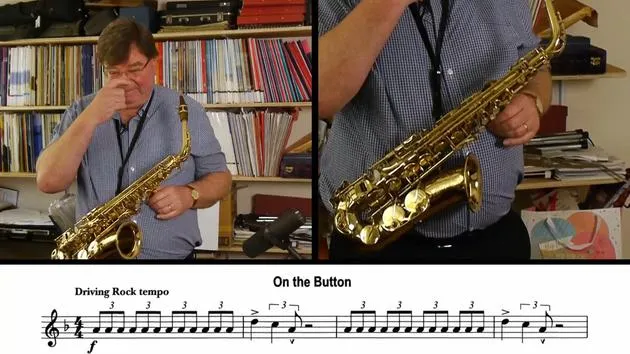
Transcription de la leçon
Music Lesson: Exploring the Low Notes on Saxophone
Introduction to the Lowest Note
Now to the lowest note on the saxophone:
Bottom B flat, low B flat, or whatever you like to call it.
It is the lowest note the saxophone can produce when you finger it.
- Every hole in the saxophone is closed.
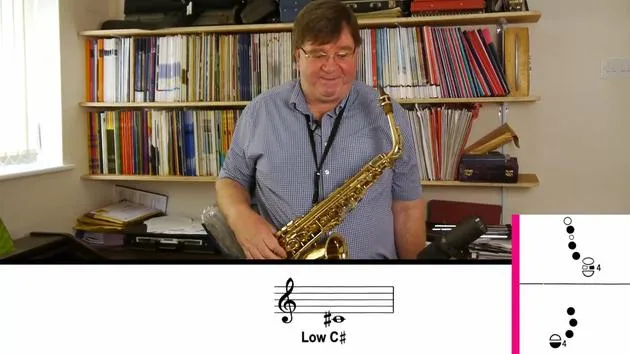
- It's fingered by fingering the C (which we know), plus the left hand's little finger on this D shape.
It's a bit of a stretch, but press it very firmly. If you press it correctly, you can hear a slight ringing sound. Boom! That means your fingers are doing their job properly.
Importance of Firm Pressure
If you press it too lightly, you don't get much of a sound. That means the holes aren't covering sufficiently, making the note difficult to produce.
If your fingers are fairly firm, the notes should come out fairly easily.
Remember: With all those notes, don't bite; otherwise, they will jump up.
Exercises for Producing B Flat
Exercise One: Step Approach
A good way to approach the B flat is by step:
- Start on D
- Go down to C
- Then down to B flat
Secret to Low Notes
A secret of low notes is air. Lots of air. Imagine you're blowing out the candles on a birthday cake or blowing up a balloon. It's that sort of air: solid airflow.
But just double-check that you're not biting the mouthpiece; otherwise, you'll get a horrible, double octave sound.
Exercise Two: Scale Preparation
Exercise two prepares us for the scale of B flat major, which involves B flat and E flat.
Now, we talked about D sharp in the previous lesson, which is the same as E flat.
But low E flat obviously doesn't have a thumb key down.
- We work our way down to the B flat.
- Nice firm little finger action for both hands is required to do this smoothly.
Note: These are weak fingers, but they will get stronger with practice.
Exercise Three: Practice Going Down and Back Up
In exercise three, we go down and back up again. Eventually, you'll be able to play it rapidly without any effort.
But as I keep mentioning, the essential secret of fast playing is slow practice.
Important: Don't try to change your embouchure to help the low notes, as it will backfire. You risk creating a 'train crash' sound. Just keep everything constant.
What we need to do is develop an embouchure that works for every single note on the saxophone without much change, so the notes come out as freely as possible.
Exercise Four: Arpeggio Preparation
Exercise four is the arpeggio preparation.
- Firm action is required, especially when you go from D to B flat.
- We then practice the B flat major scale in its entirety, ensuring lots of support for those low B flats, same with the arpeggio.
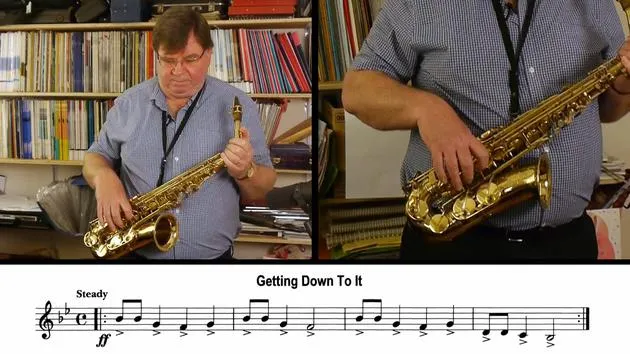
Study in B Flat
This is a scale-based study using patterns. Here, we introduce a technique called rolling.
- When going from E flat to C smoothly, roll your finger using the black roller keys.
- The secret of a good rolling technique is to keep a constant downward pressure on the key and just pull your finger across.
Avoid: Replacing the finger, as this could catch the D between the E flat and the C.
Smooth Transitions
What we want is:
- Constant firm pressure
- Pulling across results in a nice connection.
The same technique applies in the opposite direction.
At the end of the study, you need to go from low C up to E flat. For example, focus on the last three bars using a smooth rolling technique.
Conclusion
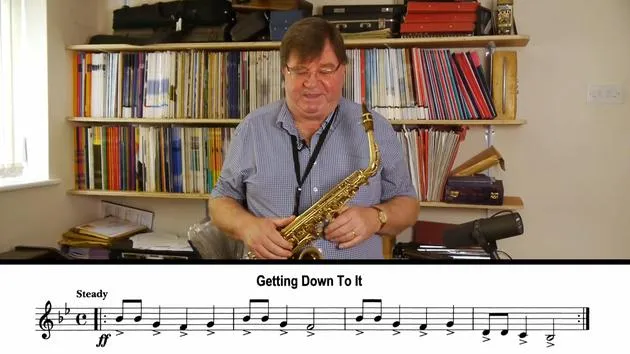
When you put the whole study together, it should sound like this. You can create your own breathing spaces as you go.
Study in B flat.
22 leçons
0h 58m de leçons vidéo structurées
Fonctions vidéo avancées
Ralentissez, bouclez un passage, suivez la partition
Mobile, tablette et ordinateur
Pratiquez où vous voulez
Satisfaction garantie à 100 %
Garantie remboursement 30 jours
Rencontrez votre guru
Rencontrez votre guru
James Rae est né à Tyneside en 1957. Il a étudié la clarinette, la clarinette basse, le piano et la composition à la Guildhall School of Music and Drama de 1975 à 1979, respectivement auprès des professeurs Yona Ettlinger, Stephen Trier, Meriel Jefferson et Patric Standford. Depuis qu'il a quitté la Guildhall, il mène une carrière très réussie et variée dans trois domaines : l'interprétation, l'écriture et l'enseignement.
James Rae a travaillé sur de nombreuses productions du West End et du Royal National Theatre, dont l'Oresteia primée de Sir Peter Hall sur une musique de Sir Harrison Birtwistle, et il a reçu de nombreux engagements en freelance auprès de certains des plus grands orchestres et ensembles du pays. Il est le leader du Phoenix Saxophone Quartet, qui, au fil des ans, a donné de nombreux récitals et diffusions à la BBC, et a enregistré l'intégrale des œuvres de Carey Blyton sur deux albums, 'The Return of Bulgy Gogo' et 'Sherlock Holmes meets Dr Who'.
En tant que compositeur, James Rae est l'un des auteurs de musique pédagogique pour vents les plus publiés d'Europe, avec plus de 250 publications à son actif, principalement éditées par Universal Edition. Sa musique comprend des cahiers d'étude instrumentale, des sonates, des méthodes, des transcriptions baroques, classiques et jazz, ainsi que de nombreux recueils de duos, dont beaucoup figurent dans tous les grands programmes d'examen pour instruments à vent du monde entier. Il a également écrit quatre comédies musicales pour écoles avec Mike Cornick, et parmi ses commandes les plus importantes figurent The Turn of a Wheel, une œuvre majeure pour orchestre d'harmonie créée en novembre 1999 pour le North Tyneside Concert Band, dont il fut membre fondateur enfant, et l'ouverture Moving On en 2012.
James Rae a travaillé de manière approfondie comme consultant de programmes et compositeur pour l'Associated Board comme pour le Trinity College London, et s'est fortement impliqué dans l'élaboration des épreuves de déchiffrage pour bois des deux jurys d'examen. Comme enseignant, il a occupé de nombreux postes dans les secteurs public et privé, et travaille actuellement à la King's College School Wimbledon, où il dirige le Wind Orchestra et le Concert Band, ainsi qu'à la Shrewsbury House School de Surbiton, où il encadre trois grands ensembles et un groupe de chambre. Cette expérience pédagogique traverse toute sa série de saxophone pour MusicGurus, qui te mène pas à pas de tes toutes premières notes jusqu'à un jeu assuré et plein de style : First Notes, New Keys & Low Notes, Expanding Your Range, Scales & High Notes, Extended Range & Rhythm, et Polish & Style.







