



PCH (leçon)
Avec
Laurence JuberDans cette leçon, Laurence Juber t'apprend à jouer son morceau "PCH" à la guitare acoustique.
Le contenu du cours
13 leçons (1h 28min) · 1 gratuites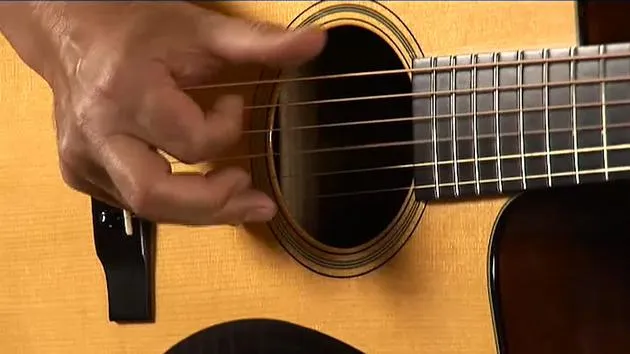
01. PCH (interprétation)
3:09
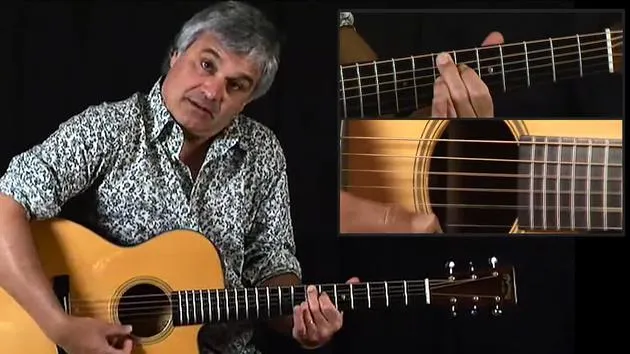
02. PCH (leçon)
Tu es ici11:01
03. Liquid Amber (interprétation)
3:50
04. Liquid Amber (leçon)
9:19
05. Gardenia (interprétation)
3:41
06. Gardenia (leçon)
13:37
07. Mosaic (interprétation)
3:49
08. Mosaic (leçon)
10:21
09. Stolen Glances (interprétation)
3:51
10. Stolen Glances (cours)
11:20
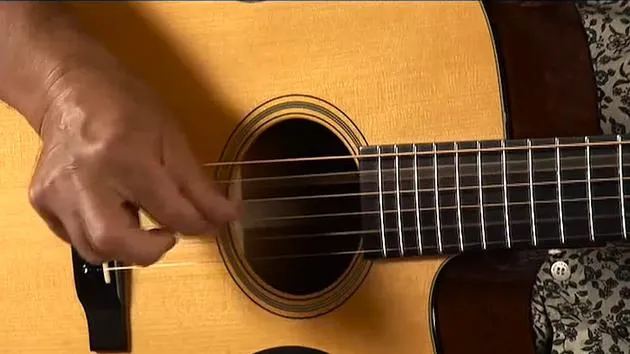
11. Bullet Train Boogie (interprétation)
3:52
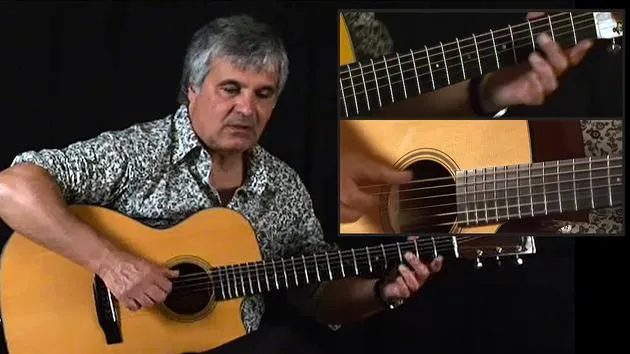
12. Bullet Train Boogie (leçon)
8:42
13. Leçon de conclusion
1:30
Transcription de la leçon
Advanced Fingerstyle Guitar Techniques: Exploring "PCH"
So that's a tune called "PCH." In keeping with the theme of this video, we're going to be exploring some of the more advanced aspects of fingerstyle guitar, both technically, compositionally, and harmonically.
Key of B Major
This particular composition is in the key of B Major, which is not a normal guitar key, nor is it an abnormal guitar key, because indeed we have:
- Open B string (tonic)
- Open E string (fourth, with two open E strings)
- A string (flat seventh, open string)
In the relative minor, G# Minor, we actually have three open strings:
- E
- B
- F double sharp
"When did you ever think that your open G string would be an F double sharp?"
In the key of G# minor, that's the seventh degree of the scale, leading to the progression from F# to G#.
Introduction to the Tune
The tune starts off with this repeated pattern. Here's what I'm doing:
- Hitting the bass note
- Fretting the note B on the third string at the fourth fret
- Alternating that with the second string open
This leads me down the bass line. For example:
- I end up here with a G Major Seventh chord, harmonically moving from B to B over A, and then to the V chord (F#).
You'll notice that because I'm involving the open top E string, I'm using my thumb to fret the bottom bass note, the F#, and then walking up in sixth to the B.
Chord Progression Breakdown
Here's the sequence of chords I use:
- B
- B over A
- E Major Seventh over G#
This gives me:
- First inversion G7
- F#
Notice that it's the same bass progression as the intro figure. Now I'm fleshing out the chords and moving into the next section:
- E7 chord: (flat 6 in G# minor)
- D#7: using the open E string as the flat 9.
In G# minor, I have three open strings but instead of landing on the G# minor cleanly, I create complexity with a melodic motif.
Melodic Motif Example
What do I have?
- G#
- A#
- B
G# and B make an A minor third, but with A# (the second of the scale) in the middle.
Along with this, I maintain an alternate bass pattern.
From here, I move to:
- E bass note
- Lydian sharp fourth
- C# minor 7 flat 5
Here's how it looks:
- Walking up the B scale
- Repeat E Lydian
- C# minor
- F#
- Back to B
Transition to the Bridge Section
In the bridge section, I go firmly into G# minor out of the riff:
- G# minor outlining the chord
- Feeling playful, I shift to E minor.
E Minor Progression
The chords here are:
- E
- F#
- G
- B
- B, C#, F#, E
(Check for E presence in the sequence).
Final Lick
Now I change in the lick at the end. I'm moving through:
- D# → E → A# → B → F# → G.
Transitioning to A, I think of this as a B flat seven chord, but technically we're dealing with A# seven.
Closing Section
With a conventional alternate bass, I move into:
- C#7
- C# minor 7 flat 5.
As I walk up in sixths, I switch to:
- F# (the C7 cowboy shape moved up to the seventh fret).
I'm walking up the sequence back to B, and we go through the verse and chorus structure again.
- Coming out at the end, I sit on the riff for an indeterminate number of times, depending on how I feel about it.
Conclusion
Let me conclude by doing this one more time.
I sit on the G, articulate a G7, and then end up on the G# minor.
"It almost sounds like I've made a key change there, but really I'm just going back to one of my two home keys of the piece, and that's 'PCH'."
13 leçons
1h 28m de leçons vidéo structurées
Fonctions vidéo avancées
Ralentissez, bouclez un passage, suivez la partition
Mobile, tablette et ordinateur
Pratiquez où vous voulez
Satisfaction garantie à 100 %
Garantie remboursement 30 jours
Rencontrez votre guru
Rencontrez votre guru
Laurence Juber s'est d'abord fait connaître comme guitariste principal des Wings, le groupe de Paul McCartney. Depuis, il a bâti une carrière de guitariste fingerstyle, compositeur et arrangeur, travaillant essentiellement en accordage DADGAD, ce qui lui a valu le surnom de 'the Duke of DADGAD'.
Élu Guitariste de l'année par les lecteurs de Fingerstyle Guitar Magazine et cité parmi les meilleurs guitaristes par le magazine Acoustic Guitar, il affiche aussi une longue liste d'albums solo et de tournées à travers le monde.
Dans ses cours, il enseigne sa technique fingerstyle et l'accordage DADGAD qui l'a rendu célèbre, comment agencer mélodie, harmonie et basse pour la guitare solo, et les morceaux - comme sa pièce phare 'Wooden Horses' - qui réunissent le tout.







