



Acordes de séptima
Con
Roy VogtRoy Vogt añade una cuarta nota sobre cada tríada para construir acordes de séptima en el bajo, empezando con un calentamiento que recorre las formas por el mástil.
Qué incluye el curso
5 lecciones (3h 21m) · 1 gratis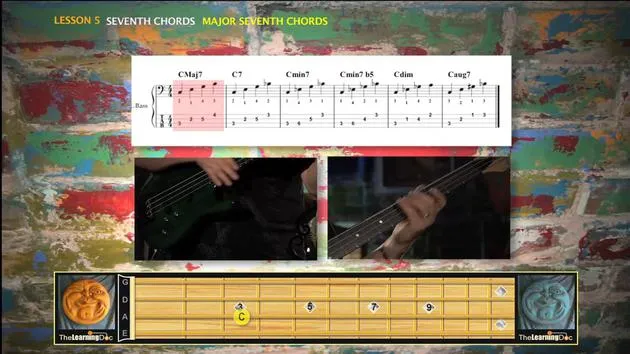
Transcripción de la lección
Music Lesson: Chord Progressions and Warm-Up
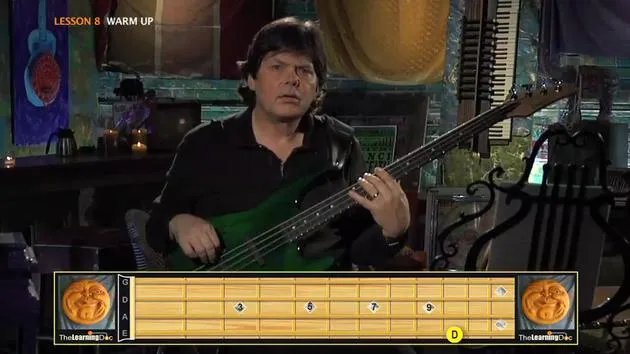
Before we get into the music and the material, let's go ahead and warm up a little bit. I'm going to take one of the chord arpeggios we're going to cover and I'm going to run this as a shape up the neck.
Warm-Up Exercise
- Stretch Out:
- I'm going to stretch out my hand and play one four.
- Move up one fret: one four.
- Move up one more fret: one four, one four.
So I'm just stretching out my hand. We'll learn a little bit more about that chord later. That's called a diminished chord, and we'll cover that and many other chords in the four-note chord section.
Adding a Seventh Chord
Now, if you're wondering if there's more to life than just roots, thirds, fifths, and triads, you're right.
What we're going to do now is:
- Add Another Note: We will add another note to the top of each of the triads, creating a seventh chord.
- Each of these chords has different sounds, and we'll use them in a lot of our tunes that we're going to play later. We'll certainly use them in the two band tunes we'll look at in this lesson.
Finding C Major Triad
So let's go ahead and find the C third fret on the A string.
- As we were looking at in lesson three, there's my major triad: root, third, fifth.
- There's that movable shape: 2, 1, 4.
To create a major seventh chord, I will add a B natural on top:
- Root, third, fifth, seventh: C, E, G, B.
Notice I have a fingering pattern that I can use; it's a movable shape: 2, 1, 4, 3. That will work anywhere on the bass.
Playing C Major 7
Let's play that C major 7 a couple of times. Play it with me:
- 1, 2, 3, 4.
What I was doing was playing the arpeggio. If I were playing the chord, it would be all the notes together on the bass. That can be a little muddy and is not terribly practical for a bass line.
So, just like we worked on with the triad bass lines, I'm just going to run one note after the other:
- Root, 3, 5, 7.
When working on the bass lines, you will see me use all four notes out of the chord, but I'll just be playing one at a time:
- Typically, I'll start with the root (safest choice).
- The second safest choice is the fifth.
- The third safest choice is the third.
- The most interesting and unstable sound for a major seven is the seventh.
Dominant Seventh Chord
Okay, now let's look at a dominant seventh. This is sometimes also called a seventh chord.
To change our C major seven to a dominant seventh, I'm just going to take that B and:
- Flat it (move it down a half step). This will be a B flat.
- The tones I'm playing are C, E, G, B flat.
Major vs. Dominant Seventh
Notice the difference in sound here:
- Major seventh chord: [Play sound]
- Dominant seventh chord: [Play sound]
You hear a lot of dominant seventh chords in funk, rhythm and blues, and blues. As a matter of fact, we're doing a James Brown inspired tune. You'll hear a lot of it in that.
Fingering for Dominant Seventh
The basic fingering I'm going to use for that is the major triad 2, 1, 4, and then I'm going to add 2 on the top of it:
- 2, 1, 4, 2.
Play that with me. We'll play this twice:
- A quarter note equals 61, 2, 3, 4
- C, E, G, B flat: 2, 1, 4, 2.
Just like the major seven, that's a movable shape. Anywhere I go on the bass, I can play a dominant seventh chord or a seventh chord.
- If I put my hand down at random, that's a D flat. Here's a D flat 7 chord.
- I'm going to put it down at random again, G. That's a G7 chord.
These shapes can be very, very helpful.
Minor Seventh Chord
Now, let's add to one note to the minor triad that we used in improv.
- This minor triad was root, flat 3, 5.
- Remember, one of our shapes was 1, 4, 3.
I'm going to add a flat 7 on top of it. That becomes a minor seventh chord.
Fingering for Minor Seventh
So my fingering will be: 1, 4, 3, 1. The notes are:
- C, E flat, G, B flat.
- The chord function is root, flat 3, 5, flat 7.
Playing the Minor Seventh
Let's play that two times:
- 1, 2, 3, 4.
5 lecciones
3h 21m de lecciones en vídeo estructuradas
Funciones de vídeo avanzadas
Ralentiza, repite un pasaje, sigue la partitura
Móvil, tablet y ordenador
Practica donde quieras
Garantía de satisfacción 100%
30 días de garantía de devolución
Conoce a tu gurú
Conoce a tu gurú
La carrera de Roy Vogt abarca una extraordinaria variedad de escenarios, desde el Headbanger's Ball de MTV, el Montreux Jazz Festival y el Montreal Jazz Festival hasta el London Palladium, el Grand Ole Opry y el Kremlin. Del punk al funk, de la sencillez del country y el blues a la complejidad del HyperJazz y el World Beat, lo ha tocado todo.
Roy fue la primera persona en obtener un máster en Interpretación de Bajo Eléctrico, en la prestigiosa escuela de música de la University of Miami, y lleva más de cuarenta años dedicado al arte del bajo. Ha sido mentor de decenas de profesionales de éxito, incluido el legendario Willie Weeks. Eléctrico, sin trastes, contrabajo - lo que quieras: si toca notas graves y tiene cuerdas, Roy es un maestro tocándolo, y enseñando a otros a hacer lo mismo.
A lo largo de su carrera de cuatro décadas, Roy ha grabado o actuado con una asombrosa lista de estrellas de primer nivel, entre ellas Larry Coryell, Victor Wooten, Dave Weckl, Tom Scott y la LA Express, Chester Thompson, Miroslav Vitous, Glen Campbell, BJ Thomas, Chet Atkins, Engelbert Humperdinck, Dickey Betts, Tony Joe White, Charlie Daniels, Jerry Reed y muchísimos más.
Roy lleva treinta años enseñando a nivel universitario. Desde 1983 ocupa la cátedra de Bajo en la prestigiosa Belmont University (Nashville, TN), una de las poquísimas escuelas que ofrece un programa de grado en música comercial diseñado para convertir a los estudiantes en músicos profesionales que trabajen en lo más alto de la industria. Los alumnos de Roy han girado y grabado con estrellas notables como Trisha Yearwood, Faith Hill, Little Texas, Michael W. Smith, Lady Antebellum, Chick Corea, Sir Tom Jones, Blood Sweat and Tears, Yanni e incontables iconos más de la música.
Su serie Teach Me Bass Guitar te acerca ese mismo enfoque de nivel universitario, llevándote desde un arranque rápido para principiantes absolutos (vol. 1), pasando por los fundamentos del ritmo (vol. 2), la búsqueda de tu propio estilo (vol. 3) y una musicalidad seria (vol. 4), hasta un kit de herramientas de intérprete profesional (vol. 5), para que desarrolles habilidades reales paso a paso.







