



Algunos comentarios sobre la afinación y la teoría
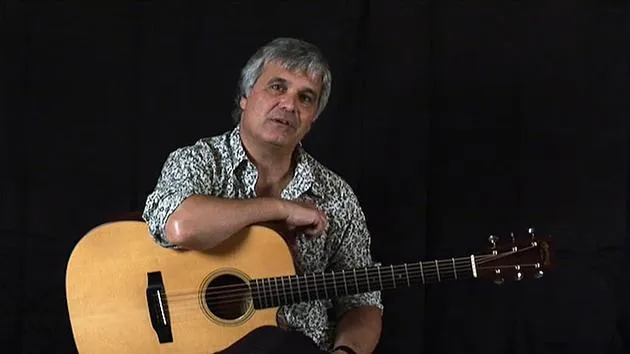
Laurence Juber pasa de la afinación estándar a DADGAD bajando el mi grave un tono entero hasta re y comparando octavas para que oigas cómo encaja la afinación.
Qué incluye el curso
16 lecciones (1h 6m) · 1 gratis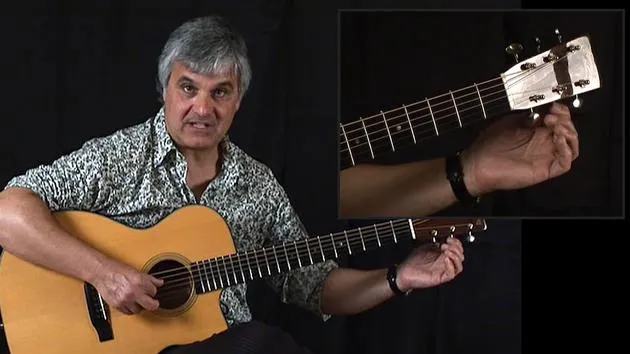
01. Algunos comentarios sobre la afinación y la teoría
Estás aquí6:11
02. Amazing Grace (lección)
10:51
03. Amazing Grace (interpretación)
1:19
04. Greensleeves (lección)
8:36
05. Greensleeves (interpretación)
1:12
06. Shebeg & Shemore (lección)
6:53
07. Shebeg & Shemore (interpretación)
1:54
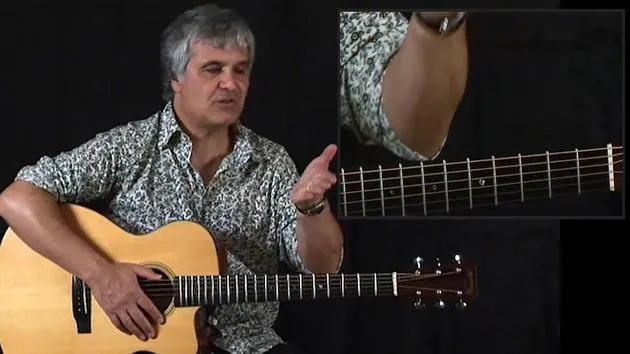
08. Wayfaring Stranger (lección)
7:35
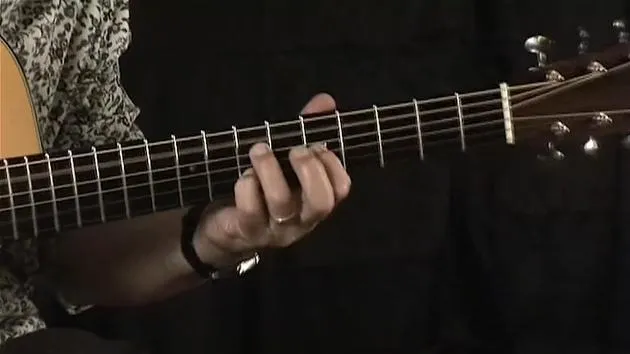
09. Wayfaring Stranger (interpretación)
2:36
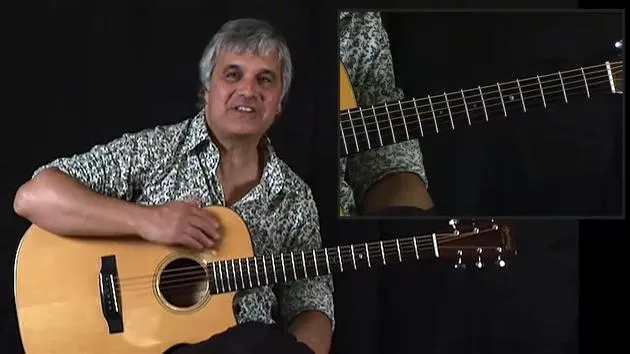
10. Shenandoah (lección)
5:34
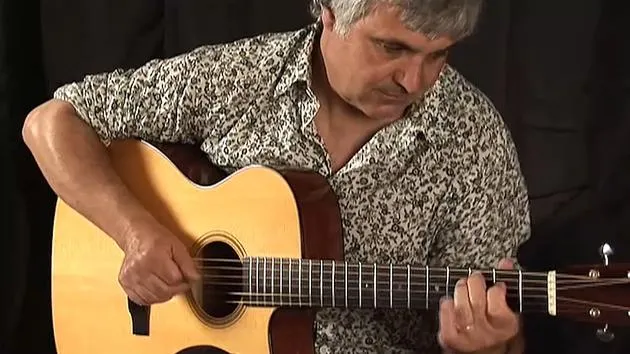
11. Shenandoah (interpretación)
1:55
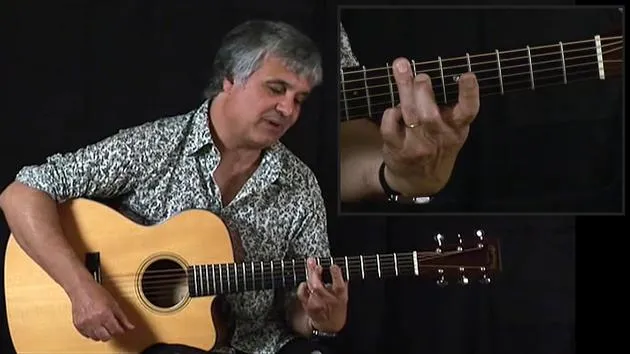
12. When The Saints Go Marching In (lección)
3:47
13. When The Saints Go Marching In (interpretación)
0:43
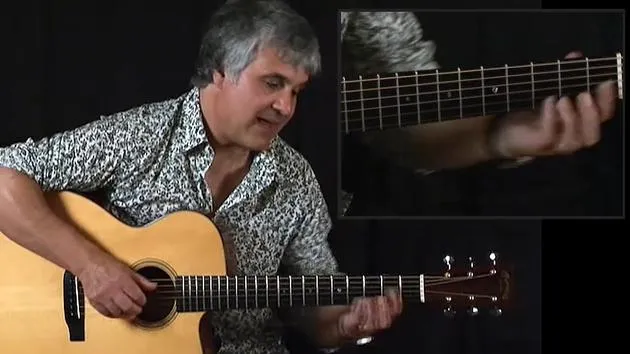
14. Take Me Out To The Ballgame (lección)
4:14
15. Take Me Out To The Ballgame (interpretación)
1:26
16. Algunas notas sobre la tonalidad de Re menor y despedida
1:40
Transcripción de la lección
DADGAD Tuning Music Lesson
Strangely enough, for a DADGAD project, I'm actually starting in standard tuning. I have a reason for doing that.
Getting Started
- Bottom E in Standard Tuning:
- Tune it down a whole step.
- This gives you a D1, which is the equivalent of 2 frets up from the E.
Now, I go up 2 frets, and I'm back to an E.
Tune and Compare
What I'd like you to do is:
- Tune that string down.
- Compare the notes on that string with those on the fourth string, which is very familiar territory.
Here's your fourth string. Play that same pattern on the bottom string, and you can hear it's just one octave lower, same fingering, one octave lower.
So, nothing unfamiliar about that; it's familiar territory.
Tuning the Top String
Now, we're going to take the top string (the E) and tune that down to a D also. You'll notice the fingering is the same:
- 3 D strings in DADGAD tuning.
- Then, we take the second string (B string) and tune that down a whole step.
Now, the tuning of that is the same as the fifth string.
This means:
- Anything I finger on the second string is the same but an octave lower on the fifth string.
So now we have:
- 3 D strings (D, D, D)
- 2 A strings
- The G (third string) hasn't changed.
In many respects, the individual string fingerings in DADGAD are already familiar territory.
- Anything on the top string or the bottom string is fingered the same as you would normally do on the fourth string (since those are all Ds).
- On the second string, everything is the same as on the fifth string in standard tuning (both A strings).
- The G string hasn't changed.
Experimenting with DADGAD
To get a little familiar with the sound of DADGAD, why don't we just pick across the strings?
You'll notice that, if you treat this as an open chord, this is a D sus chord:
- You have a D (the root)
- You have the ingredients of a D triad, but instead of having an F sharp as a major third, you have the fourth, which is the sus four.
So just to strum the open strings gives you a sus4 chord.
Playing Up the Neck
If you bar up the neck, for example, at the 5th fret:
- Now you have a G sus 4 at the 7th fret.
- An A sus 4 at the 12th fret (with the harmonics).
This openness of the tuning creates a suspended feel to it.
Understanding Adjacent Scale Tones
There is a very, very useful and musical thing that happens:
- You have a G and an A as adjacent scale tones.
- They are both open strings.
Here's my G, here's my A. This quality becomes very useful.
Let's say, for example, we're going to construct a scale of D. You'll notice that you have two of those scale tones that are on open strings:
- D
- E
- F sharp
- G
- A
Now, if I add an E to that, I have four adjacent scale tones, and then I let me say, play the open fourth string as the D.
So it goes:
- D, E, F sharp, G, A.
If I continue going up the scale, I added a B, a C sharp, and a D.
Conclusion
This progression gives us a very characteristic sound in DADGAD tuning.
This kind of cascading, cross-fingered pattern is very typical of how you can use the tuning to gain extra sustain in the melodic passages that you might play.
16 lecciones
1h 6m de lecciones en vídeo estructuradas
Funciones de vídeo avanzadas
Ralentiza, repite un pasaje, sigue la partitura
Móvil, tablet y ordenador
Practica donde quieras
Garantía de satisfacción 100%
30 días de garantía de devolución
Conoce a tu gurú

Conoce a tu gurú
Laurence Juber se dio a conocer primero como guitarrista principal de Wings, la banda de Paul McCartney. Desde entonces ha construido una carrera como guitarrista fingerstyle, compositor y arreglista, trabajando en gran medida con la afinación DADGAD, que le valió el apodo de 'the Duke of DADGAD'.
Los lectores de Fingerstyle Guitar Magazine lo han votado Guitarrista del año, y la revista Acoustic Guitar lo ha incluido entre los mejores guitarristas, junto a una larga lista de álbumes en solitario y giras por todo el mundo.
En sus cursos enseña su técnica fingerstyle y la afinación DADGAD por la que es conocido, cómo combinar melodía, armonía y bajo en un arreglo para guitarra sola, y las piezas -como su emblemática 'Wooden Horses'- que lo reúnen todo.







