



Las séptimas de dominante no siempre están en V

Con
Tim RichardsTim Richards presenta el truco de los tres acordes —I, IV y V en sol mayor— y por qué el acorde de V es tan a menudo una séptima de dominante.
Qué incluye el curso
20 lecciones (0h 40m) · 1 gratis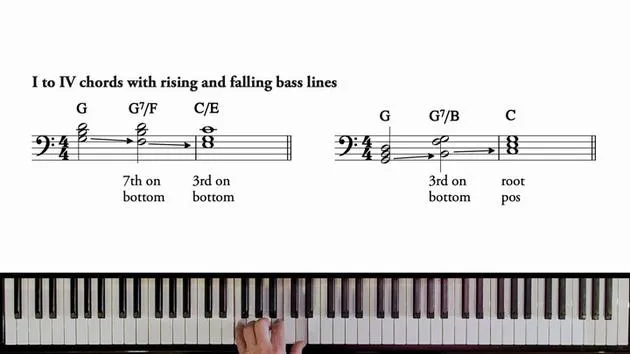

Transcripción de la lección
The Three Chord Trick
In this chapter, The Three Chord Trick, we're going to look at tunes that feature I, IV, and V chords. These three chords are like the backbone of Western music. You can find many folk, popular, traditional tunes, and hymns, for instance, that use nothing but these three chords.
If you're playing:
- Pop
- Soul
- R&B
- Jazz
- Blues
- Gospel
- Reggae
- Rock and Roll
- Calypso
All these styles have a lot of tunes that only use those three chords.
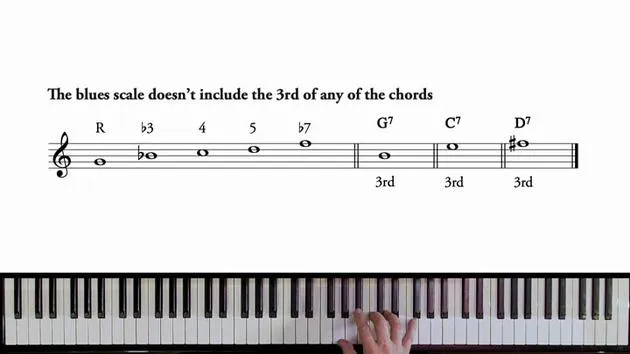
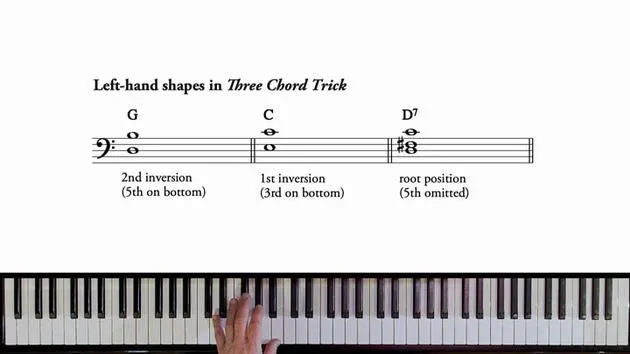
While the I and IV chords may indeed just be triads, the V chord is often a dominant seventh.
Chords in the Key of G
So you might have:
- I chord: G
- IV chord: C
- V chord: D7 (often with a seventh)
A good example of this type of tune is "Suwanee River," which we'll be playing next.
Perfect Cadence
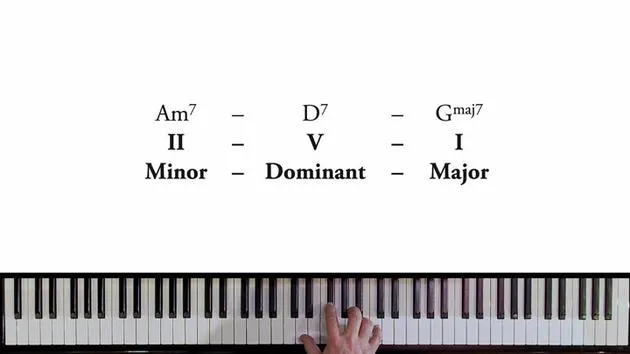
Dominant seventh chords always want to resolve up a fourth, like:
- D7 to G.
That's called a perfect cadence. You can play that in different positions and inversions, but the root is always going up a fourth, from D to G.
In "Suwanee River," we also have an unexpected dominant chord on one, like G7 instead of G major seven. This is because it's taking us to C, with C being the IV chord in the key of G.
The dominant seventh and the perfect cadence can take you to other places, in this case, from I to IV instead of V to I.
Two Ways to Transition
Now, there are two ways of doing this, which are kind of neat:
-
Descending Bass Line:
- Play your G chord.
- Move to G7 with F in the bass.
- This takes you to C with E in the bass.
You can write that with slash chords if you like:
- G7 over F
- C7 over E
-
Rising Bass Line:
- Start with a root position G down here.
- Go to A first inversion with B in the bass.
- This takes us to C in root position.
This implies a rising bass line:
- G7 over B
These are two different ways of going from G via G7 to the IV chord C major.
This slash chord notation is often employed in chord charts or lead sheets as a way of specifying this type of chord movement.
20 lecciones
0h 40m de lecciones en vídeo estructuradas
Funciones de vídeo avanzadas
Ralentiza, repite un pasaje, sigue la partitura
Móvil, tablet y ordenador
Practica donde quieras
Garantía de satisfacción 100%
30 días de garantía de devolución
Conoce a tu gurú
Conoce a tu gurú
Aclamado por la crítica, el pianista y compositor de jazz Tim Richards es uno de los educadores de jazz más experimentados de Gran Bretaña, y ha enseñado piano de forma privada durante más de 30 años, además de en el Morley College, el Goldsmiths College, la University of Surrey, Premises Studios y otros centros del Reino Unido y del extranjero. Ha producido numerosos títulos para Schott Music, entre ellos los superventas en dos volúmenes Exploring Jazz Piano, Blues, Boogie & Gospel Collection y el aclamado Improvising Blues Piano. También es coautor, junto con John Crawford, de Exploring Latin Piano y Brazilian Piano Collection.
Más recientemente, Schott ha publicado Jazz, Latin & Modern Collection (15 piezas para piano solo), que reúne originales de Tim Richards junto a piezas de Duke Ellington y Thelonious Monk, y el estuche de dos volúmenes Beginning Jazz Piano (ahora un curso de MusicGurus en dos partes).
“La verdadera alegría de la música de Tim… es que resulta a la vez enormemente didáctica y tremendamente divertida de tocar. Cualquiera con el más mínimo interés en aprender a tocar o a enseñar piano de jazz debería hacerse sin falta con una colección de los libros de Tim.” PianoDao
Como intérprete, Tim ha sido una presencia en la escena del jazz británico desde la década de 1980, tocando también el blues con leyendas del Reino Unido y de Estados Unidos como Otis Grand, Earl Green, Dana Gillespie, Larry Garner, Joe Louis Walker y Mojo Buford. Ha publicado más de una docena de álbumes como líder (con muchos de los mejores músicos de jazz de Londres, entre ellos Pete King, Gilad Atzmon, Tony Kofi, Jason Yarde, Seb Rochford, Ed Jones, Dick Pearce y muchos otros) y ha girado por toda Europa con formaciones que van del dúo al noneto. Su última grabación, el álbum ‘Telegraph Hill’ del sexteto Hextet, fue descrita en The Observer como "Una auténtica delicia de principio a fin".
Puedes encontrar más información en su sitio web www.timrichards.ndo.co.uk







